
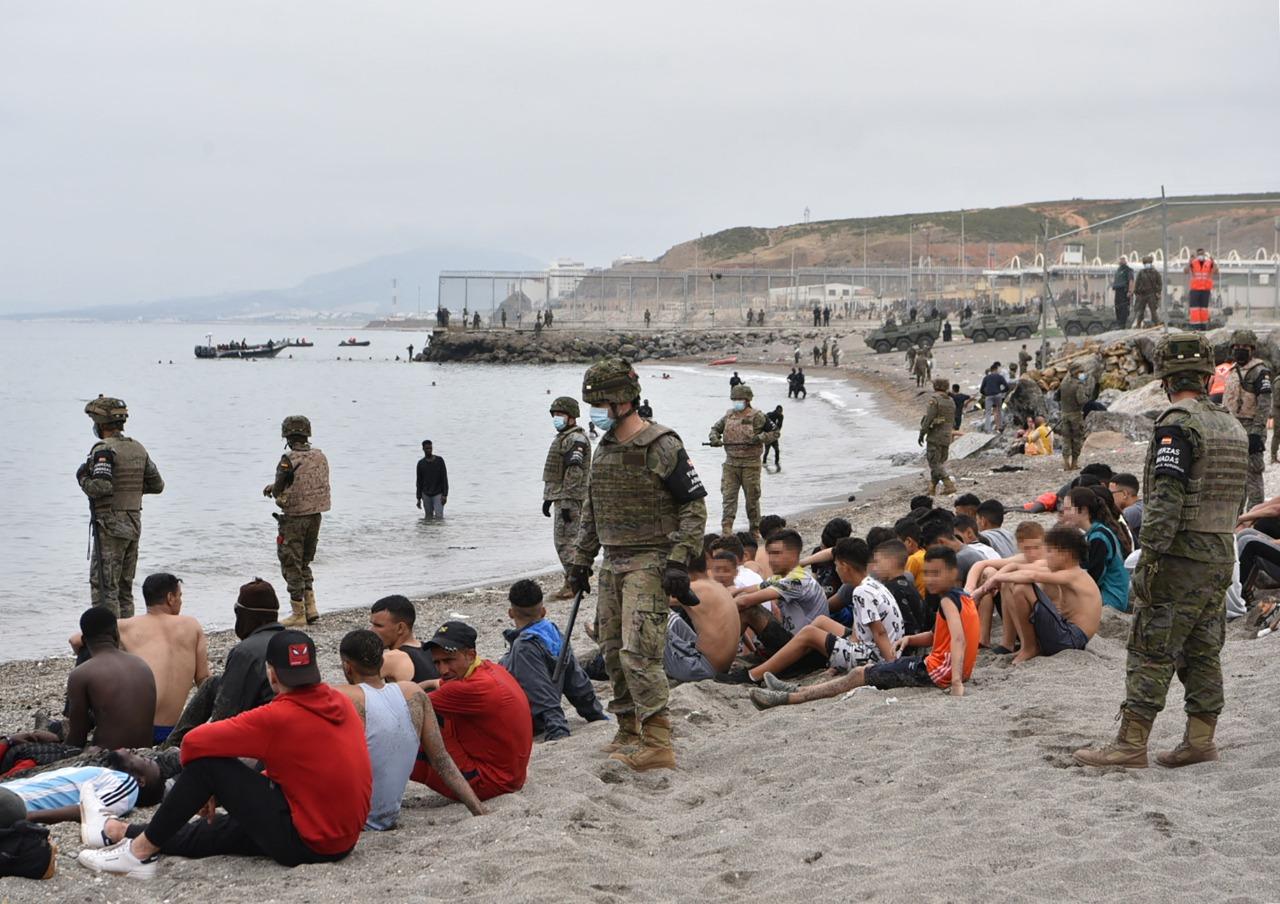
Spain says most of the tens of thousands of migrants who entered Ceuta during an unprecedented border surge have begun returning to Morocco, as authorities confirmed that at least 57 people died while attempting to reach the Spanish enclave.
Around 50,000 people crossed into Ceuta by land and sea from Thursday morning, according to Spain’s Interior Ministry. Officials estimated that approximately 37,500 had since returned voluntarily to Morocco.
Ceuta’s local government chief, Juan Jesus Vivas, said the total number of people who entered the territory over the past two days may have reached 60,000.
Spanish authorities said 57 bodies had been recovered on their side of the border, while warning that additional deaths may have occurred in Morocco. Some of the victims drowned, while others were crushed as crowds attempted to climb a breakwater supporting the border fence.
Moroccan security forces used batons and tear gas to disperse crowds gathered near the entry gates and prevent further crossings into the small Spanish territory on Morocco’s Mediterranean coast.
Water cannon vehicles were deployed near the border, where the burned remains of a bus and seven cars could be seen following clashes. Spanish military vehicles were also stationed along sections of the frontier.
Hundreds of migrants were seen returning to Morocco through official crossings and gaps in the fence. Several said they had been unable to find food, shelter or other basic necessities after entering Ceuta.
“I honestly don’t even know why I came, and now I’m going back,” a young Moroccan man from Tangier said. He added that he had not eaten since the previous day despite carrying money with him.
Spanish Prime Minister Pedro Sanchez travelled to Ceuta on Friday and described the mass entry as a “violation of Spain’s territorial sovereignty.”
Sanchez said authorities were accelerating the return of migrants who had entered illegally, with the cooperation of the Moroccan government. He was met by angry protesters during his visit to the enclave.
Ceuta and Melilla, Spain’s two autonomous territories on the northern coast of Morocco, form the European Union’s only land borders with Africa. Both regularly experience attempts by migrants to enter European territory, but officials said the scale of the latest surge was unprecedented.
Spain’s Guardia Civil association, AUGC, said too few officers had been deployed along the border fence when the crossings began, leaving security forces unable to contain the crowds.
Territorial Policy Minister Angel Victor Torres said a recent Spanish Supreme Court ruling may have contributed to the surge. The ruling stated that migrants intercepted at sea while trying to reach Ceuta or Melilla could not be immediately rejected at the border, although legal experts said they could still be expelled under existing procedures.
Thousands of people also gathered overnight in the Moroccan border town of Fnideq despite an increased security presence. Although most attempts to cross were blocked, some groups moved along the coast in search of alternative routes around the fence.
The crisis has deepened political divisions across Europe, where migration has become a central issue and support for right-wing parties has grown.
France announced that it was immediately strengthening checks along its border with Spain. French Interior Minister Laurent Nunez did not provide details about how the additional controls would operate.
Italy also threatened extraordinary measures, including suspending open-border arrangements with Spain under Europe’s Schengen system.
Italian Prime Minister Giorgia Meloni said Rome was prepared to act to protect its borders and citizens, while Foreign Minister Antonio Tajani accused Spain’s migrant regularisation programme of encouraging human trafficking.
Spain summoned the Italian ambassador in protest over Tajani’s remarks.
Madrid has maintained that it remains committed to preventing illegal entry while arguing that legal migration supports Spain’s growing economy. Its government recently introduced a regularisation programme allowing hundreds of thousands of undocumented migrants to apply for legal residency.
U.S. President Donald Trump also commented on the Ceuta crisis, using it to warn about migration ahead of the next U.S. presidential election.
“That’s going to be us in three years if the wrong side gets in,” Trump was quoted as saying by Fox News.