
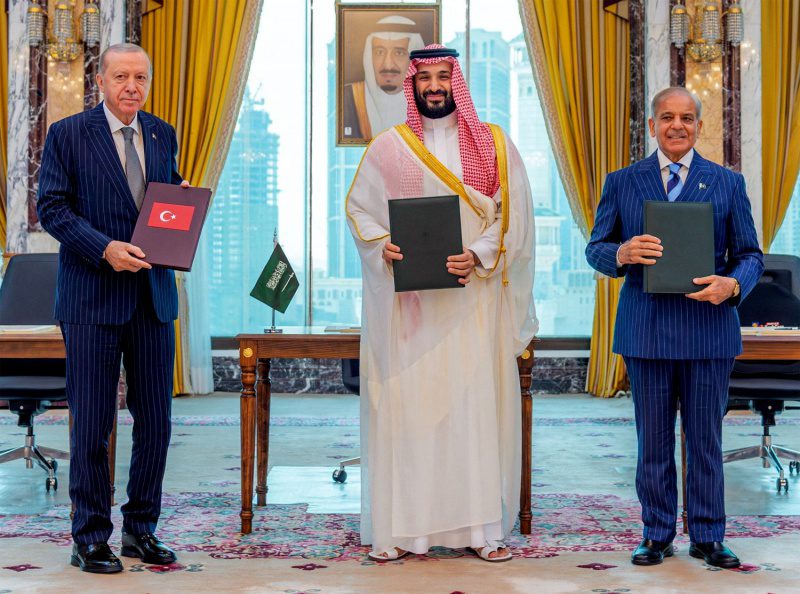
The new joint defence agreement signed by Saudi Arabia, Turkey and Pakistan is already facing questions over how far its collective security clause would extend if the kingdom came under renewed attack from Iran, Yemen’s Houthis or Iran-aligned armed groups in Iraq.
The “Mecca Joint Defence Agreement” goes beyond a conventional military cooperation framework by declaring that an armed attack on any one of the three countries would be regarded as a threat to them all.
The pact was signed by Saudi Crown Prince Mohammed bin Salman, Turkish President Recep Tayyip Erdogan and Pakistani Prime Minister Shehbaz Sharif as regional powers reassess their security arrangements following the Iran war and a wider escalation in missile and drone threats across the Middle East.
Its wording, however, leaves a central question unresolved: what exactly would constitute an attack requiring a joint response?
A direct strike by another state may appear relatively straightforward, but the issue becomes more complicated when attacks are carried out by armed groups aligned with Tehran, including the Houthis in Yemen or Iraqi factions with links to Iran.
It also remains unclear whether the collective defence clause would automatically require military intervention or whether each government would retain the right to determine the scale and nature of its response.
Those questions are particularly important for Saudi Arabia, which has repeatedly faced missile and drone attacks targeting oil facilities, airports and other critical infrastructure.
Iran has long relied on allied armed groups as part of its regional deterrence strategy, making the definition of an “armed attack” crucial to determining how the new agreement would operate in practice.
For Riyadh, the pact may therefore function first and foremost as a deterrence mechanism designed to increase the potential cost of attacking the kingdom.
The prospect that an assault on Saudi territory could trigger military coordination involving both Turkey and Pakistan may itself complicate the calculations of Iran and allied groups, even if neither Ankara nor Islamabad has committed to automatic combat operations.
Saudi Arabia has increasingly sought to diversify its defence relationships rather than rely exclusively on its longstanding security partnership with the United States.
The Mecca agreement fits into a broader Saudi strategy of developing regional and international partnerships that provide Riyadh with greater flexibility in responding to emerging threats.
Turkey brings significant military capabilities to the arrangement, including an expanding defence industry, combat drones, air-defence technology and electronic warfare systems.
Ankara’s membership in NATO also gives the agreement additional political weight, although Turkey’s willingness to become directly involved in a future confrontation with Iran remains uncertain.
Turkey has sought to maintain working relations with Tehran despite regional disagreements and could, depending on the circumstances, favour intelligence, logistical or technological assistance over direct participation in a wider war.
Pakistan faces similar constraints.
Islamabad has maintained close defence ties with Saudi Arabia for decades and possesses one of the region’s largest militaries as well as nuclear weapons.
At the same time, Pakistan shares a long border with Iran and has its own security and economic interests in avoiding a major confrontation with Tehran.
Islamabad has traditionally been cautious about becoming directly involved in conflicts between Middle Eastern powers, suggesting that any Saudi request for military assistance would be weighed against broader national interests.
The effectiveness of the Mecca agreement will therefore depend less on the wording of its collective defence clause than on the mechanisms established to implement it.
Key questions include how quickly the three governments could make joint decisions, what forms of military support each would be expected to provide, and whether they intend to develop integrated air-defence, early-warning, intelligence-sharing or command systems.
The pact could initially evolve through expanded military exercises, greater coordination between armed forces, defence-industrial cooperation and improved intelligence exchanges before developing into a more integrated security framework.
Some of the ambiguity surrounding the agreement may also be deliberate.
Leaving the nature of a collective response undefined gives all three governments room to tailor their involvement to individual crises and reduces the risk that they could be automatically pulled into a war they would otherwise prefer to avoid.
In that sense, the agreement may be intended as much to prevent attacks through political and military deterrence as to establish a formal mechanism for fighting a joint war.
The pact also carries a broader regional message.
By bringing Turkey and Pakistan into a new security framework, Saudi Arabia is signalling that it can rapidly assemble influential military partners as the Gulf and Red Sea security environment becomes increasingly unstable.
The agreement could eventually serve as the basis for wider security arrangements, potentially through cooperation with other states or links to Saudi-led maritime initiatives aimed at protecting commercial shipping.
Its credibility, however, will ultimately be determined by events rather than declarations.
If Saudi Arabia is again attacked by Iran, the Houthis or Iran-aligned Iraqi factions, Ankara and Islamabad will have to decide what the principle that an attack on one constitutes a threat to all means in practice.
Only then will it become clear whether the Mecca agreement represents an enforceable collective defence commitment or primarily a political deterrent intended to make another regional attack less likely.