
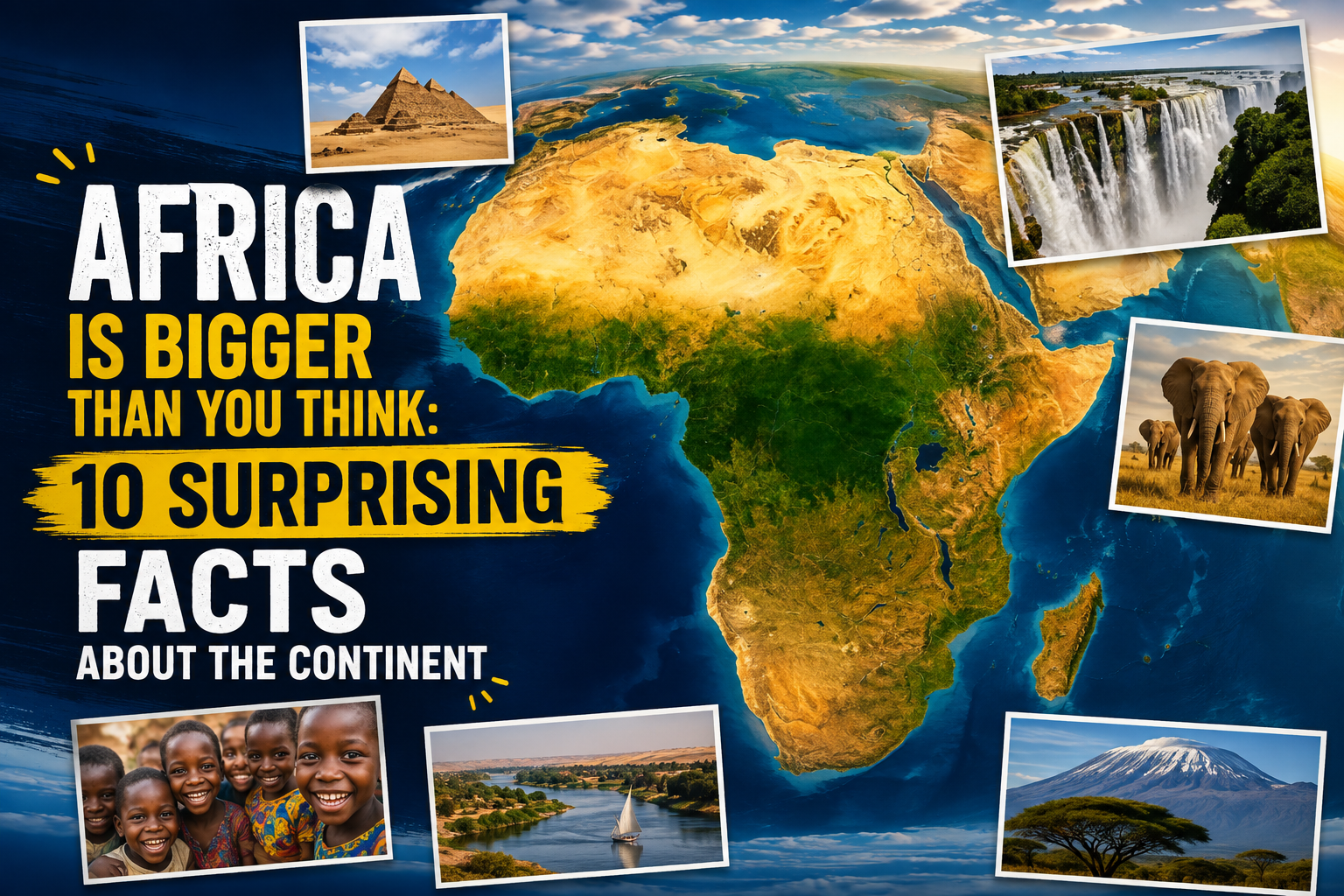
Illustration: AI-generated with OpenAI.
Africa is one of the most diverse and fascinating places on Earth. More than 50 countries, thousands of languages and centuries of history make the continent unique.
Africa also holds some incredible records. Its vast landscapes include deserts, rainforests, mountains and enormous rivers.
Here are 10 surprising facts about Africa that you may not know.
1. Africa is much bigger than it looks on many maps
Africa ranks as the second-largest continent in the world. It covers around 30 million square kilometres.
However, many common world maps make Africa look smaller than it really is. Map projections can distort the true size of countries and continents.
Africa’s enormous size becomes clearer when you compare it with other parts of the world. The continent could comfortably contain the United States, China and India, with room for several European countries too.
2. Africa has 54 internationally recognised countries
Africa contains 54 UN-recognised sovereign states.
Those countries offer an extraordinary mix of cultures, landscapes and traditions. Algeria sits along the Mediterranean, while South Africa reaches the continent’s southern tip.
Each region has its own history, languages and identity.
3. Africans speak more than 2,000 languages
Few places can match Africa’s linguistic diversity.
People across the continent speak more than 2,000 languages, although estimates vary depending on how researchers classify languages and dialects.
Millions of people speak languages such as Arabic, Swahili, Hausa, Amharic, Yoruba and Zulu.
4. The Sahara is the world’s largest hot desert
The Sahara Desert stretches across much of North Africa and covers around 9 million square kilometres.
It reaches across several countries, including Algeria, Chad, Egypt, Libya, Mali, Mauritania, Morocco, Niger, Sudan and Tunisia.
Many people picture endless sand dunes when they imagine the Sahara. In reality, rocky plateaus and gravel plains cover large parts of the desert.
5. Africa has the world’s longest river
The Nile traditionally holds the title of the world’s longest river. It stretches for approximately 6,650 kilometres.
The Nile river system connects several African countries before reaching Egypt and flowing into the Mediterranean Sea.
For thousands of years, communities along the Nile have relied on the river for farming, trade and daily life. It also helped shape some of the world’s most famous ancient civilisations.
6. Africa holds some of humanity’s oldest history
Africa plays a central role in the story of humankind.
Scientists have discovered some of the most important evidence about early human evolution in eastern and southern Africa.
For this reason, people often call Africa the cradle of humankind.
7. Two major geographic lines cross Africa
Africa holds another unusual geographic distinction.
Both the Equator and the prime meridian cross the continent.
As a result, Africa stretches across the Northern, Southern, Eastern and Western hemispheres.
8. Sudan has a remarkable number of ancient pyramids
Egypt may dominate conversations about African pyramids, but Sudan also has an extraordinary pyramid heritage.
Ancient Nubian civilisations constructed numerous pyramids in what we now call Sudan. The famous archaeological sites at Meroë showcase the legacy of the powerful Kingdom of Kush.
These monuments offer a fascinating glimpse into Africa’s ancient civilisations.
9. Africa has extraordinary wildlife
Africa has become famous around the world for animals such as lions, elephants, giraffes, rhinos and gorillas.
But those famous species represent only part of the continent’s wildlife.
Africa’s deserts, forests, mountains, wetlands and savannas support an enormous variety of animals and plants. This biodiversity also makes the continent crucial to global conservation efforts.
10. Africa has the world’s youngest population
Africa has the youngest population of any continent.
Young people make up a large share of its population. This demographic trend could shape Africa’s economic, technological and cultural future for decades.
Africa’s growing youth population also makes education, employment and technology increasingly important issues across the continent.
There is much more to discover about Africa
No single fact can capture Africa’s diversity.
The continent stretches from Mediterranean coastlines and the Sahara to tropical rainforests, vast lakes and major cities.
Its 54 countries also contain countless cultures, languages and traditions.
That makes Africa far more diverse and far bigger than many people realise.