
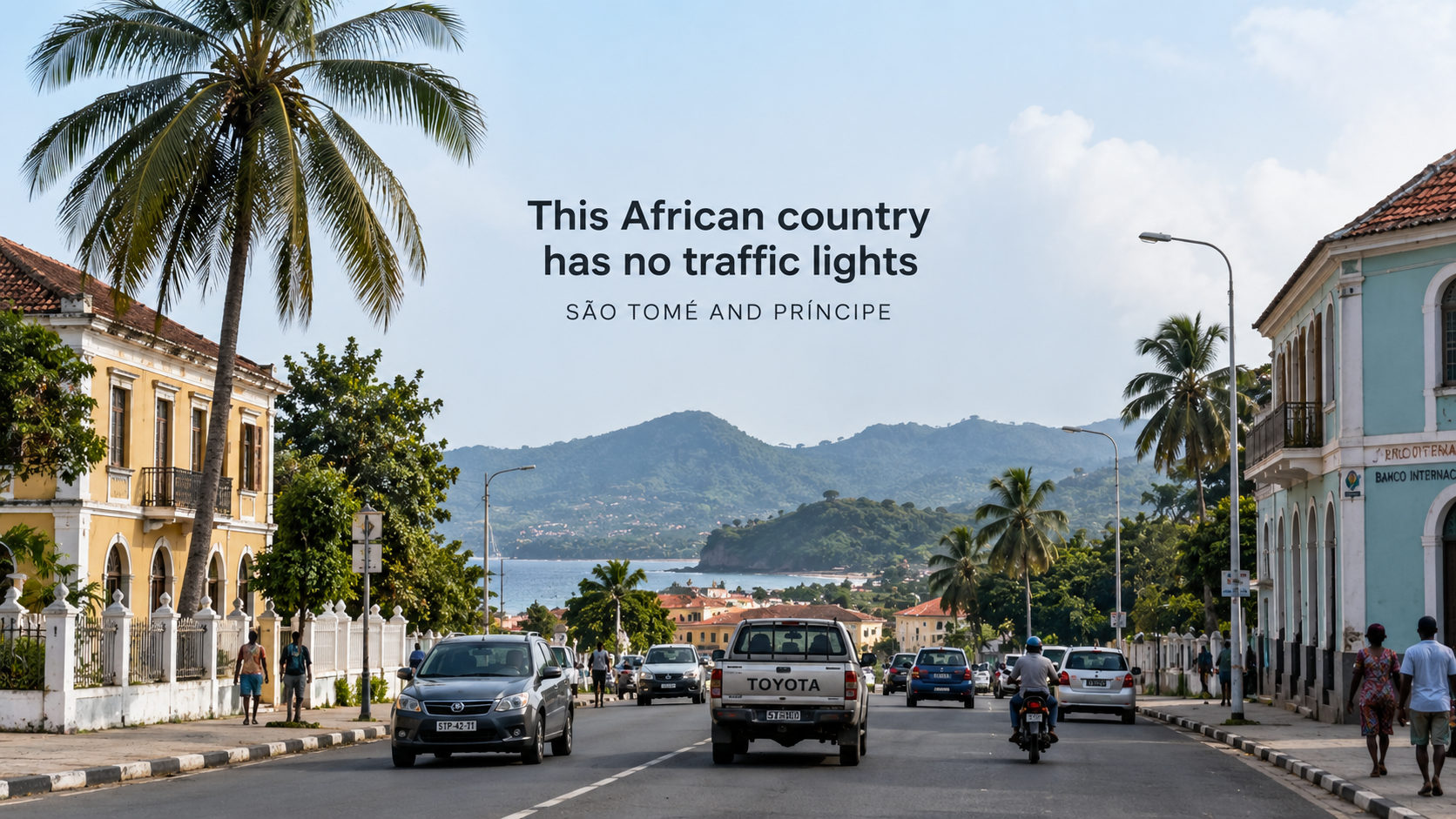
Imagine driving across an entire country without stopping at a red light.
In São Tomé and Príncipe, that is possible.
The tiny African island nation is known for an unusual feature: it has no traffic lights.
But that is not the only thing that makes this country unusual.
Where is São Tomé and Príncipe?
São Tomé and Príncipe sits in the Gulf of Guinea, off the west coast of Central Africa.
The country consists mainly of two volcanic islands: São Tomé and Príncipe.
It is one of Africa’s smallest countries and has a population of only a few hundred thousand people.
As a result, its roads are very different from the huge urban networks found in cities such as Lagos, Cairo or Johannesburg.
No traffic lights in São Tomé and Príncipe
Despite having cars, towns and a capital city, São Tomé and Príncipe has long been noted for having no traffic lights.
Instead, drivers navigate the country’s relatively small road network without the familiar red, yellow and green signals found across much of the world.
For visitors from crowded cities, that can make driving around the islands feel very different.
One of Africa’s smallest nations
São Tomé and Príncipe covers only about 1,000 square kilometres.
However, its small size hides some spectacular scenery.
The islands were formed by volcanic activity. Today, they are covered with tropical forests, mountains and cocoa plantations.
The country also sits close to the Equator.
In fact, the Equator passes through Ilhéu das Rolas, a small island south of São Tomé.
Africa’s chocolate islands
São Tomé and Príncipe also has a long connection with cocoa.
Its tropical climate made the islands an important centre of cocoa production.
That history has earned them a reputation for high-quality chocolate and helped shape the country’s economy and culture.
So while São Tomé and Príncipe may be tiny, it has plenty of unusual facts.
And one of the easiest to remember?
You can travel around an entire African country without ever waiting for a traffic light to turn green.