
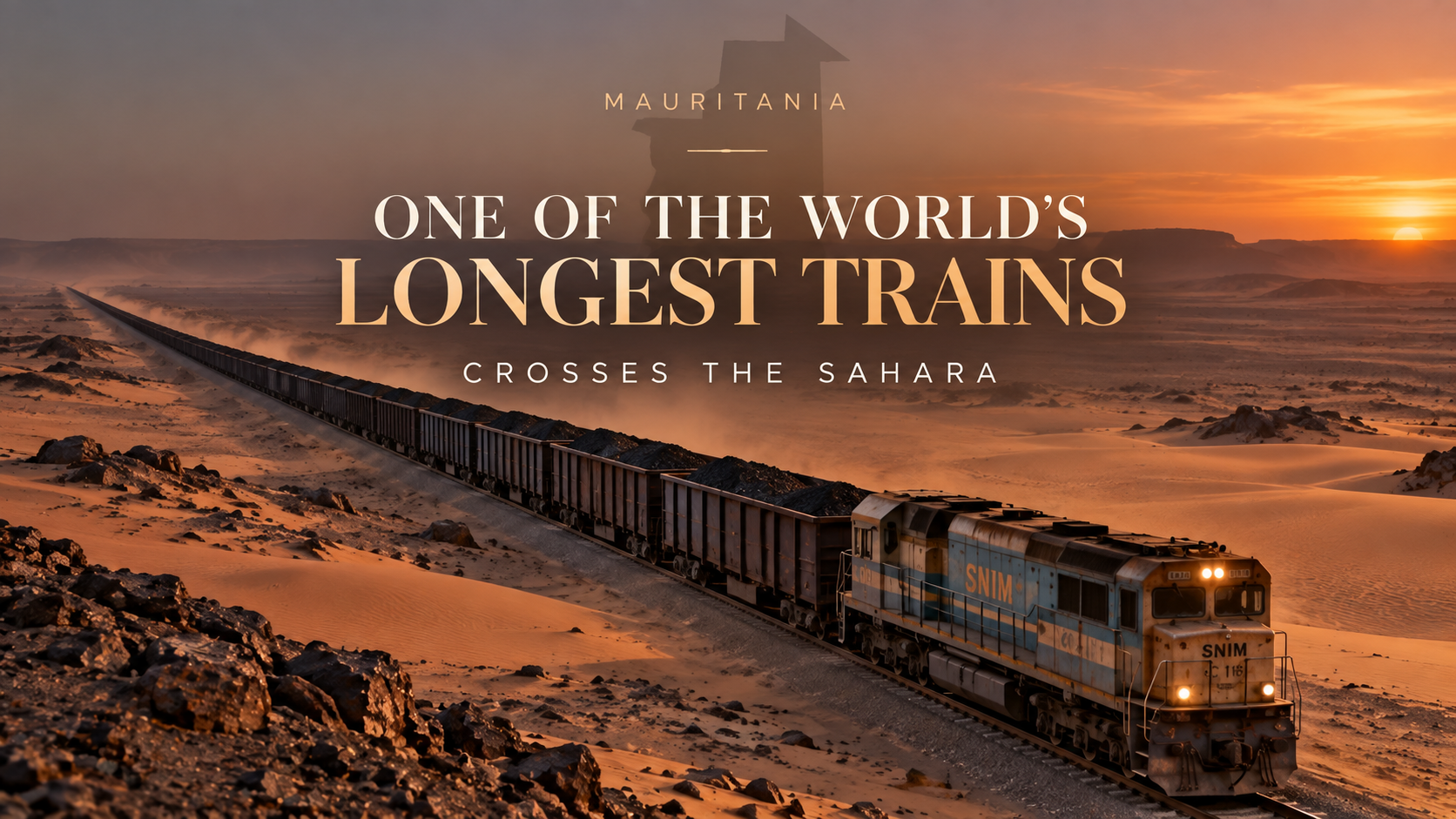
Imagine a huge train carrying iron ore across hundreds of kilometres of open desert.
That happens every day in Mauritania.
The country’s famous iron-ore trains travel between mining areas in the north and the Atlantic port of Nouadhibou.
They use a railway stretching for more than 700 kilometres across the country.
Mauritania’s iron ore train crosses the desert
The railway belongs to Mauritania’s National Industrial and Mining Company, known as SNIM.
The company mines iron ore around Zouerate in northern Mauritania.
It then transports the ore by rail to Nouadhibou on the Atlantic coast. There, the mineral is prepared for export.
SNIM says it owns and operates more than 700 kilometres of railway mainly for transporting iron ore.
Several huge trains run every day
The railway plays a major role in Mauritania’s mining industry.
SNIM says around six ore trains normally travel between the mines and the port each day.
The railway is mainly a single track. Therefore, SNIM uses 17 sidings along the route so loaded and empty trains can pass each other.
The company also monitors train movements from a control centre in Nouadhibou.
In 2022 alone, SNIM transported about 12.79 million tonnes of iron ore by rail.
A railway at the heart of Mauritania’s economy
The trains do much more than create an impressive sight in the Sahara.
They connect Mauritania’s iron ore deposits with its export infrastructure on the Atlantic coast.
Iron ore remains one of the country’s most important exports.
SNIM says it sold more than 14.7 million tonnes of iron ore in 2025. The company also accounted for 27% of Mauritania’s exports.
Can passengers ride Mauritania’s iron ore train?
The railway has also become famous among adventurous travellers.
However, there is an important safety warning.
SNIM says people must not ride on top of the iron ore inside freight wagons.
The company says the practice is unauthorised and can put people’s health and safety at risk.
Instead, the train includes designated passenger cars. SNIM’s tourism subsidiary manages the passenger service.
So while images of people riding open ore wagons have made Mauritania’s train famous online, the railway operator explicitly warns travellers not to do it.
More than just a giant train
Mauritania’s iron ore railway combines mining, engineering and one of Africa’s most dramatic landscapes.
For more than 700 kilometres, trains carry mineral resources from the country’s desert interior towards the Atlantic Ocean.
It is a remarkable example of how a railway can connect mines deep in the Sahara with the global economy.