
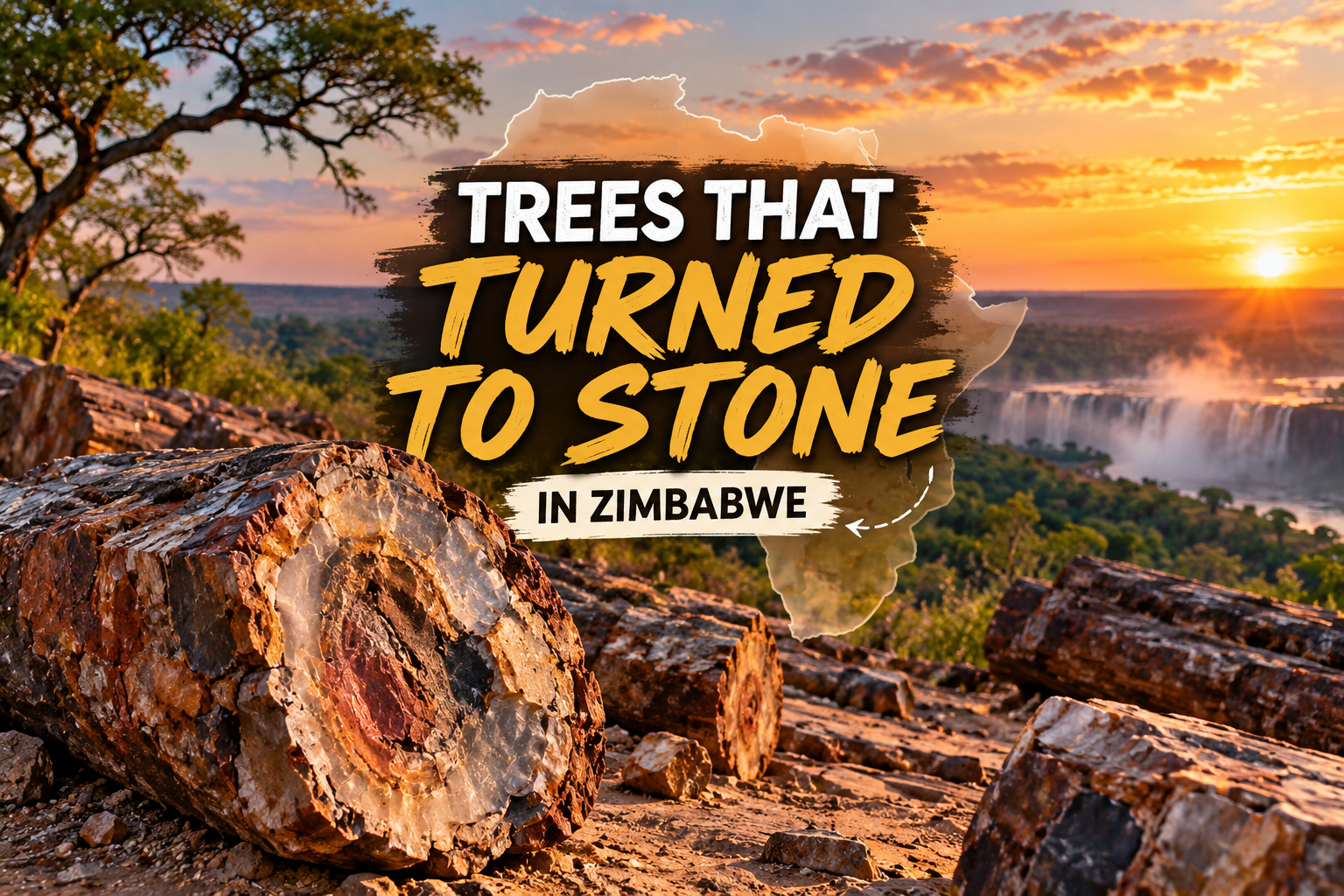
Did you know Zimbabwe is home to ancient trees that have turned into stone?
In northwestern Zimbabwe, a remarkable natural site offers visitors a glimpse into the country’s distant past.
Known as the Victoria Falls Petrified Forest, the area contains fossilised wood that has survived for millions of years.
Although the trees no longer grow, their ancient structures have been preserved in stone.
The site offers a fascinating example of how nature can preserve evidence of life from long ago.
How can a tree turn into stone?
Petrified wood forms when buried trees undergo a natural process called mineralisation.
Over long periods, mineral-rich water moves through the buried wood.
Gradually, minerals replace or fill parts of the original material.
As a result, the wood becomes stone while retaining features of the original tree.
In some cases, the fossilised remains still show patterns resembling bark, growth rings and branches.
The process can take thousands or millions of years, depending on environmental conditions.
Zimbabwe’s ancient natural history
Zimbabwe is known for its diverse landscapes, wildlife and geological formations.
The country contains rocks and fossils that provide evidence of ancient environments.
Petrified wood is one example of how natural materials can be preserved over geological time.
Such fossils can help scientists understand the types of plants that existed in the past.
They may also provide clues about ancient climates and ecosystems.
However, determining the exact age of petrified wood requires geological study.
Why is petrified wood important?
Petrified wood is more than an unusual natural object.
It can preserve details about ancient trees that disappeared long ago.
Scientists study these remains to learn about plant evolution and environmental change.
The fossils also demonstrate how geological processes can transform organic material.
For visitors, petrified wood offers a striking reminder of the Earth’s long natural history.
Zimbabwe has many natural wonders
Beyond its fossil discoveries, Zimbabwe is home to some of Africa’s most remarkable landscapes.
Victoria Falls, located along the Zambezi River, is among the world’s largest waterfalls.
The country also contains national parks, ancient rock formations and important archaeological sites.
Together, these attractions highlight Zimbabwe’s rich natural and cultural heritage.
From powerful waterfalls to ancient fossils, Zimbabwe offers countless opportunities to discover the continent’s fascinating history.
And sometimes, one of the most surprising discoveries is something as simple as a tree that has turned into stone.