
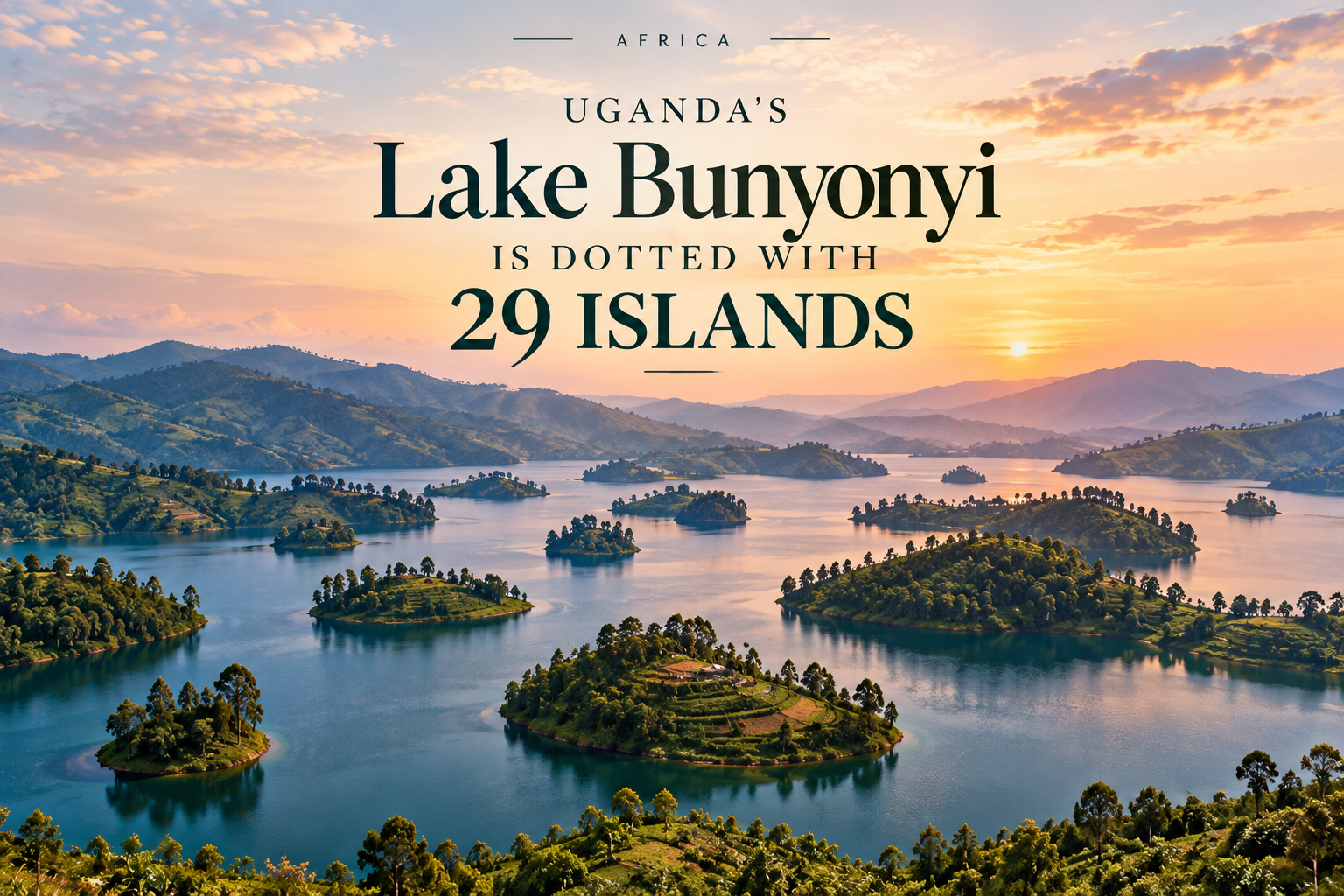
Uganda is home to a lake filled with small islands.
Lake Bunyonyi has 29 islands spread across its waters. The lake sits among the green hills of southwestern Uganda.
It is close to the border with Rwanda.
From above, the islands create a striking landscape. Some are small, while others are home to farms, buildings and tourism sites.
Lake Bunyonyi means ‘place of many little birds’
The name Bunyonyi is commonly translated as “place of many little birds.”
Birds are an important part of the area. However, the lake is best known for its many islands and surrounding hills.
Local communities also use the lake for transport and other daily activities.
Boats and traditional canoes are a common way to travel across the water.
How did Lake Bunyonyi form?
Lake Bunyonyi formed thousands of years ago.
Volcanic activity blocked a river valley in the area. As a result, water collected behind the natural barrier.
Over time, this created the lake we see today.
The lake is about 25 kilometres long. At its widest point, it stretches about seven kilometres.
Lake Bunyonyi attracts visitors
Today, Lake Bunyonyi islands are a popular attraction in Uganda.
Visitors can explore the lake by boat or canoe. They can also view the islands from the surrounding hills.
Meanwhile, tourism supports businesses and communities around the lake.
The lake also faces environmental challenges. These include erosion, pollution and sediment entering the water.
Still, its 29 islands and green hills make Lake Bunyonyi one of Uganda’s most distinctive natural landscapes.