
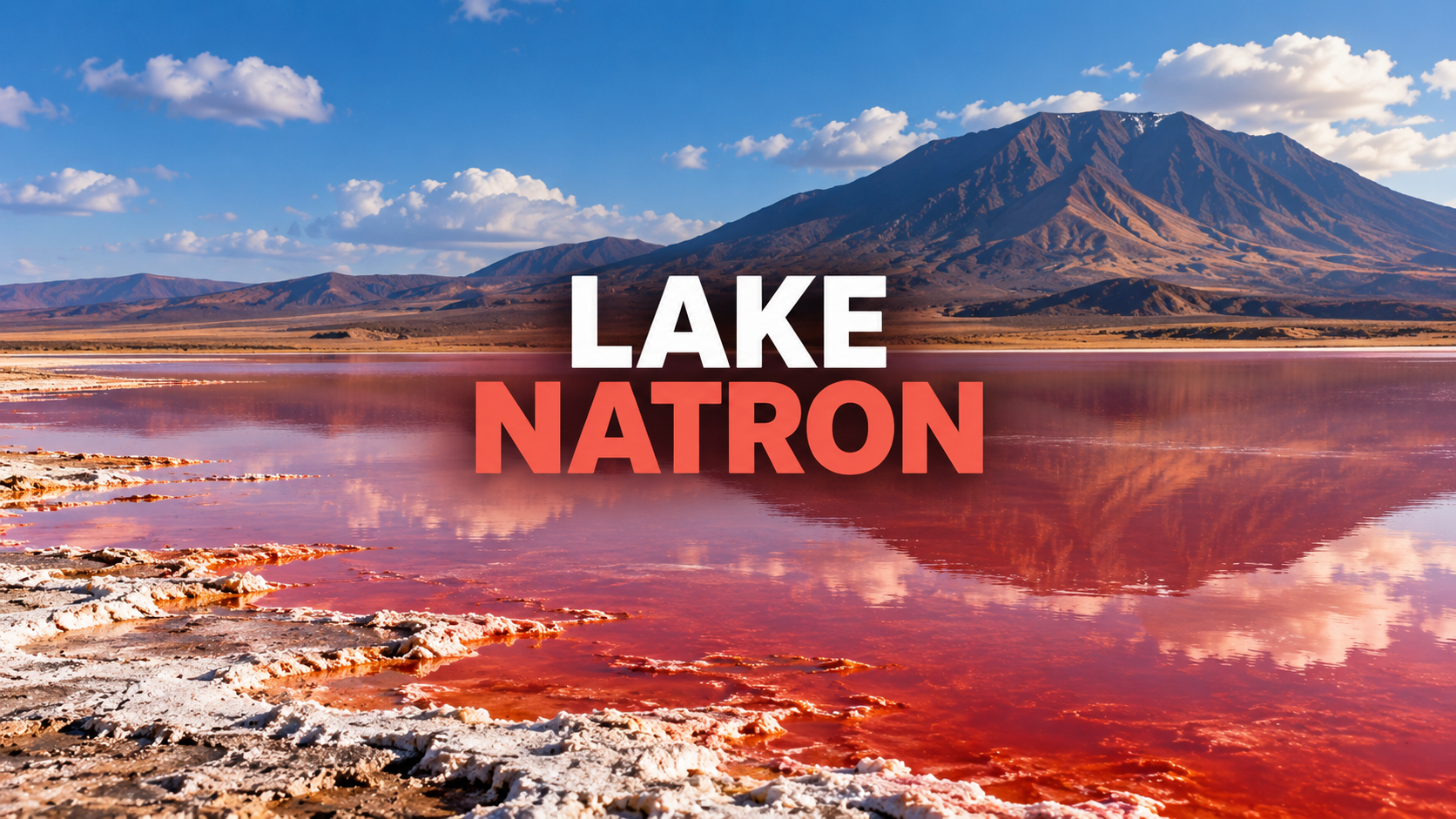
In northern Tanzania lies one of Africa’s most unusual bodies of water.
Lake Natron is famous for its red waters and extreme alkalinity. It is also known for animal remains that have sometimes been found hardened and preserved along its shores.
This has created a dramatic claim: Lake Natron can turn animals to stone.
That is not literally true. However, the real explanation is just as fascinating.
Why is Lake Natron so unusual?
Lake Natron is a shallow salt and soda lake in Tanzania’s Great Rift Valley.
Its water contains high concentrations of salts and minerals, including sodium carbonate.
According to Tanzania’s Wildlife Management Authority, the water can reach a pH of around 9.5 to 12. That makes the lake extremely alkaline.
It also has no major outlet.
As water evaporates, salts and minerals become more concentrated. Therefore, conditions can become difficult for many animals.
Does Lake Natron turn animals to stone?
Not exactly.
Animals do not enter the water and suddenly become stone.
Instead, animals that die in or around Lake Natron can become coated and preserved by its mineral-rich environment.
Photographer Nick Brandt helped make this phenomenon famous. He photographed calcified animal remains found around the lake.
His photographs showed birds and other animals appearing almost like statues.
However, the dead animals were positioned for the photographs. They were not discovered naturally standing in those poses.
Therefore, “turned to stone” is a dramatic description of calcification and preservation. It is not literal petrification.
Lake Natron is also full of life
Despite its extreme conditions, the lake supports an important ecosystem.
According to the Ramsar Convention on Wetlands, Lake Natron is East Africa’s only regular breeding site for the lesser flamingo.
Large numbers of flamingos can gather there when conditions are suitable.
The harsh environment can also offer the birds some protection. Many predators struggle to reach their nesting areas.
Meanwhile, specialised microorganisms and some fish can survive in and around the lake.
Why does Lake Natron turn red?
The lake has another remarkable feature: its colour.
Parts of Lake Natron can appear red, orange or pink.
These colours are linked to microorganisms that thrive in its salty environment. Their natural pigments can become especially visible under certain conditions.
As a result, aerial images of the lake can look almost unreal.
However, its unusual colours come from natural biological and chemical processes.
One of Africa’s most unusual lakes
Lake Natron combines extreme conditions with a surprisingly rich ecosystem.
Its alkaline and mineral-rich environment can help preserve animal remains. Yet the same lake provides an important breeding habitat for lesser flamingos.
So, does Lake Natron really turn animals to stone?
Not literally.
But the science behind this unusual African lake is arguably even more interesting than the myth.