
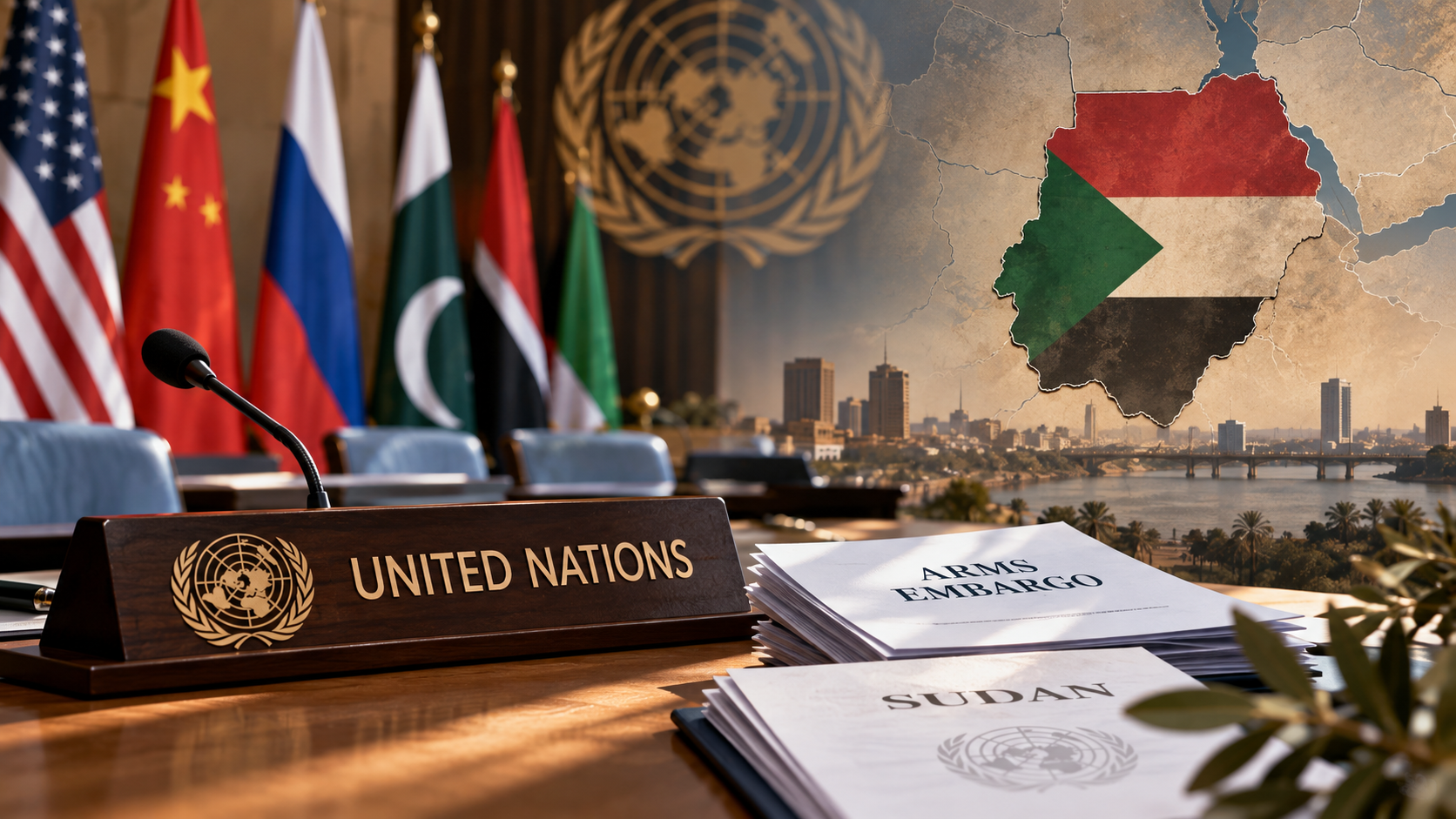
The United States has delayed its push for a nationwide Sudan arms embargo following disagreements within the United Nations Security Council.
Instead, Washington has proposed temporarily extending existing sanctions on Darfur. The move comes as council members remain divided over broader restrictions on weapons entering Sudan.
The Security Council is expected to vote on Thursday, October 8, on the proposed extension.
US proposal for Sudan arms embargo faces opposition
Washington had sought to expand the existing arms embargo beyond Darfur to cover all of Sudan.
The proposal aimed to restrict weapons supplies, military drones, financing networks and foreign support linked to the ongoing conflict.
However, Russia, China, Pakistan and several African council members opposed the expansion.
They argued that the existing sanctions should remain in place and that enforcement should improve.
As a result, the United States proposed a shorter extension while negotiations continue.
The latest disagreement follows a similar deadlock in September. At that time, council members agreed to extend the sanctions for one month rather than adopt wider restrictions.
UN Security Council considers temporary extension
Under the latest proposal, sanctions established through UN Security Council Resolution 1591 would remain in place until December 11.
Meanwhile, the mandate of the UN Panel of Experts monitoring sanctions violations would continue until January 11, 2027.
The proposed extension would preserve the existing Darfur-focused restrictions.
However, it would not introduce a nationwide arms embargo.
The Security Council has yet to reach an agreement on expanding the measures across Sudan.
Sudan’s army rejects wider arms restrictions
Sudan’s army-aligned authorities in Port Sudan have welcomed the temporary extension while opposing broader restrictions.
Ammar Mohammed Mahmoud, Sudan’s deputy permanent representative to the UN, argued that a nationwide embargo would treat the Sudanese Armed Forces (SAF) and Rapid Support Forces (RSF) under the same sanctions framework.
He made the remarks in comments reported by The Hill.
However, Washington has rejected claims that either armed faction holds legitimate constitutional authority to govern Sudan.
US State Department spokesman Tommy Pigott said last month that neither the SAF nor the RSF, nor their leaders, could claim such authority.
The US position reflects its refusal to recognise either side as Sudan’s legitimate government.
Sudan war continues amid international pressure
Sudan’s war began in April 2023 between the RSF and Sudan’s regular armed forces.
The conflict has displaced millions of people and created a severe humanitarian crisis.
Both sides have faced accusations of serious violations of international humanitarian law.
The United States has imposed sanctions on Sudan’s army chief, Abdel Fattah al-Burhan, and has accused members of both warring parties of serious abuses.
Washington has also determined that the RSF and allied forces committed genocide in Darfur.
Meanwhile, international efforts to restrict weapons supplies have faced political disagreements.
Supporters of a nationwide embargo argue that broader restrictions could help limit the flow of weapons sustaining the conflict.
Opponents have questioned whether expanding the existing sanctions would be effective or appropriate.
For now, the proposed Sudan arms embargo remains under discussion.
The Security Council’s immediate priority is deciding whether to extend the existing measures while negotiations continue.