
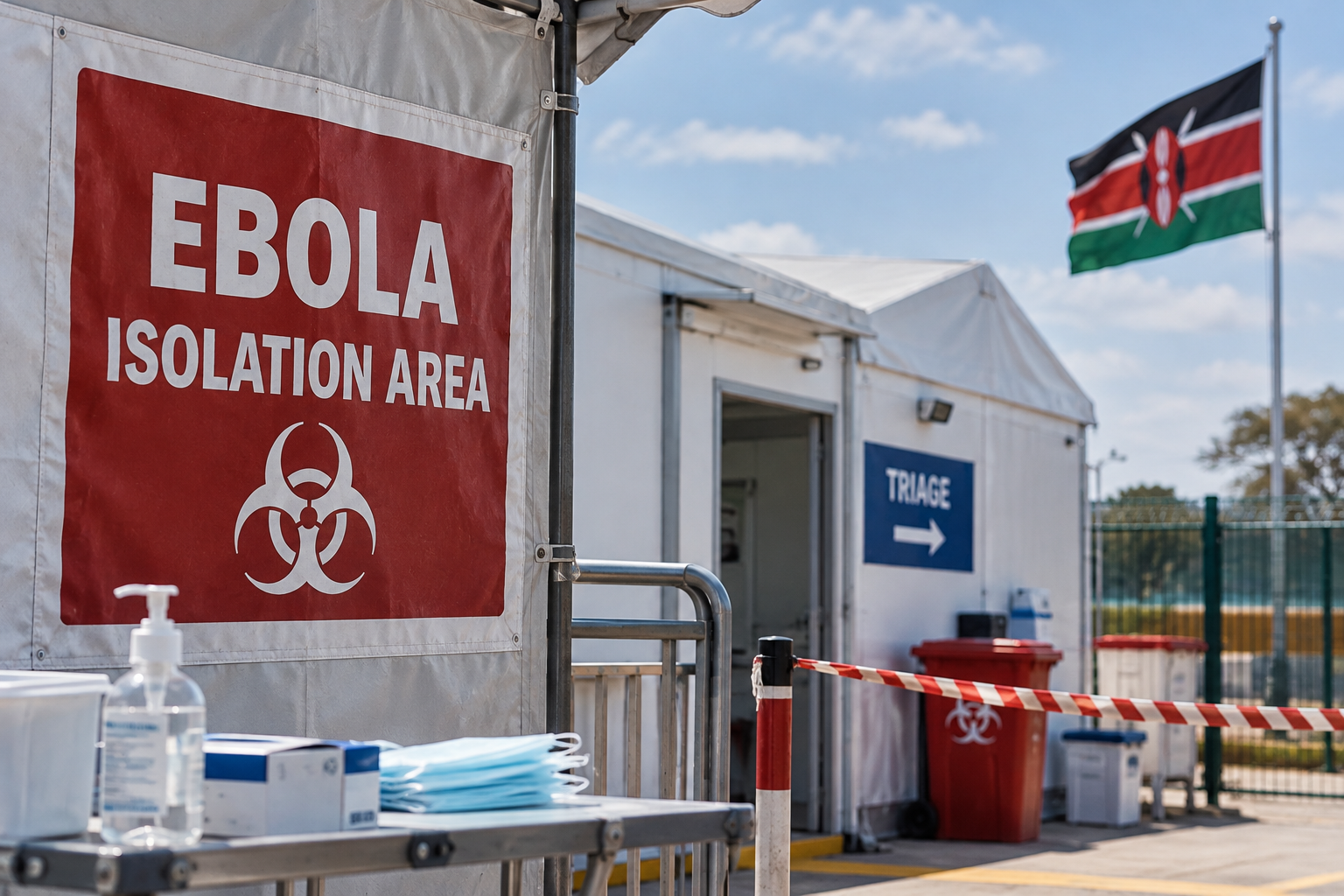
Kenyan health authorities have confirmed that preliminary laboratory tests for a suspected Ebola case in Wajir County have returned negative results, easing concerns about another infection.
The suspected Ebola case in Kenya involved a 20-year-old man who had travelled from the Democratic Republic of Congo (DRC) through Uganda before seeking medical attention.
Health officials are continuing to monitor the patient while providing necessary medical care.
The development follows Kenya’s first reported Ebola death earlier this week, which raised concerns about the country’s border screening and disease surveillance systems.
Suspected Ebola case in Kenya tests negative
According to Africanews, citing local reports and other agencies, preliminary laboratory results showed that the patient in Wajir County had tested negative for Ebola.
The 20-year-old man had travelled from the DRC through Uganda before arriving in Kenya.
He later sought medical attention at a local health facility, prompting concerns about a possible infection.
Local media reported that the Wajir County governor confirmed the negative preliminary results.
However, health authorities will continue monitoring the patient and providing treatment where necessary.
The report did not specify whether additional confirmatory testing would be conducted.
Kenya investigates contacts after first Ebola death
The suspected case emerged shortly after Kenya reported its first Ebola-related death.
A Kenyan citizen who had travelled from the DRC died in Nairobi on Tuesday after contracting the virus, according to the report.
The death prompted health authorities to strengthen surveillance and investigate possible exposure among people who had contact with the patient.
Officials are also tracing contacts connected to the suspected case in Wajir County.
So far, authorities have not identified any new infections linked to that patient.
However, contact tracing remains an important part of efforts to prevent further transmission.
Border screening concerns emerge
The recent Ebola cases have raised questions about the effectiveness of Kenya’s border health screening procedures.
According to Africanews, the first confirmed patient travelled through several screening points without the infection being detected.
The report said the individual passed multiple airport temperature checks before receiving a diagnosis.
The incident has highlighted potential gaps in systems designed to identify travellers who may be carrying infectious diseases.
Temperature screening alone cannot reliably detect every Ebola infection, particularly during the early stages when symptoms may not yet be present.
Consequently, health officials must also rely on surveillance, clinical assessments and contact tracing.
Ebola outbreak in DRC raises regional concerns
Kenya’s reported Ebola death has been linked to an outbreak in the eastern Democratic Republic of Congo.
According to Africanews, the outbreak has recorded more than 8,000 cases and has affected several countries.
The report describes Kenya as the fourth country to register a case linked to the epidemic.
The movement of people across regional borders has increased the importance of coordinated public health surveillance.
Meanwhile, countries receiving travellers from affected areas face challenges in identifying suspected infections quickly.
Health authorities must balance disease prevention measures with access to medical care for people who may have been exposed.
Kenya continues Ebola surveillance
Despite the negative preliminary test results in Wajir County, Kenyan authorities are maintaining surveillance efforts.
Health workers are monitoring the suspected patient and tracing potential contacts.
The absence of newly identified infections linked to the patient is a positive development, although it does not eliminate the need for continued monitoring.
For now, the latest suspected Ebola case in Kenya has not been confirmed as an infection.
The findings offer some reassurance as health officials continue efforts to prevent further cases.