
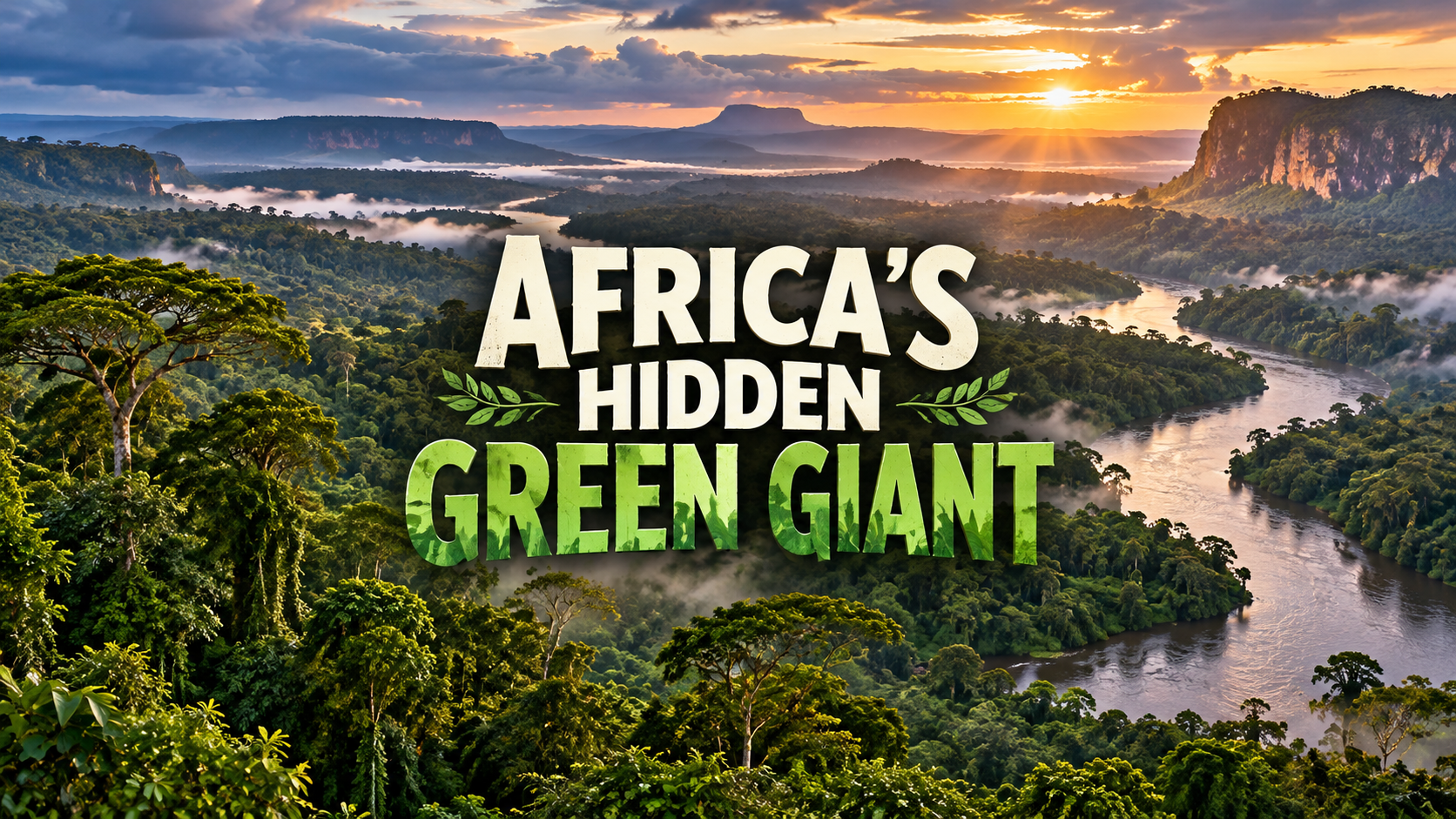
Deep in Central Africa lies a vast tropical rainforest filled with towering trees, rare animals and extraordinary natural landscapes.
Known as the Congo Basin rainforest, it is the second-largest tropical rainforest in the world, after the Amazon.
The forest stretches across several African countries and supports millions of people, thousands of plant species and an extraordinary variety of wildlife.
Yet many people outside Africa know surprisingly little about this remarkable natural treasure.
Where is the Congo Basin rainforest?
The Congo Basin rainforest lies in the heart of Central Africa.
Its forests extend across six countries: the Democratic Republic of Congo, Republic of Congo, Cameroon, Gabon, Equatorial Guinea and Central African Republic.
Together, they form a vast green landscape covering roughly 200 million hectares, depending on how forest boundaries are measured.
The region also contains the Congo River, one of the world’s largest rivers by water discharge.
Its waterways, wetlands and dense forests create habitats for countless animals and plants.
The rainforest has its own natural gardeners
One of the most fascinating animals living in the Congo Basin is the African forest elephant.
These elephants are smaller than their savannah relatives. They also have adaptations that help them move through dense forests.
However, their most remarkable contribution is something they do while eating.
Forest elephants consume fruit and spread seeds through their droppings as they travel.
This helps new trees grow across different parts of the forest.
Because of this important role, scientists sometimes describe them as the gardeners of the rainforest.
Meet the okapi, the rainforest’s striped mystery
The Congo Basin is also home to the okapi, one of Africa’s most unusual mammals.
At first glance, it looks like a mixture of a giraffe, horse and zebra.
Its body is mostly brown, while its legs feature distinctive black-and-white stripes.
Despite its appearance, the okapi is closely related to the giraffe.
It lives naturally in the forests of the Democratic Republic of Congo.
Its striped markings help it blend into the vegetation and changing shadows of the rainforest.
Some trees grow taller than 15-storey buildings
The Congo Basin contains enormous tropical trees.
Some grow more than 50 metres tall, reaching heights comparable to a 15-storey building.
Their branches form a thick canopy that blocks much of the sunlight from reaching the ground.
As a result, the rainforest has several natural layers.
Birds and monkeys move through the upper branches. Meanwhile, insects, smaller mammals and other animals occupy the lower levels.
Each layer supports different forms of life.
The forest stores enormous amounts of carbon
The Congo Basin rainforest plays an important role in Earth’s climate.
Its trees absorb carbon dioxide as they grow and store carbon in their trunks, branches and roots.
The region also contains extensive tropical peatlands.
These wetland soils have accumulated large amounts of carbon over thousands of years.
If forests and peatlands are damaged, some of that stored carbon can enter the atmosphere.
Therefore, protecting these ecosystems has importance far beyond Central Africa.
A home for millions of people
The Congo Basin is not simply a wilderness filled with animals.
Millions of people live in or around its forests.
Communities depend on the region for food, water, medicine, building materials and livelihoods.
Many Indigenous communities also maintain deep cultural and historical connections to the forest.
Their knowledge of local plants, animals and ecosystems contributes to understanding the region.
Protecting the rainforest therefore involves both environmental conservation and respect for local communities.
Why the Congo Basin rainforest matters
Despite its importance, parts of the Congo Basin face growing environmental pressure.
Logging, agricultural expansion, mining and infrastructure development have contributed to forest loss and habitat damage.
Climate change adds further challenges.
However, conservation projects and community-led initiatives are working to protect important habitats.
The Congo Basin remains one of Africa’s most remarkable natural environments.
From its towering trees to its seed-spreading elephants and elusive okapis, this vast rainforest shows just how diverse the African continent truly is.