
As fighting spread to Gezira State in December 2023, she was forced to relocate again, eventually reaching Port Sudan.
Today, Hasanat requires daily insulin, but the cost of treatment presents a continuing challenge.
Her doctor recommended an insulin pen, which costs approximately 70,000 Sudanese pounds ($8).
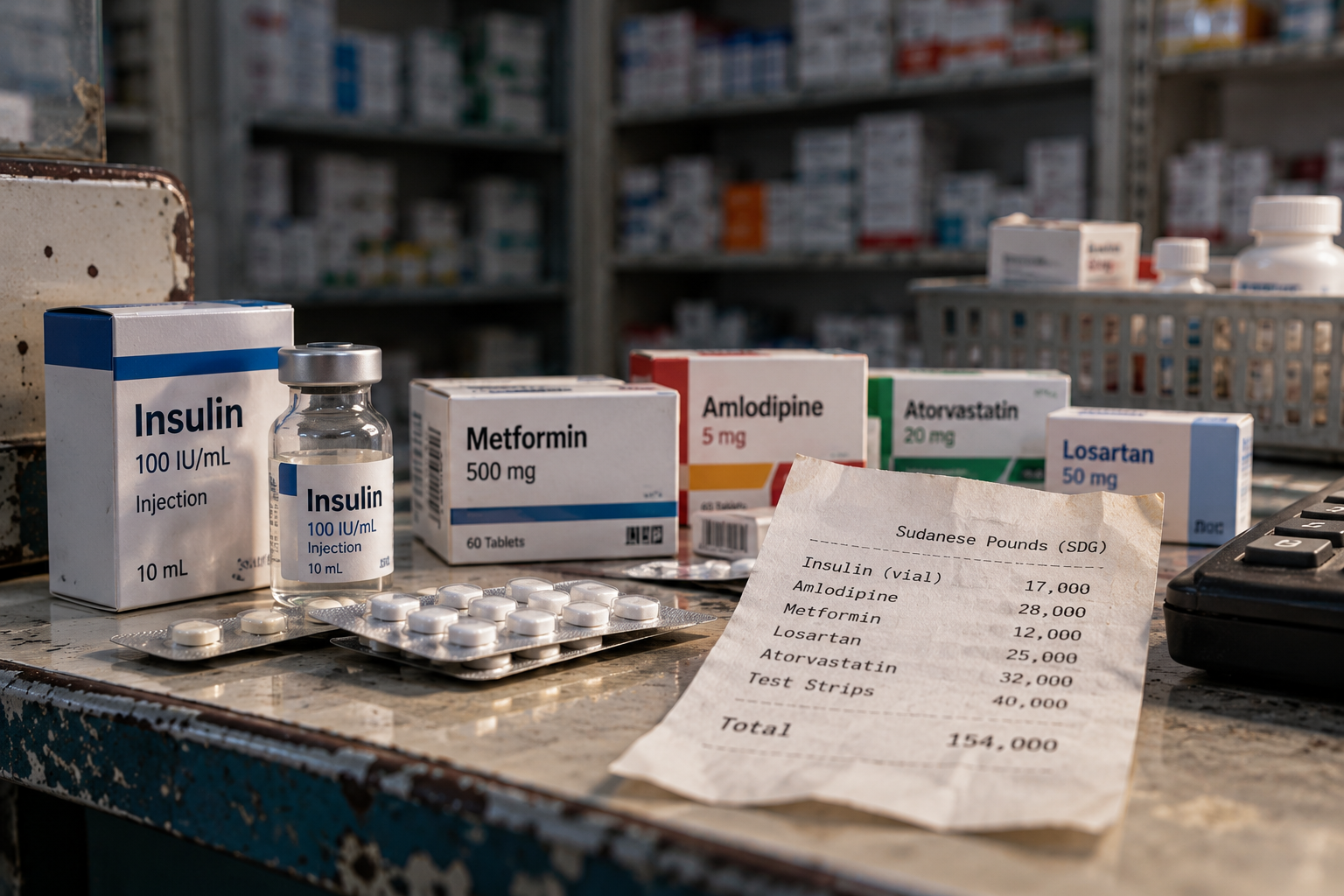
Unable to afford the upfront expense, she instead purchases insulin vials costing around 17,000 pounds ($1.80).
However, without a refrigerator, she must buy ice every day to preserve the medicine.
That adds approximately 180,000 Sudanese pounds ($20) to her monthly expenses.
Although the vials can ultimately cost more, spreading the payments throughout the month makes them her only affordable option.
Rising healthcare costs place families under pressure
The medicine crisis is also affecting elderly patients who depend on regular treatment.
Fatima Adam, 75, is receiving care at Port Sudan Hospital for complications linked to hypertension and a thyroid condition.
Her daughter, Aisha, told Al Jazeera that the family now struggles to purchase the six medicines Fatima needs.
Before the conflict, Sudan’s National Health Insurance Fund covered most of her treatment costs.
However, the medicines she requires are no longer covered under the scheme.
Her son, who works as a casual labourer, is responsible for supporting the family and paying for her treatment.
Because his income is unpredictable, the family sometimes purchases only small quantities of medicine.
A month’s supply recently cost approximately 160,000 Sudanese pounds ($17.80).
For households depending on irregular daily earnings, such expenses can consume a substantial share of available income.
Sudan’s pharmaceutical industry suffers major war damage
The conflict has also severely disrupted Sudan’s medicine supply system.
According to figures provided to Al Jazeera by the National Medical Supplies Fund, damage to pharmaceutical stocks, infrastructure and transport fleets has caused estimated losses of $500 million.
Meanwhile, Sudan’s National Medicines and Poisons Board reported that only eight of the 30 pharmaceutical factories in Khartoum that closed during the conflict have resumed operations.
The disruption has increased the country’s dependence on imported medicines.
However, the depreciation of the Sudanese pound has made imports and local pharmaceutical production significantly more expensive.
As a result, both pharmacies and patients face growing financial pressure.
Pharmacists struggle to keep essential medicines available
Hossam al-Naeem, a pharmacist in Port Sudan, described the difficulties of maintaining medicine supplies as prices continue to rise.
He told Al Jazeera that patients are often shocked when they discover how much their prescriptions cost.
The currency’s depreciation has also affected pharmacy operations.
Before the war, the US dollar traded at approximately 600 Sudanese pounds. Al Jazeera reported that black-market traders were quoting around 9,300 pounds per dollar.
This has increased the cost of replacing pharmaceutical stocks.
In some cases, pharmacists sell medicines at prices that barely cover their wholesale costs.
Hossam described selling a strip of cold and flu tablets for 6,000 Sudanese pounds, only to discover that the replacement stock would cost the same amount.
Such conditions make it increasingly difficult for pharmacies to remain financially sustainable while providing affordable treatment.
Heart patients face growing risks from interrupted treatment
For people living with heart disease, disruptions to medication can have serious consequences.
Huda Mahmoud, 58, lives in el-Obeid, the capital of North Kordofan State.
She has experienced heart problems for more than 12 years and depends on five different medicines.
At times during the conflict, the medicines were unavailable locally.
She relied on contacts in Wad Madani, Sennar and Port Sudan to obtain supplies.
Her treatment previously cost approximately 300,000 Sudanese pounds ($33.30) a month.
After returning to el-Obeid following displacement, her regular medication now costs around 151,000 pounds ($16.80) monthly.
Despite the lower amount, she continues to struggle to afford it.
Huda fears that interruptions to her treatment could expose her to serious health complications, including blood clots.
Her experience reflects the growing vulnerability of patients who require uninterrupted access to essential medicines.
Sudan’s war deepens the healthcare crisis
Sudan’s conflict has affected healthcare access through displacement, damaged infrastructure, rising prices and declining household incomes.
The United Nations Development Programme has estimated that the war has pushed income levels back to those seen in the 1990s.
For patients managing long-term illnesses, the economic consequences are especially severe.
Medicines that were once accessible through insurance schemes or local pharmacies have become increasingly difficult to obtain.
Families are now forced to balance the costs of treatment against food, shelter and other essential needs.
Without improved access to affordable medicines and a more stable healthcare supply system, Sudanese patients with chronic conditions will continue to face serious risks to their health and livelihoods.