
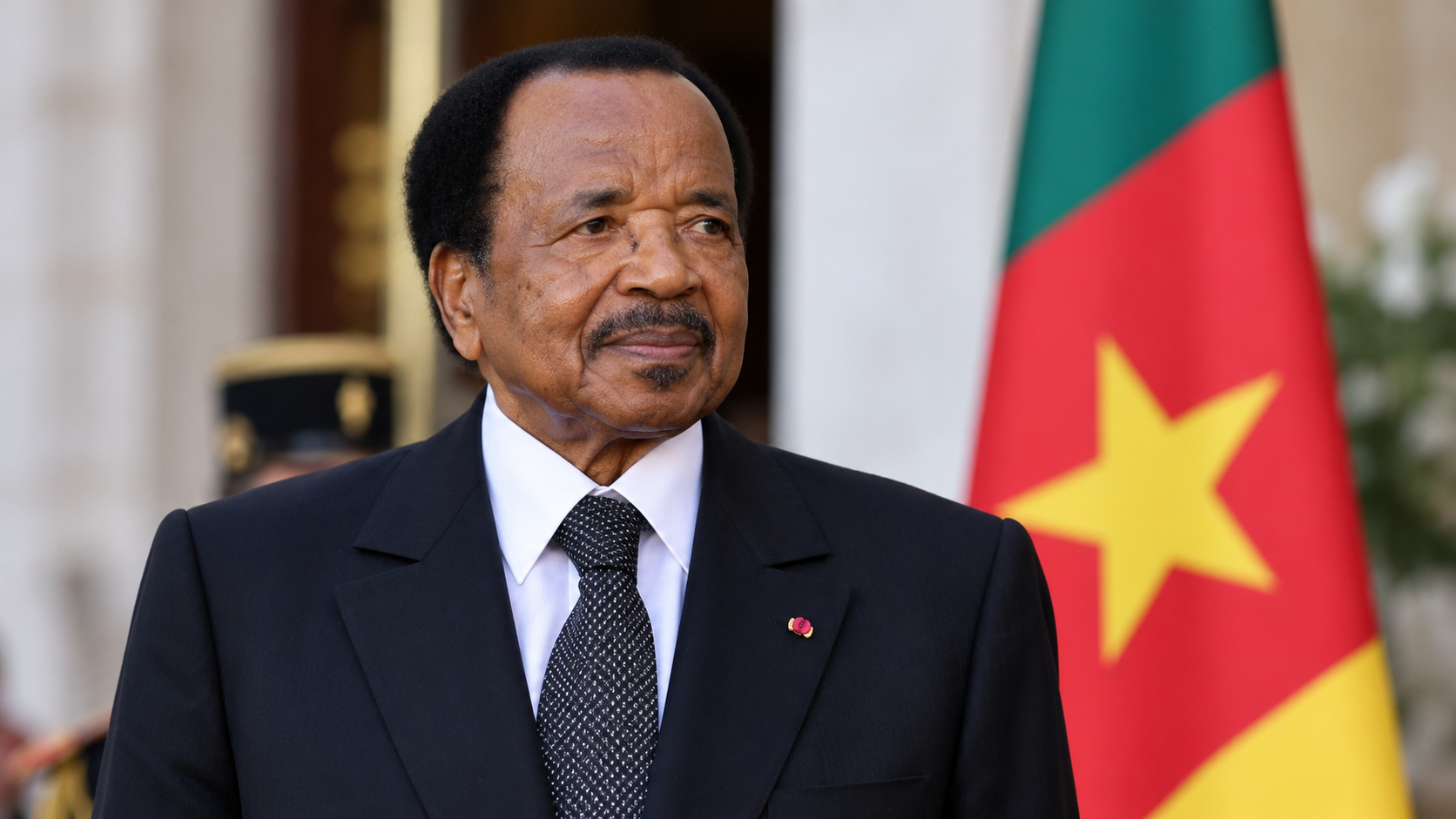
Cameroon’s political future remains uncertain as President Paul Biya, 93, faces growing questions about succession following a lengthy absence from the country.
Biya returned to Cameroon in August after spending 74 days abroad. However, his return has not ended public debate over the country’s leadership.
The president has yet to announce a new cabinet following his disputed re-election in October 2025.
Meanwhile, attention has turned to the vacant vice presidency, which could play a central role in Cameroon’s political future.
The uncertainty comes as the country faces security challenges, economic concerns and divisions following last year’s election.
Paul Biya returns after 74 days abroad
Biya arrived in Cameroon on August 20 after spending more than two months in Geneva, Switzerland.
His office described the trip as a private stay.
However, the lengthy absence prompted speculation about the president’s health, including unconfirmed reports of hospitalisation.
Government officials denied those reports.
Upon his return, supporters gathered to welcome Biya and his wife, Chantal.
The president appeared briefly in public, greeting officials and waving from his vehicle.
Nevertheless, questions about his prolonged absence have continued.
Biya has frequently travelled abroad during his decades in office.
According to an investigation by the Organized Crime and Corruption Reporting Project, he had spent around four and a half years on private trips outside Cameroon by 2018.
Cameroon awaits a new government
Biya has governed Cameroon since 1982, making him Africa’s longest-serving current president.
He secured an eighth term in October 2025 following a disputed presidential election.
However, opposition groups challenged the result.
The election also triggered protests, which security forces suppressed.
Human rights organisations reported that at least 48 people died during the unrest.
Opposition leader Issa Tchiroma Bakary claimed victory and later went into exile in The Gambia.
Since the election, Biya has not announced a new cabinet.
The delay has increased uncertainty over the government’s direction.
Some political analysts believe the president may be delaying appointments to maintain influence over competing groups within the ruling Cameroon People’s Democratic Movement.
However, others warn that prolonged uncertainty could affect investor confidence and government operations.
Vice presidency becomes central to succession debate
Cameroon’s succession debate has gained attention following a major constitutional change.
In April 2026, parliament restored the position of vice president, which had been abolished in 1972.
Under the new system, the president can appoint and dismiss the vice president.
The officeholder would complete the remainder of the presidential term if the president became unable to continue in office.
As a result, the appointment could shape Cameroon’s political future.
However, Biya has not yet named anyone to the position.
Opposition parties have criticised the arrangement, arguing that it limits voters’ influence over presidential succession.
Supporters of the government, meanwhile, have maintained that Cameroon’s institutions continue to function.
The absence of an appointment has left questions about the country’s future leadership unresolved.
Who could succeed Paul Biya?
Several prominent figures have emerged in discussions about Cameroon’s political future.
One is Ferdinand Ngoh-Ngoh, the secretary-general of the presidency.
Ngoh-Ngoh holds an influential position within the government and has been described by some analysts as a powerful figure in the administration.
However, Biya has not publicly identified him as a successor.
Another name is Franck Biya, the president’s son.
Some observers believe he could attract support from sections of the ruling party, particularly in southern and central Cameroon.
Nevertheless, Franck Biya has limited experience in elected political office.
If the vice presidency remains vacant, Senate President Aboubakary Abdoulaye would be next in the constitutional line of succession.
Under the existing arrangements, he would oversee a transition until elections could take place.
For now, the president has not publicly endorsed any potential successor.
Cameroon faces wider political challenges
The leadership debate comes at a difficult time for Cameroon.
The country continues to face attacks linked to Boko Haram in its northern regions.
Meanwhile, separatist violence remains a major security concern in the country’s English-speaking northwest and southwest.
Economic challenges have also affected households despite Cameroon’s natural resources.
These pressures have increased public expectations for effective government leadership.
Biya’s long presidency has shaped Cameroon’s political institutions for more than four decades.
However, his latest absence has renewed discussion about how those institutions would manage a future transition.
Uncertainty continues over Cameroon’s future
Biya remains president following his return from Switzerland.
However, the lack of a new cabinet and vice president has kept succession questions at the centre of political debate.
The next major development could be an announcement of government appointments.
Such a decision may offer greater clarity about the president’s plans for the remainder of his term.
Until then, Cameroon’s political future remains the subject of growing public discussion.