
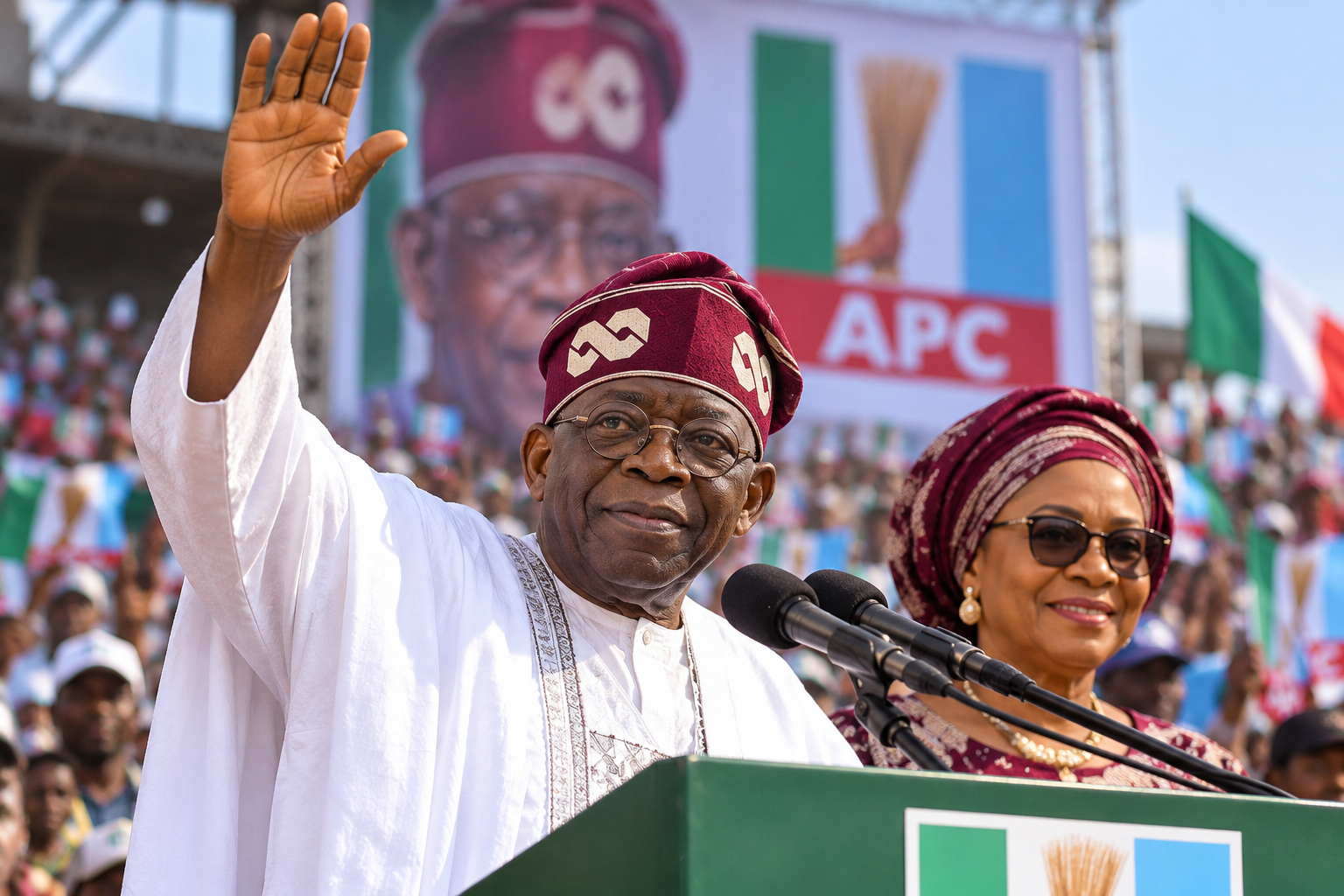
Nigerian President Bola Tinubu has officially launched his campaign for a second term, defending his economic reforms as millions of Nigerians continue to struggle with rising living costs.
Thousands of supporters gathered at a stadium in Kaduna on Saturday, October 24, for the campaign rally.
The 74-year-old president promised Nigerians a better economic future while defending policies that have faced widespread criticism.
According to Africanews and the Associated Press, Tinubu insisted that his government’s reforms were necessary to improve Nigeria’s economy.
However, the president faces growing concerns over inflation, poverty and insecurity ahead of the January 16 presidential election.
Tinubu launches campaign for second term
Tinubu formally began his re-election campaign in Kaduna, one of northern Nigeria’s major cities.
Thousands of supporters attended the event, where officials from his ruling All Progressives Congress (APC) defended his leadership.
The president used the rally to highlight his administration’s economic policies and development projects.
He also promised that Nigerians would experience improvements in their living conditions.
Nigeria’s Minister of Works, David Umahi, praised the government’s infrastructure projects.
Umahi argued that completed and ongoing projects demonstrated the administration’s commitment to national development.
Meanwhile, ruling party officials insisted that Tinubu’s economic reforms were beginning to produce positive results.
However, the president’s campaign comes at a difficult time for many Nigerian households.
Nigeria’s economic reforms face criticism
Since taking office in 2023, Tinubu has introduced several major economic reforms.
One of his most significant decisions was removing Nigeria’s longstanding fuel subsidy.
The government also allowed the naira to lose value as part of broader currency reforms.
These measures were intended to improve public finances, attract investment and reduce economic distortions.
However, they also contributed to higher transport costs and rising prices for essential goods.
Many Nigerians have struggled to afford food, fuel and other basic necessities.
According to Africanews, the reforms have improved government finances and investor confidence.
Nevertheless, they have also contributed to one of Nigeria’s most severe cost-of-living crises in decades.
As a result, the economy is expected to become a central issue in the presidential election.
Tinubu blames opposition for poverty
During the Kaduna rally, Tinubu rejected criticism of his administration’s economic record.
Instead, he accused opposition parties of contributing to Nigeria’s longstanding economic difficulties.
The president argued that his government was working to address problems inherited from previous administrations.
He also defended his economic strategy despite public frustration over living costs.
However, opposition figures have repeatedly criticised the government’s handling of inflation and economic hardship.
For many voters, the key question will be whether Tinubu’s reforms can deliver noticeable improvements before the election.
Security remains a major election concern
Alongside economic difficulties, Nigeria continues to face serious security challenges.
Armed groups, kidnappers and bandits remain active in several parts of the country.
These threats have affected communities, disrupted businesses and forced families to leave their homes.
According to Africanews, gunmen killed at least 20 people during an attack on a village in northeastern Nigeria on Friday.
The latest violence highlights the security challenges facing Tinubu’s administration.
Insecurity is expected to become another major issue during the election campaign.
Voters will likely assess the government’s ability to protect communities and reduce attacks.
Who will challenge Tinubu in Nigeria’s election?
Tinubu is expected to face several political opponents in the January 16 presidential election.
Among his main challengers are former Vice President Atiku Abubakar and former Anambra State Governor Peter Obi.
Both politicians contested the 2023 presidential election.
Abubakar finished second, while Obi placed third.
Their participation could create another competitive election focused on economic management, security and government performance.
However, the political landscape may continue to change as campaigning progresses.
Nigeria prepares for crucial presidential vote
Nigeria’s upcoming election will take place against a backdrop of economic pressure and security concerns.
Tinubu’s supporters argue that his reforms are necessary to create long-term economic stability.
Meanwhile, critics question whether ordinary Nigerians have benefited from those policies.
The president will need to convince voters that his administration can improve living standards and address insecurity.
For opposition candidates, the campaign presents an opportunity to challenge the government’s economic record.
As Nigeria prepares for the January 16 vote, the country’s economic future and security challenges are likely to dominate political debate.