
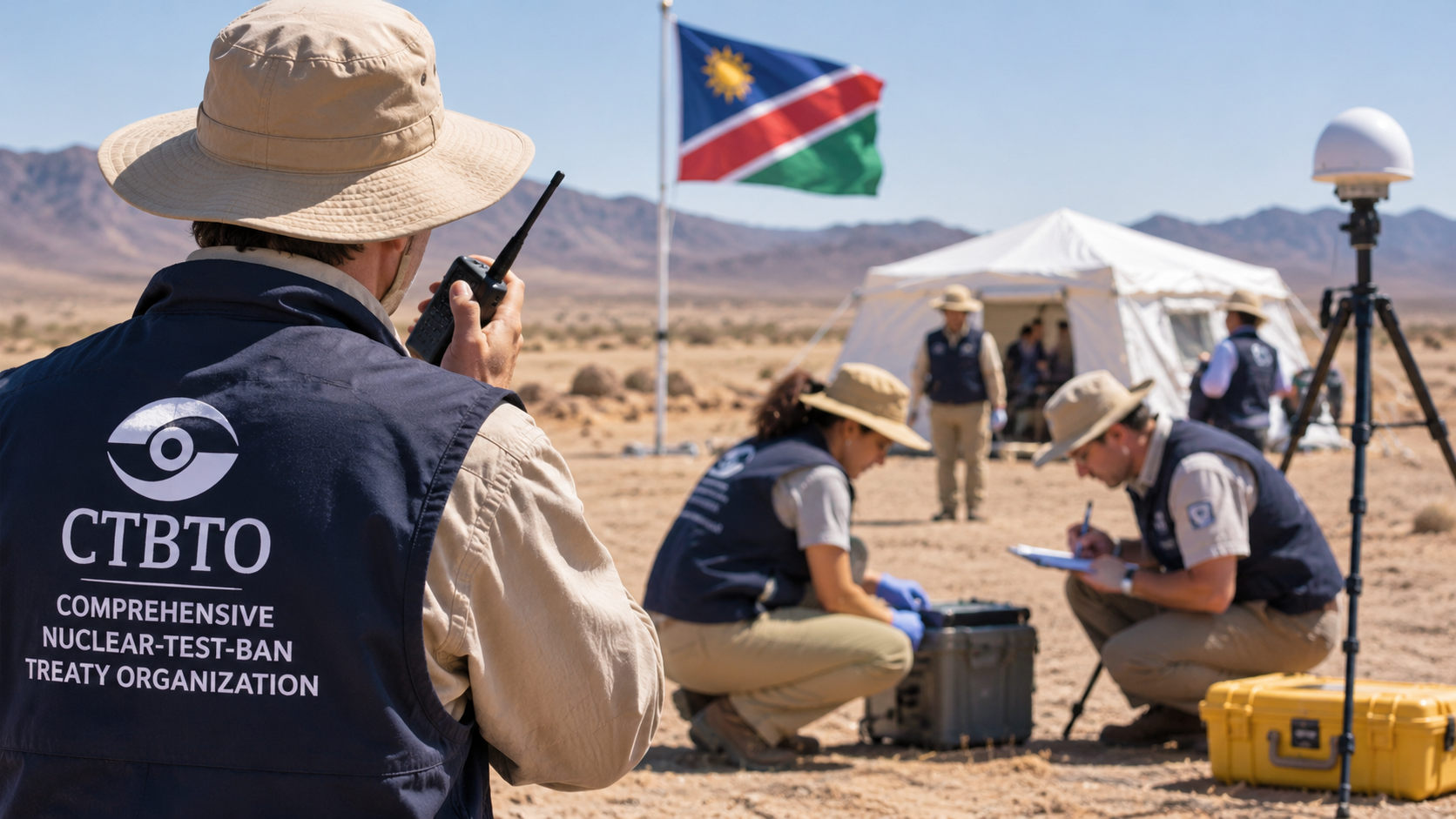
Namibia is hosting a major international exercise to test how experts would investigate a suspected nuclear weapons explosion.
Around 250 specialists have gathered in the Namibian desert for the training programme. The exercise aims to strengthen the world’s ability to detect and verify nuclear tests.
According to Africanews and the Associated Press (AP), the operation is organised by the Comprehensive Nuclear-Test-Ban Treaty Organization (CTBTO).
It is the first major exercise of its kind held in Africa. The training will continue until November 20.
Experts simulate a nuclear test investigation
The exercise allows international experts to practise investigating a suspected nuclear explosion.
Teams are testing methods used to collect evidence and determine whether a nuclear weapons test has taken place.
The CTBTO calls this process an on-site inspection.
Such inspections aim to establish the facts surrounding a suspected nuclear explosion.
During the exercise, specialists will assess how effectively inspection teams can operate in challenging conditions.
The training also helps experts improve coordination, equipment use and field procedures.
However, the exercise does not mean that a nuclear explosion has occurred in Namibia.
Instead, it is a planned simulation designed to test international verification systems.
First major nuclear inspection exercise in Africa
The Namibia exercise marks an important milestone for the CTBTO.
Oleg Rozhkov, director of the organisation’s On-site Inspection Division, said it was only the third major integrated field exercise in the organisation’s 30-year history.
He also confirmed that it was the first such exercise on the African continent.
The previous exercises took place in Kazakhstan in 2008 and Jordan in 2014.
These programmes help the organisation evaluate its readiness to investigate suspected nuclear tests.
They also allow specialists from different countries to work together under realistic conditions.
As a result, the CTBTO can identify areas where its inspection capabilities need improvement.
What is the nuclear test ban treaty?
The Comprehensive Nuclear-Test-Ban Treaty (CTBT) aims to prohibit nuclear weapons test explosions worldwide.
The treaty opened for signature in 1996.
However, it has not yet entered into force because several required countries have not completed the necessary ratification process.
Despite this, the agreement has helped establish a strong international norm against nuclear testing.
More than 2,000 nuclear tests took place before the treaty opened for signature.
Since then, fewer than a dozen nuclear test explosions have been conducted.
The CTBTO works to support the treaty through international monitoring and verification systems.
Nearly 190 countries have signed the treaty
CTBTO Executive Secretary Robert Floyd highlighted the treaty’s broad international support.
He said 188 countries had signed the agreement.
According to Floyd, this shows that most countries support the goal of ending nuclear weapons testing.
However, signing the treaty does not automatically mean that a country has completed ratification.
The treaty’s full legal implementation still depends on the remaining required ratifications.
Meanwhile, the CTBTO continues developing the systems needed to monitor compliance.
These include technologies designed to detect signs of possible nuclear explosions.
Why nuclear test detection matters
Nuclear test detection plays an important role in international security.
Reliable monitoring systems help countries identify possible nuclear explosions and assess whether treaty commitments have been respected.
They can also provide evidence when governments raise concerns about suspected nuclear tests.
However, detecting an unusual event is only part of the process.
Experts may need additional information to determine whether an explosion was caused by a nuclear weapon.
This is where on-site inspections could play an important role once the treaty enters into force.
The Namibia exercise allows specialists to practise these procedures before they are needed in a real investigation.
Namibia exercise continues until November 20
The training programme will bring together around 250 experts before concluding on November 20.
During this period, participants will test inspection procedures and evaluate their performance.
The findings could help the CTBTO improve future training and operational readiness.
For Namibia, hosting the exercise places the country at the centre of an international effort to strengthen nuclear test verification.
The programme also highlights Africa’s role in supporting global nuclear non-proliferation efforts.
Although the treaty has not entered into force, the CTBTO continues preparing its verification systems.
The Namibia exercise represents another step towards ensuring that suspected nuclear explosions can be investigated effectively.