
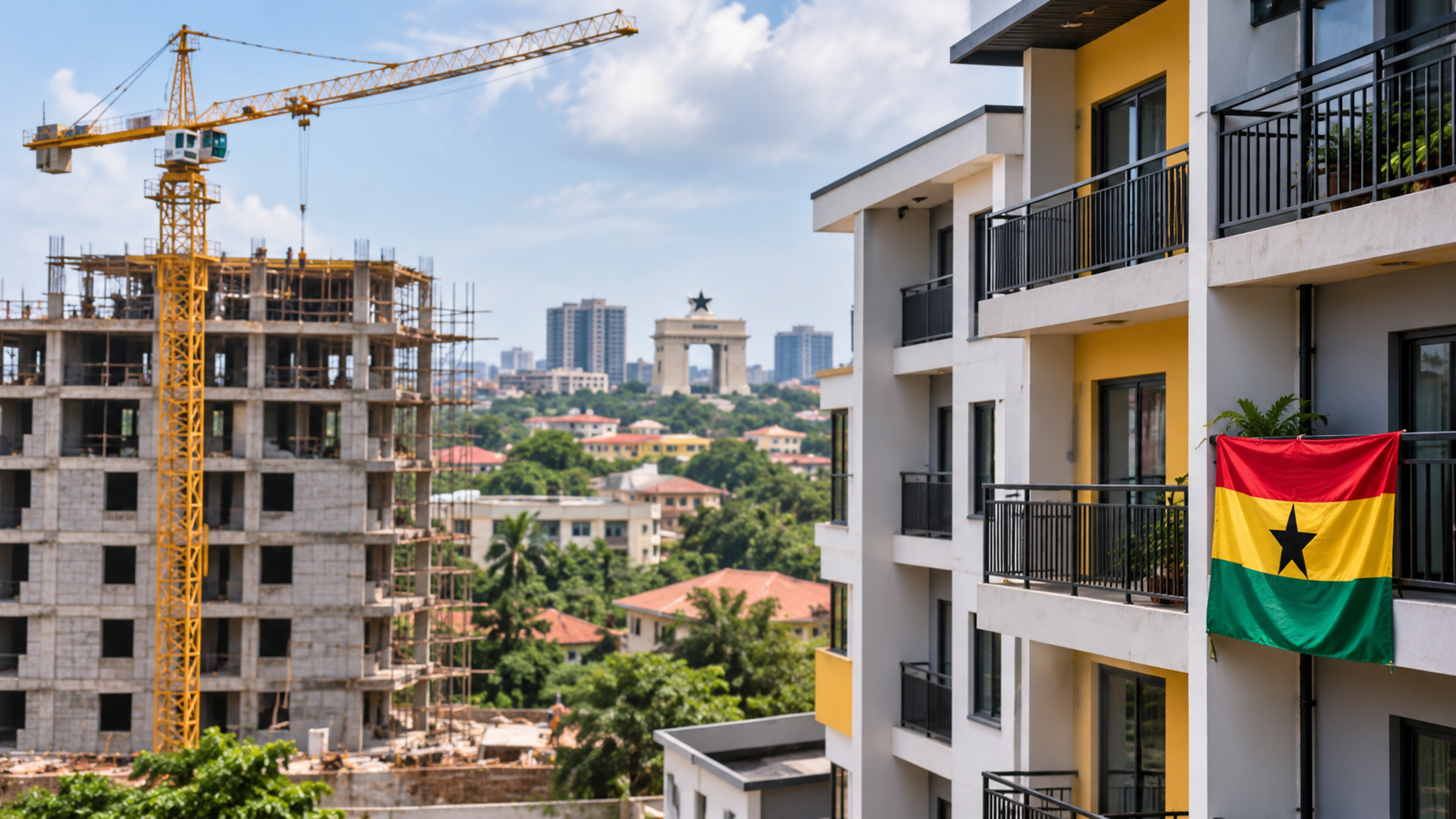
Ghana faces a growing housing crisis as high construction costs, expensive land and limited financing keep homes beyond the reach of millions.
The country needs more than 1.8 million additional housing units. However, increased investment has not made homeownership affordable for most households.
According to a report by Al Jazeera, these challenges dominated discussions at the Africa Real Estate Conference & Expo in Accra.
Developers, investors and government officials explored ways to increase housing supply and reduce costs.
Yet a major problem remains. Many new homes are too expensive for the people who need them most.
Ghana faces a shortage of affordable homes
Ghana’s housing shortage continues to place pressure on families, especially in urban areas.
Around 56.7% of the population lives in cities. However, only about 5% of Ghanaians can afford housing without government support, according to figures cited by Al Jazeera.
As a result, many households struggle to buy or rent suitable homes.
Developers also face difficulties building properties at prices ordinary workers can afford.
Although demand for housing remains strong, purchasing power is limited.
This gap between demand and affordability has become one of the country’s biggest housing challenges.
Government introduces cheaper housing loans
The Ghanaian government has introduced several measures to improve access to housing finance.
The National Homeownership Fund has reduced mortgage interest rates from 13.5% to 8.4%.
Meanwhile, a revolving fund worth three billion Ghanaian cedis, approximately $256 million, aims to support public sector workers.
The programme offers repayment periods of 15 to 20 years.
President John Dramani Mahama has also announced plans to allocate one billion cedis, around $85 million, to the National Housing Fund in the 2027 budget.
However, many workers still struggle to qualify for mortgages.
This is particularly difficult for people working in the informal economy.
Although they may earn regular incomes, they often lack payslips or conventional banking records.
Mahama has therefore called on financial institutions to consider alternative ways of assessing borrowers.
High construction costs push house prices up
Expensive land and building materials remain major obstacles to affordable housing in Ghana.
Samuel Amegayibor, executive director of the Ghana Real Estate Developers Association (GREDA), identified financing and secure land ownership as key challenges.
According to the Al Jazeera report, borrowing costs for developers have fallen from around 30% to between 9% and 15%.
However, these rates can still make construction expensive.
Developers also face problems securing land with clear ownership documents.
In addition, some projects require new roads, electricity connections and water infrastructure.
These costs increase the final selling price of homes.
Amegayibor also estimated that around 70% of housing construction inputs are imported.
As a result, developers remain exposed to import costs, taxes and changes in international prices.
Expanding local production could help reduce some of these pressures.
Most Ghanaians build homes using savings
Access to mortgage financing remains extremely limited.
According to figures cited in the report, around 90% of housing in Ghana is built through personal savings and gradual construction.
Meanwhile, mortgage lending represents just 0.3% of the country’s gross domestic product.
This means many families build homes in stages rather than purchasing completed properties.
Some households spend years saving money and buying materials before finishing construction.
However, rising costs can delay projects and increase financial pressure.
Bako Ambianda, chief executive of Backbone Capital Ventures, said the problem extends beyond housing demand.
He argued that construction costs, financing options and household incomes are poorly aligned.
Therefore, attracting more investors alone may not solve the crisis.
High rent deposits burden tenants
Ghana’s housing affordability problem also affects renters.
Under the country’s Rent Act of 1963, advance rent payments are limited to six months.
However, some landlords reportedly demand one or two years of rent before tenants can move in.
These payments create a major financial burden for households.
The government has introduced measures aimed at improving enforcement.
According to Al Jazeera, penalties for violations can reach 3,000 cedis or six months in prison.
Authorities have also introduced the FirstKey application to help identify non-compliant landlords and verify property listings.
Meanwhile, a proposed Easy Rent programme would allow the National Housing Fund to pay rent advances directly to landlords.
Workers would then repay the amount through monthly instalments.
However, these measures may ease payment pressures without solving the shortage of affordable homes.
Technology could help reduce housing costs
Technology companies are exploring new ways to make housing more efficient.
At the Africa Real Estate Conference & Expo, 30 property technology startups presented products and services.
Some focused on reducing electricity costs. Others introduced digital tools for property management.
Isaac Ayitey Chris-Quaye, co-founder of NeuraHomes, said smart-home systems could help households monitor energy use.
He described a project where property managers reduced annual energy costs by 20%.
However, actual savings depend on installation costs and electricity consumption.
Another company, AWA Roofing Sheets, has developed a reflective roof coating.
Founder William Atitso Amankwah said the product can reflect up to 60% of sunlight.
He estimated that it could reduce indoor temperatures by two to five degrees Celsius.
The company also estimates possible cooling-energy savings of 11% to 27%.
However, these figures are company estimates rather than guaranteed results for every household.
Alternative building materials offer opportunities
Some developers are also experimenting with cheaper construction methods.
Builderman Estates has explored housing designs using sandbags and recycled materials.
The approach aims to reduce construction costs and dependence on conventional building materials.
However, expanding these projects requires additional investment.
Developers must also demonstrate that alternative materials meet safety and durability standards.
Meanwhile, industry representatives believe local manufacturing could reduce reliance on imported construction products.
This could create jobs while making building materials more accessible.
Still, lower construction costs do not automatically guarantee cheaper homes.
Developers would also need to pass those savings on to buyers.
Ghana seeks new solutions to housing crisis
Housing experts believe Ghana needs broader reforms to improve affordability.
These include better access to land, lower construction costs and financing options suited to household incomes.
For informal-sector workers, lenders could consider mobile-money transactions, savings records and rental payment histories.
Such measures could help more people qualify for housing finance.
However, lenders would also need to protect borrowers’ financial information and avoid unaffordable loans.
GREDA has proposed establishing a National Housing Authority to improve long-term planning.
The government is also working to revive the stalled Saglemi Housing Project.
Authorities aim to deliver its first 700 units by March 2027.
In addition, plans are underway for a 200-acre Green City Project at Dedesua.
These initiatives could help expand housing supply.
However, their success will depend on whether ordinary households can afford the homes being built.
For Ghana, the challenge is no longer simply attracting investment.
It is ensuring that investment produces housing people can realistically buy or rent.