
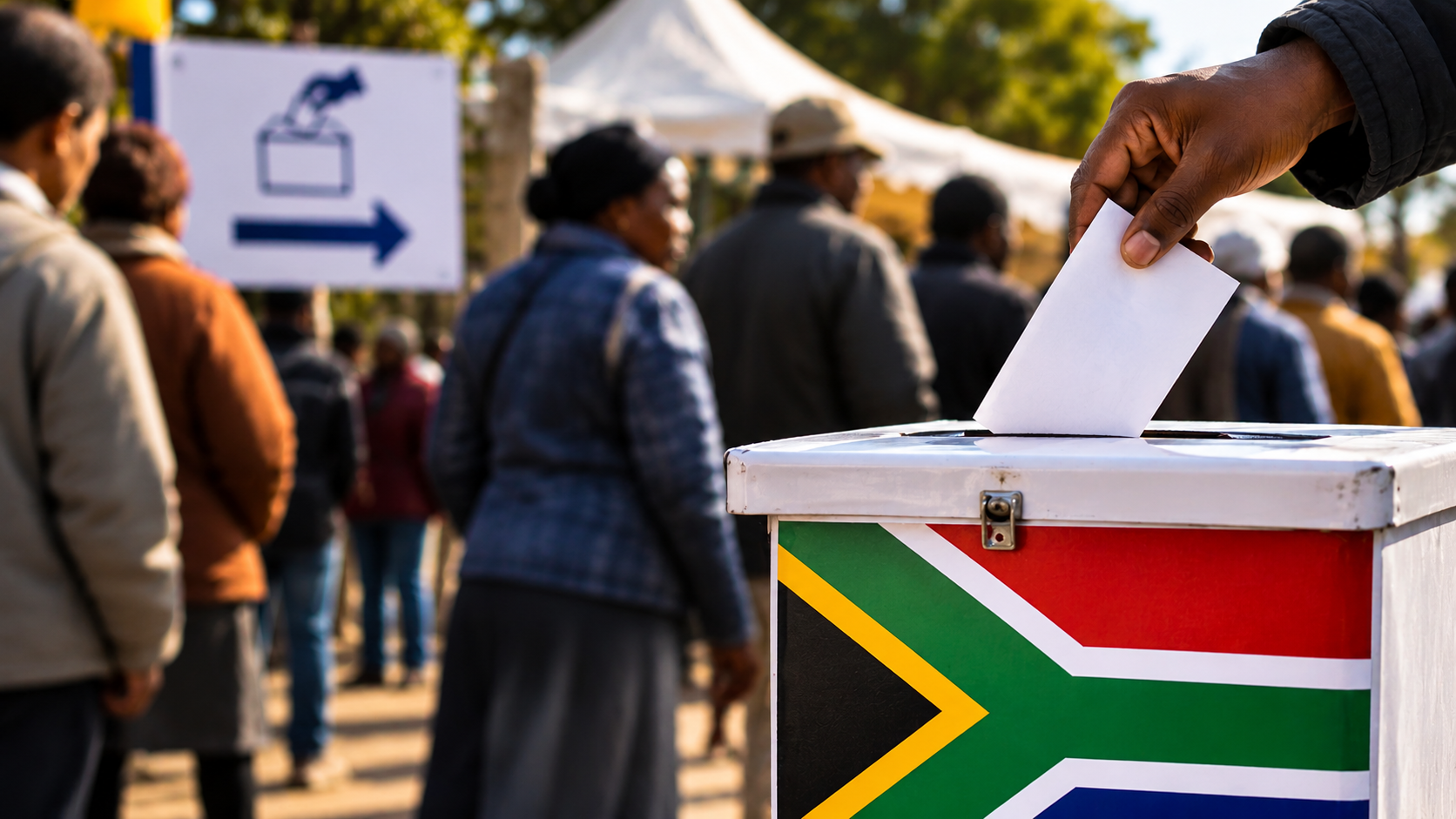
Vote counting is underway in South Africa’s municipal elections, with early results showing a sharp decline in support for the African National Congress (ANC).
The ANC remains the largest party nationally in the provisional count. However, its lead over the opposition Democratic Alliance (DA) has narrowed significantly.
With more than half of votes counted on Thursday, November 5, the ANC had approximately 32% of the vote. The DA followed with around 26%, according to figures reported by BusinessTech.
The figures remain provisional and could change as more votes are counted.
The elections are a major test for the ANC, which has dominated South African politics since the end of apartheid in 1994.
ANC faces major losses in early results
The early figures suggest the ANC could record another significant decline in electoral support.
In the 2021 municipal elections, the party received 45.6% of the national vote.
Its current share of approximately 32% would represent a drop of nearly 14 percentage points if maintained.
Meanwhile, the DA has improved on its 2021 performance, when it received 21.7%.
The uMkhonto weSizwe (MK) Party, associated with former President Jacob Zuma, has also emerged as an important force.
The Economic Freedom Fighters (EFF) and ActionSA are among the other parties competing for municipal influence.
However, national vote shares do not determine control of individual municipalities.
Major cities could see political changes
Several of South Africa’s largest cities are emerging as closely watched contests.
Early results indicate that the DA is performing strongly in Johannesburg and Tshwane.
In Johannesburg, the DA led with approximately 37% when 26% of votes had been counted, according to figures published by BusinessTech.
The ANC followed with around 18%, while ActionSA was close behind.
In Tshwane, the DA also held an early lead.
Meanwhile, the MK Party has shown strength in eThekwini, which includes Durban.
An eNCA projection published on Thursday evening suggested the MK Party could secure between 34% and 38% in eThekwini.
However, these figures are projections rather than final results.
Coalition negotiations could become necessary in municipalities where no party secures an outright majority.
Nearly 16 million South Africans participated
A record 29.2 million people registered for the municipal elections, according to Al Jazeera.
Voting took place on Wednesday, November 4, across 23,696 polling stations.
More than 1.4 million special votes were cast earlier in the week.
The Electoral Commission of South Africa (IEC) said approximately 15.9 million people participated, including special voters.
However, the commission stressed that final turnout figures would only be available after counting was completed.
Election officials continue counting and verification
The IEC said vote counting and verification continued throughout Wednesday night and Thursday.
By 9am Thursday, officials had captured approximately 34.8% of expected results slips.
Results processing had been completed in 18 municipalities.
The commission said the process was moving faster than during the previous municipal elections.
However, officials urged political parties and voters to remain patient.
The IEC also warned against spreading unverified election results.
Final results cannot be formally declared before the deadline for objections on Friday, November 6, at 5pm local time.
The commission is expected to announce the complete results after reviewing outstanding objections.
Why South Africa’s municipal elections matter
The elections determine who governs local municipalities and manages essential public services.
These include water supplies, electricity distribution, roads, waste collection and local infrastructure.
Public frustration over service delivery has become a major political issue.
According to Al Jazeera, President Cyril Ramaphosa has acknowledged that municipal failures have weakened public confidence.
Many voters have expressed concerns about water shortages, power disruptions, unemployment and deteriorating infrastructure.
As a result, the elections are widely viewed as a measure of public satisfaction with the ANC’s performance.
Coalition talks could shape local government
South Africa’s political landscape has become increasingly competitive.
The ANC lost its national parliamentary majority in 2024 and subsequently entered a coalition government.
Now, the municipal elections could further reshape local politics.
If no party wins a majority in major cities, coalition agreements will determine who controls local councils.
The results could also influence political strategies ahead of the country’s next national elections in 2029.
For now, the ANC remains ahead nationally in the provisional municipal count.
However, its reduced vote share suggests that competition for local political power is intensifying.
The final results will determine the balance of power across South Africa’s municipalities.