
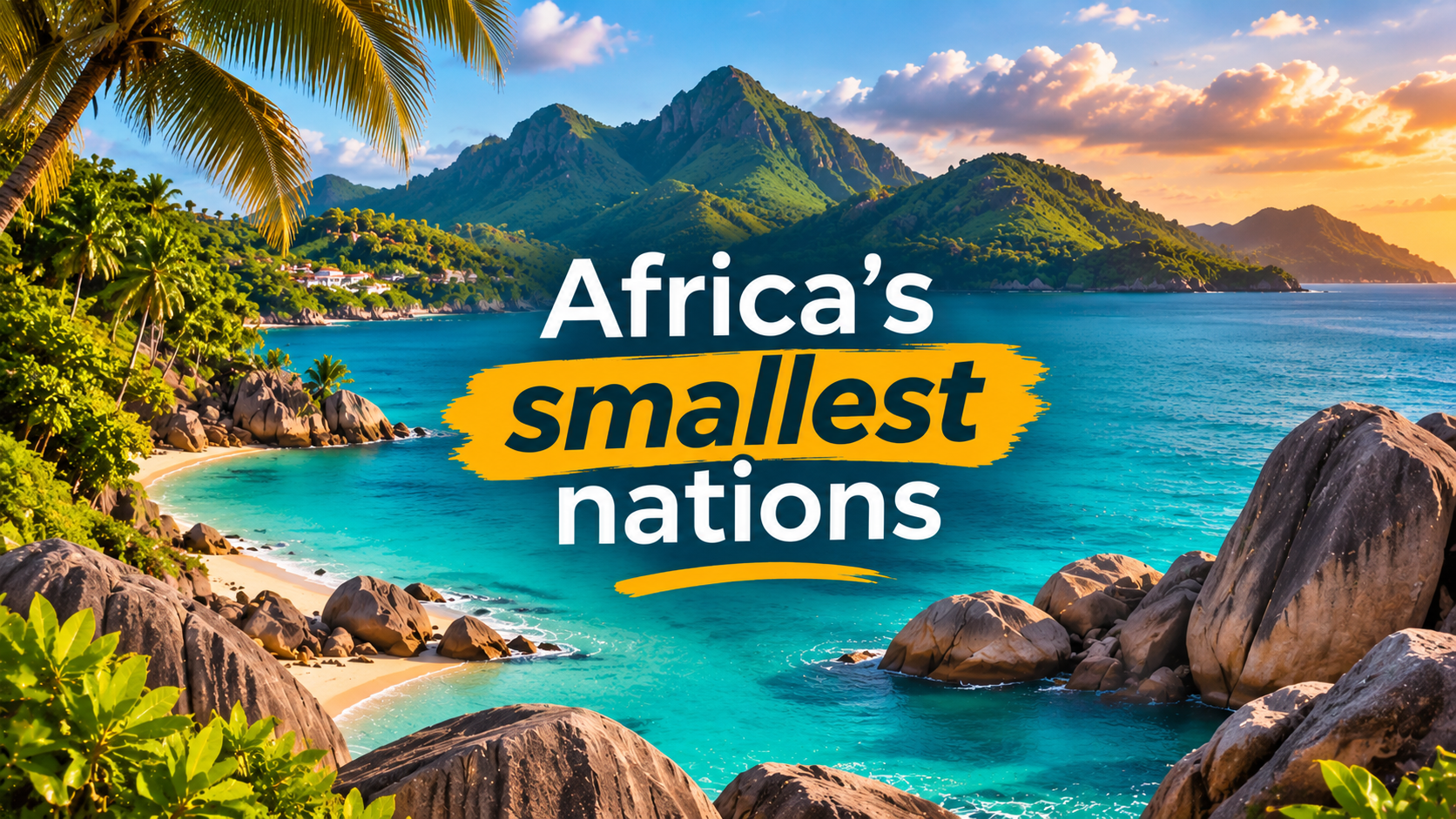
Africa is the world’s second-largest continent, covering approximately 30 million square kilometres. However, it is also home to some remarkably small countries.
From tropical islands to coastal nations, Africa’s smallest countries offer rich histories, diverse cultures and unique natural landscapes.
Here are the five smallest African countries by total area.
1. Seychelles – 455 km²
Seychelles is Africa’s smallest country by area. Located in the Indian Ocean, the nation consists of 115 islands.
It is famous for its white sandy beaches, giant tortoises and rare wildlife. Moreover, Seychelles is home to the coco de mer palm, which produces the world’s largest seed.
2. São Tomé and Príncipe – 964 km²
Located in the Gulf of Guinea, São Tomé and Príncipe is Africa’s second-smallest country.
The island nation is known for its tropical rainforests, volcanic mountains and cocoa production.
In addition, the equator passes through Ilhéu das Rolas, a small island off the southern coast of São Tomé.
3. Mauritius – 2,040 km²
Mauritius lies in the Indian Ocean, east of Madagascar.
Despite its small size, the country has a diverse cultural heritage shaped by African, Asian and European influences.
Mauritius was also the only known natural home of the dodo, a flightless bird that became extinct in the 17th century.
4. Comoros – 1,862 km²
Comoros is an island nation located between Mozambique and Madagascar.
The country is famous for producing ylang-ylang, vanilla and cloves. Its fragrant plants have earned it the nickname “Perfume Islands”.
Comoros also has a rich Islamic heritage that influences its architecture, traditions and daily life.
5. Cabo Verde – 4,033 km²
Cabo Verde consists of ten main volcanic islands in the Atlantic Ocean, off the coast of West Africa.
The country is known for its mountainous landscapes, colourful towns and maritime heritage.
Despite its limited natural resources, Cabo Verde has developed a strong tourism and service-based economy.
Small countries with remarkable identities
Although Africa’s smallest countries occupy only a tiny fraction of the continent, each has its own distinctive culture, history and natural environment.
Their stories demonstrate that geographical size does not determine a nation’s cultural richness or global significance.