
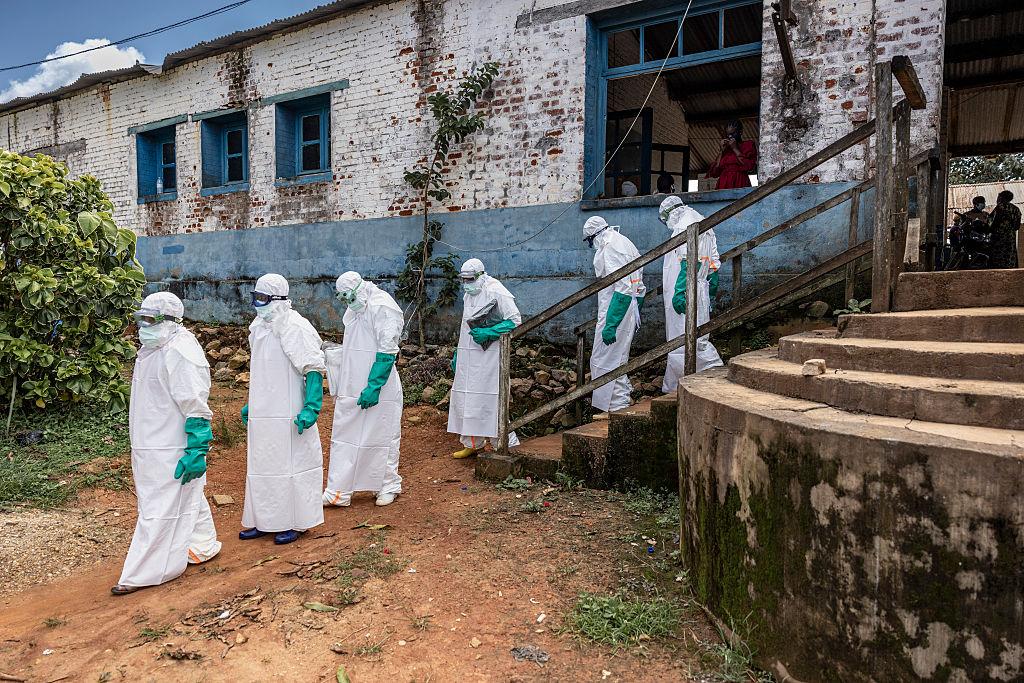
Congolese health authorities are tracking possible Ebola exposure in two additional provinces, raising fears that the country’s latest outbreak may be spreading beyond the eastern areas already hit by the virus, according to a Health Ministry report and a senior health official.
The outbreak, declared on May 15, has infected 1,307 people and killed 377 in Ituri, North Kivu and South Kivu provinces, according to government figures released Monday.
In Tshopo province, health workers are tracing people who may have come into contact with the body of a pregnant woman who died from Ebola in Ituri’s Niania health zone, according to a June 29 Health Ministry report reviewed by Reuters.
The woman fell ill on June 18 and died on June 27, the report said. Her body was then transported by motorcycle roughly 300 kilometers west to Kisangani, the capital of neighboring Tshopo province. A sample taken at a morgue later tested positive for Ebola.
The report warned that the movement of the body through several health zones before Ebola was confirmed created a high risk of transmission. Authorities have since launched contact-tracing efforts across Tshopo.
Separately, a senior health official said two people who had been identified as contacts of Ebola cases in Niania fled isolation while awaiting testing and travelled to Haut-Uele province, which borders Ituri as well as South Sudan and the Central African Republic.
The official, who spoke on condition of anonymity because he was not authorized to brief the media, said one of the two had tested positive for Ebola, while the second was awaiting confirmatory results.
Both people have since been located and are being returned to Niania, the official said. Health teams are now tracing anyone they may have encountered in Haut-Uele.
The developments mark a worrying moment in Congo’s response to the outbreak, as health authorities work to contain the virus in a region where insecurity, displacement and cross-border movement can complicate surveillance and emergency medical operations.