
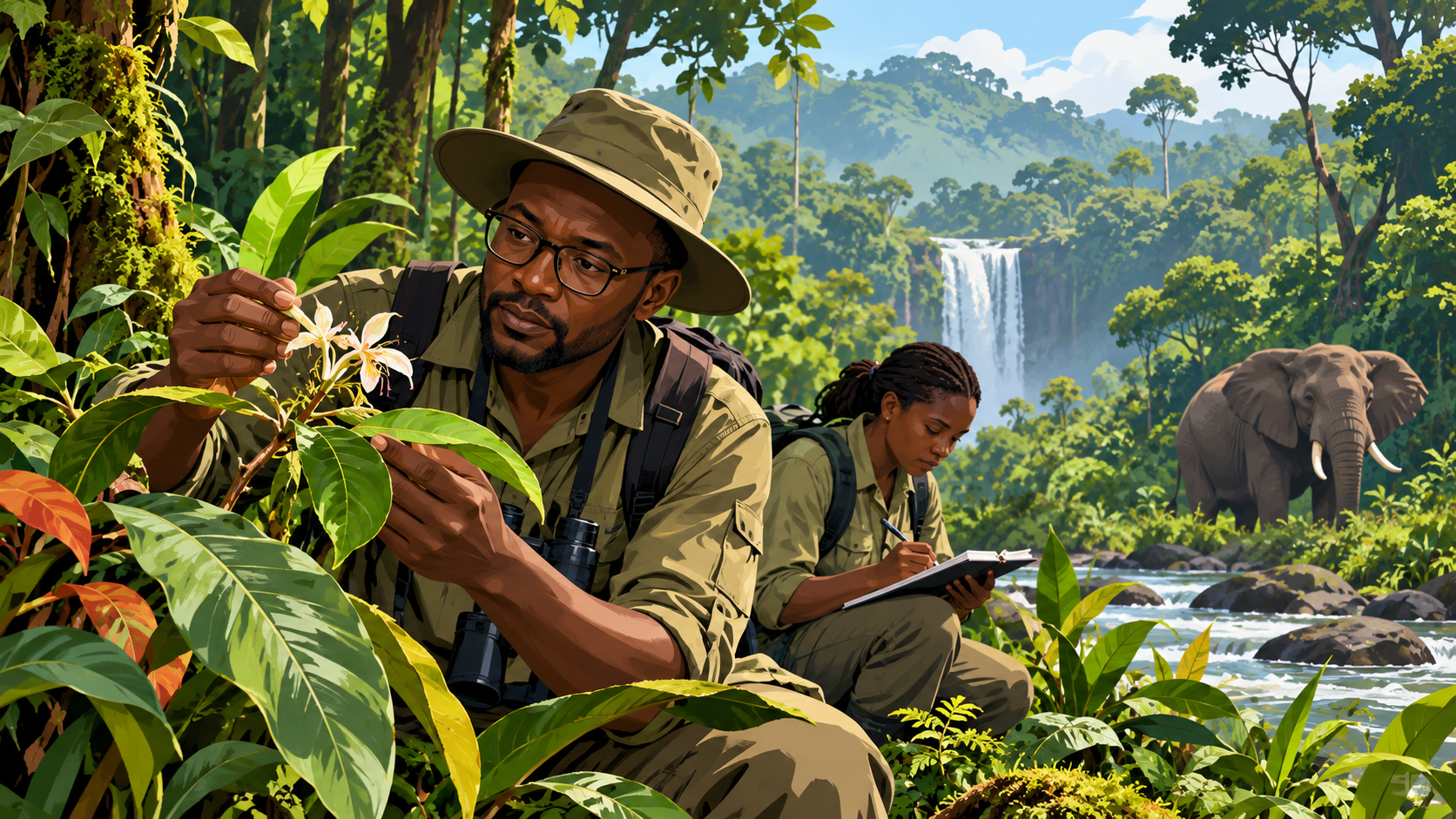
Scientists in Gabon discover an average of 10 new plant species every year, revealing the extraordinary biodiversity of a country where nearly 90% of the land remains covered by rainforest.
However, researchers warn that deforestation, mining, urban expansion and major infrastructure projects are threatening rare plants before scientists can fully understand them.
At the centre of these conservation efforts is the Sibang Botanical Garden in Libreville, where botanists are working to document and protect Gabon’s largely unexplored plant life.
Gabon’s rainforests remain largely unexplored
Gabon is home to some of Africa’s most important tropical forests.
Around 88% of the country is covered by rainforest, making it one of the most heavily forested nations in the world.
The country forms part of the Congo Basin, the world’s second-largest tropical rainforest after the Amazon.
These forests play a major role in absorbing carbon dioxide and regulating the global climate.
Yet much of Gabon’s biodiversity remains undocumented.
According to Archange Boupoya, director of the Sibang Botanical Garden, researchers discover approximately 10 previously unknown plant species during botanical surveys each year.
Speaking to Africanews and the Associated Press, Boupoya stressed the importance of understanding biodiversity before attempting to protect it.
“We cannot preserve that which we do not understand,” he said.
Thousands of plant species face growing threats
Scientists estimate that Gabon is home to between 7,000 and 10,000 known plant species.
However, approximately 10% of these species are believed to be under threat.
Researchers say the dangers include expanding cities, mining operations, deforestation and industrial development.
Infrastructure projects are also putting pressure on fragile ecosystems.
One example involves the Podostemaceae family of aquatic plants, which grow near waterfalls and resemble mosses.
Some species in this family were discovered only recently.
However, their habitats face potential destruction from the Kinguele hydroelectric dam project, located around 100 kilometres from Libreville.
With construction nearing completion, conservationists are calling for support to relocate endangered plants where possible.
Scientists race to document Gabon’s biodiversity
At Sibang Botanical Garden, a team of more than 30 botanists works to identify and preserve the country’s plant species.
The researchers regularly undertake expeditions lasting two to three weeks in remote forest areas.
During these trips, they collect plant samples before drying and documenting them for scientific analysis.
Their work forms part of a partnership with the Missouri Botanical Garden in the United States that has lasted approximately four decades.
Scientists from the United States, Britain, France and Belgium also assist with identifying specimens.
When researchers discover an unknown species, they must prepare a detailed scientific description before it can receive formal recognition.
The work is particularly challenging because large parts of Gabon’s rainforest remain difficult to access.
Gabon preserves a collection of 100,000 plants
Gabon has also developed an extensive botanical archive containing approximately 100,000 plant specimens.
The collection is stored at the headquarters of the country’s national parks agency.
Its oldest specimen dates back to 1880.
The archive survived a major fire during Gabon’s post-election unrest in 2016, when the collection was housed at another location.
Today, researchers continue to preserve these specimens as an important record of the country’s natural heritage.
However, conservation efforts face financial and logistical difficulties.
Scientists report inadequate storage facilities, limited funding and increasing pressure from urban development.
The Sibang Botanical Garden itself is gradually losing land as surrounding areas expand.
Conservation funding becomes increasingly important
The challenges facing Gabon’s botanists come as international attention turns towards protecting biodiversity.
The United Nations COP17 biodiversity conference opened in Armenia this week, bringing renewed attention to the protection of endangered ecosystems.
Researchers in Gabon hope that international donors and private investors will provide additional support for conservation projects.
One possible source of funding involves biodiversity credits, which are intended to encourage investment in protecting natural ecosystems.
Such financing could help scientists improve storage facilities, conduct additional expeditions and protect threatened plant habitats.
For Gabon’s researchers, the priority remains documenting the country’s natural wealth before more species disappear.
With vast areas of rainforest still unexplored, scientists believe many discoveries remain ahead.