
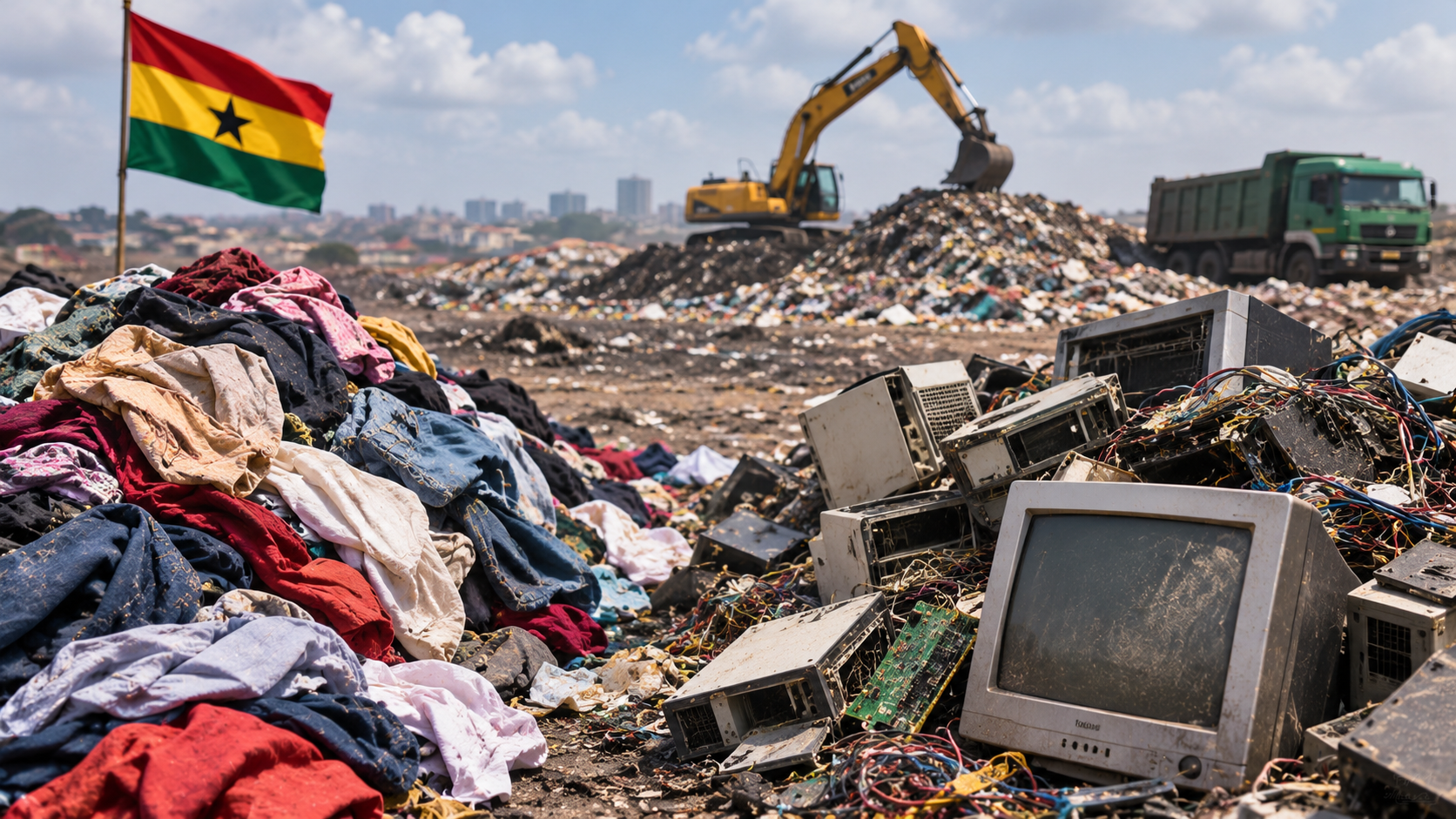
Ghana has launched a major cleanup operation in Accra to tackle toxic waste and create new employment opportunities. The government aims to remove about one million tonnes of rubbish from the Agbogbloshie area.
The three-month initiative also seeks to improve public health and protect the environment.
According to Africanews and AFP, authorities plan to involve informal waste workers in a more organised recycling system.
Officials hope the programme will create up to 20,000 permanent jobs in waste management and the circular economy.
Ghana tackles pollution in Agbogbloshie
Agbogbloshie, near Accra’s Korle Lagoon, has struggled with waste pollution for decades.
Large amounts of discarded electronics, clothing and household rubbish have accumulated in the area.
As a result, nearby communities face growing environmental and health concerns.
Workers often collect valuable materials from old appliances and electronic devices. However, many lack protective equipment.
Some dismantle refrigerators, computers and other products by hand to recover copper, aluminium and iron.
Others burn cables to extract metals, releasing potentially harmful substances into the air.
According to AFP, workers regularly face smoke, dust and hazardous materials.
Health experts warn of toxic exposure
Environmental health experts have raised concerns about pollution in Agbogbloshie.
Burning electronic waste can release dangerous substances, including lead, mercury and other pollutants.
These materials may affect workers and nearby communities through contaminated air, soil and water.
University of Ghana epidemiologist Reginald Quansah warned about the potential effects of long-term exposure.
However, he also noted that researchers have not established direct links between specific illnesses and pollution at the site.
Meanwhile, contaminated runoff enters Korle Lagoon, raising further concerns about water quality and the surrounding environment.
Imported clothing adds to waste crisis
Ghana also faces growing pressure from imported second-hand clothing.
Many garments arrive from Europe, North America and Asia.
Although traders sell some of these products, large quantities remain unsold.
According to Greenpeace Africa, around 15 million used garments enter Ghana each week.
The organisation estimates that roughly half eventually becomes waste.
Greenpeace also warned that many discarded clothes contain synthetic fibres, including polyester.
These materials can release microplastics as they break down. Burning them can also produce harmful emissions.
As a result, environmental groups are calling for greater responsibility across the global clothing industry.
Government launches major cleanup
President John Mahama launched the cleanup programme in September.
The government plans to remove approximately one million tonnes of waste from Agbogbloshie over three months.
Heavy equipment has already begun clearing rubbish from the area.
Authorities intend to transport the collected waste to a landfill about 50 kilometres outside Accra.
According to the report, the waste will be compacted and covered under environmental safeguards.
The operation aims to reduce pollution and improve conditions for nearby communities.
Ghana plans 20,000 waste management jobs
The government also wants to create employment opportunities through the cleanup programme.
Local Government Minister Mahama Ayariga said authorities plan to include informal waste collectors and tricycle operators in the formal recycling sector.
The initiative could create up to 20,000 permanent jobs.
However, the figure remains a government target rather than a confirmed number of new positions.
Officials hope the programme will support recycling businesses while improving waste collection and disposal.
For now, the cleanup represents an effort to address Accra’s pollution challenges while developing a more organised waste management industry.