
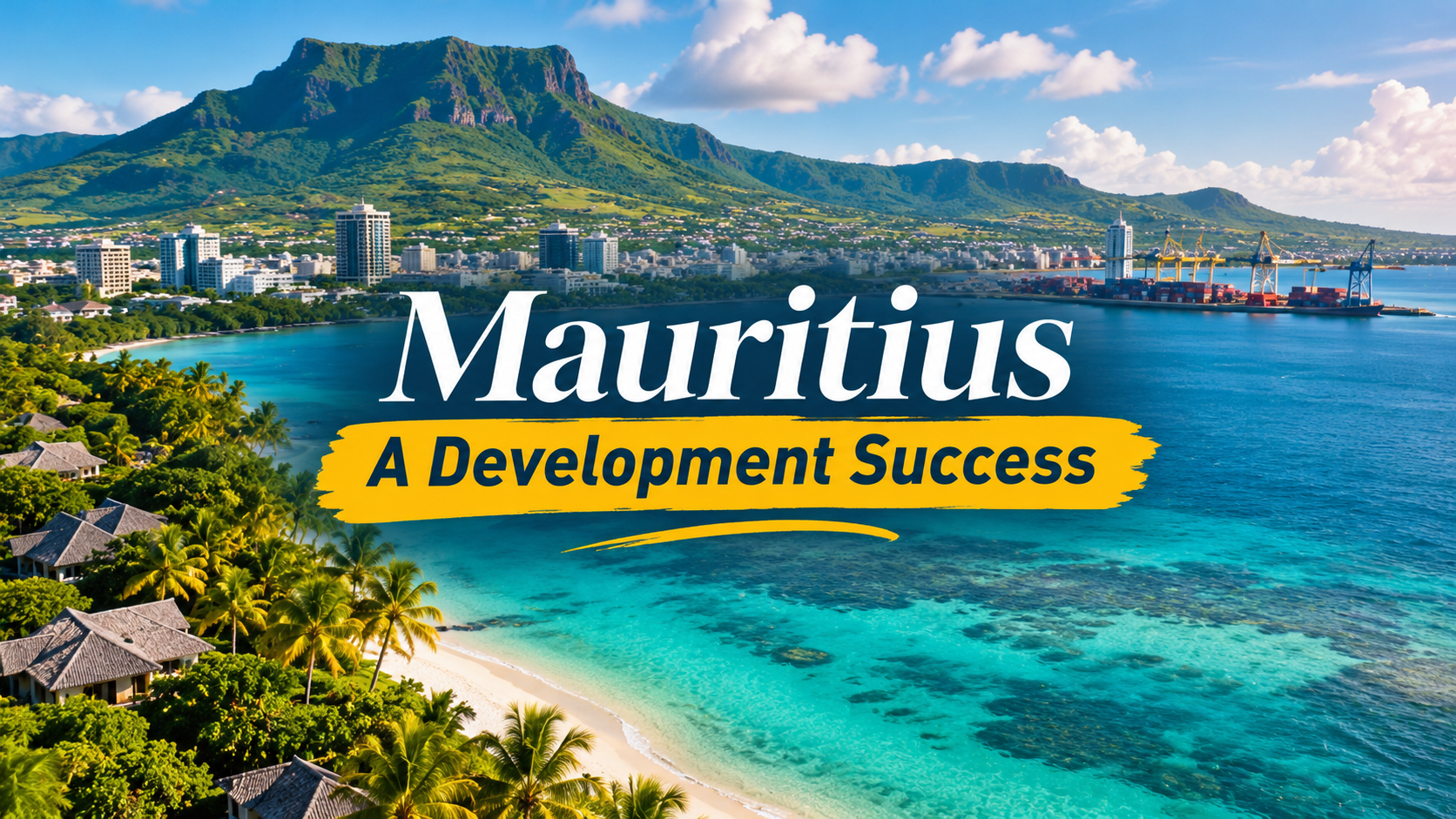
Mauritius is one of Africa’s most remarkable economic success stories. The small island nation transformed itself from a sugar-dependent economy into a major centre for tourism, manufacturing and financial services.
Located in the Indian Ocean, east of Madagascar, Mauritius has a population of approximately 1.3 million people.
Despite its small size and limited natural resources, the country has achieved one of the highest income levels in sub-Saharan Africa.
According to the World Bank, Mauritius briefly reached high-income status in 2020 before the COVID-19 pandemic disrupted its economy.
Today, it remains an upper-middle-income country and an important example of African economic development.
From sugar plantations to economic growth
When Mauritius gained independence from Britain in 1968, its economy depended heavily on sugar production.
At the time, the country’s GDP per capita was approximately $260, according to the World Bank.
Agriculture, mainly sugarcane cultivation, accounted for more than 22% of economic output.
However, Mauritius gradually reduced its dependence on agriculture.
The government encouraged investment in manufacturing and export industries. Textile and clothing production became important sources of employment.
As a result, the country developed new industries and expanded its participation in international trade.
By 2003, agriculture contributed less than 10% of GDP.
Tourism helped transform the economy
Mauritius also recognised the economic potential of its natural environment.
Its beaches, tropical climate and coastal landscapes helped attract international visitors.
Over time, tourism became one of the country’s major economic sectors.
Hotels, restaurants, transport companies and other businesses created employment opportunities.
Tourism also supported investment in airports, roads and public infrastructure.
However, the COVID-19 pandemic demonstrated the risks of relying heavily on international travel.
The country’s economy contracted sharply in 2020 as tourism activity collapsed.
This encouraged renewed efforts to strengthen other industries.
Financial services created new opportunities
Mauritius developed a financial services industry that connects international businesses and investors.
The country attracted companies involved in investment management, business services and cross-border trade.
According to the World Bank, financial services now contribute approximately 14% of national GDP.
Meanwhile, information and communication technology has become another important economic sector.
These developments helped Mauritius expand beyond traditional agriculture and tourism.
The country also invested in education and workforce development to support its growing services economy.
A remarkable rise in national income
One of the most striking facts about Mauritius is how dramatically its income levels have changed.
At independence in 1968, GDP per capita stood at approximately $260.
By 2025, it had reached approximately $12,991, according to World Bank data.
That represents an increase of nearly 50 times in nominal US-dollar terms.
However, this comparison does not account for inflation or changes in purchasing power.
The OECD also reports that Mauritius’s GDP per capita, adjusted for purchasing power, increased more than fivefold between 1990 and the early 2020s.
These figures illustrate the scale of the country’s long-term economic transformation.
Political stability supported development
Mauritius has also benefited from relatively stable political institutions.
Since independence, the country has maintained a multiparty democratic system and held regular elections.
The World Bank and OECD identify effective economic management, public institutions and cooperation between government and businesses as important factors in its development.
Investment in education, healthcare and social protection also supported improvements in living standards.
Furthermore, policies encouraging exports helped businesses reach markets beyond the island’s small population.
Together, these factors supported economic growth over several decades.
Mauritius still faces economic challenges
Despite its achievements, Mauritius faces significant economic pressures.
The country remains vulnerable to international economic shocks because of its small domestic market.
Tourism depends on global travel demand, while manufacturing faces competition from other countries.
An ageing population, skills shortages and slower productivity growth also present challenges.
According to the International Monetary Fund’s July 2026 assessment, public debt remained elevated, while economic growth was expected to slow.
The IMF projected growth of approximately 2.8% in 2026.
Therefore, Mauritius must continue improving productivity, strengthening public finances and developing new industries.
What can Africa learn from Mauritius?
Mauritius demonstrates how economic diversification can help transform a country’s development prospects.
Rather than depending entirely on one agricultural product, the island expanded into manufacturing, tourism, technology and services.
Its experience also highlights the importance of education, infrastructure and long-term economic planning.
However, its development model cannot be copied directly by every African country. Geography, population size, institutions and available resources differ across the continent.
Nevertheless, Mauritius offers an important lesson.
A country does not need enormous mineral deposits or a large population to build a stronger economy.
With effective institutions, investment and economic diversification, even a small island nation can achieve significant development.
Today, Mauritius remains one of Africa’s clearest examples of how sustained economic transformation can improve national prosperity.