
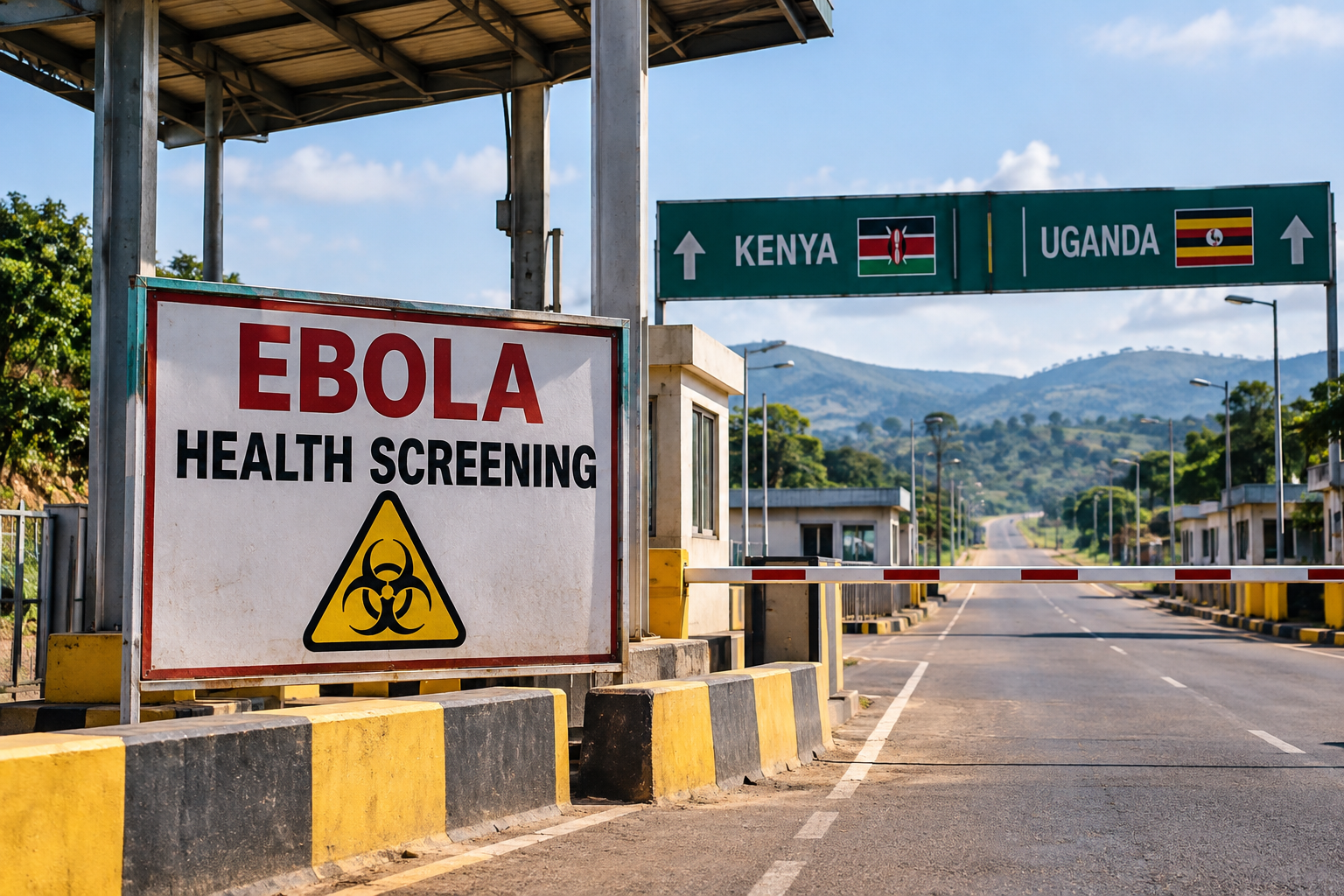
Kenya has increased Ebola screening at its borders following the country’s first reported death from the virus, raising concerns among communities that regularly travel between Kenya and neighbouring Uganda.
The death of a Kenyan businessman who had travelled through the Democratic Republic of Congo (DRC) and Uganda has prompted health authorities to strengthen surveillance at entry points.
Residents in border communities have expressed fears about the possible spread of the disease. However, some remain confident that screening and public health measures can help contain the threat.
According to Africanews and international news agencies, officials are monitoring people who may have come into contact with the deceased.
Border communities express concern over Ebola
Residents near Kenya’s border with Uganda say the reported death has increased anxiety about cross-border travel.
Many people move between the two countries daily for work, business and family visits.
Phelister Nekesa, who recently returned to Kenya from Uganda, expressed concern about travellers entering the country without adequate health checks.
Another cross-border worker, Ramadhan Wahatenze, called for screening measures to extend beyond major border crossings into rural communities.
Their concerns reflect the challenges facing health authorities in areas where frequent movement makes disease surveillance more difficult.
Kenyan officials have pledged to strengthen Ebola screening at entry points following the reported death.
How did the Ebola patient reach Kenya?
Kenya’s Health Minister Aden Duale said the deceased was a 40-year-old businessman who had previously received medical treatment in the DRC.
The man reportedly travelled overland to Uganda’s capital, Kampala, before flying to Nairobi on October 3.
According to the minister, he experienced symptoms including fever, severe fatigue, muscle pain, a sore throat and bleeding beneath the skin near injection sites.
His relatives later took him to a Nairobi hospital, where tests confirmed an Ebola infection.
The patient subsequently died, prompting authorities to begin contact tracing and arrange a burial in accordance with public health safety procedures.
Health officials have questioned how the man was able to travel while experiencing symptoms associated with the disease.
Kenya monitors contacts and flight passengers
Kenyan authorities have identified 28 people who had contact with the deceased, including relatives and healthcare workers.
None had tested positive for Ebola at the time of the latest figures cited in the report.
Officials are also tracing 23 passengers and four crew members who travelled on the same flight as the patient.
Preparations have been made for possible quarantine measures if health authorities determine that individuals face a significant risk of infection.
Health Minister Duale urged the public to remain calm, saying the government had activated measures intended to prevent further transmission.
Patrick Amoth, director general at Kenya’s Health Ministry, emphasised the need for stronger surveillance at border crossings.
He also raised concerns about weaknesses in the screening system that allowed the infected traveller to reach Nairobi.
DRC Ebola outbreak raises regional concerns
Kenya’s response comes amid a major Ebola outbreak in the Democratic Republic of Congo.
The DRC declared its latest outbreak in May 2026, with infections spreading across several provinces in the country’s north and east.
According to World Health Organization figures cited in the report, 8,463 cases and 4,082 deaths had been recorded by October 2.
The outbreak involves the Bundibugyo strain of the Ebola virus.
Healthcare responses have faced difficulties in areas affected by armed violence, displacement and shortages of medical resources.
Médecins Sans Frontières has also warned about a sharp increase in infections in North Kivu province, which borders Uganda.
Uganda previously recorded Ebola infections linked largely to travel from the DRC before authorities declared the country Ebola-free in August.
Africa CDC prepares support for Kenya
The Africa Centres for Disease Control and Prevention is preparing additional assistance for Kenya as health officials work to prevent further infections.
According to the report, an Africa CDC team was expected to travel to the country, with Director General Jean Kaseya also planning a visit.
The agency’s involvement is intended to support national surveillance, preparedness and outbreak response efforts.
Kenyan authorities have stressed that identifying contacts, screening travellers and maintaining public awareness are central to preventing further transmission.
For border communities, the situation highlights the importance of coordinated public health measures between neighbouring countries.
While no additional positive cases had been identified among the initial contacts at the time of reporting, health officials continue to monitor the situation closely.