
A week after Washington celebrated a “historic” peace accord between DR Congo and Rwanda, the agreement has been upended by a dramatic rebel advance that saw the M23 capture the strategic city of Uvira.
The US ambassador to the UN accused Rwanda of steering the Great Lakes region “toward instability and toward war”, saying Kigali’s influence over the rebels was undermining President Donald Trump’s mediation effort.
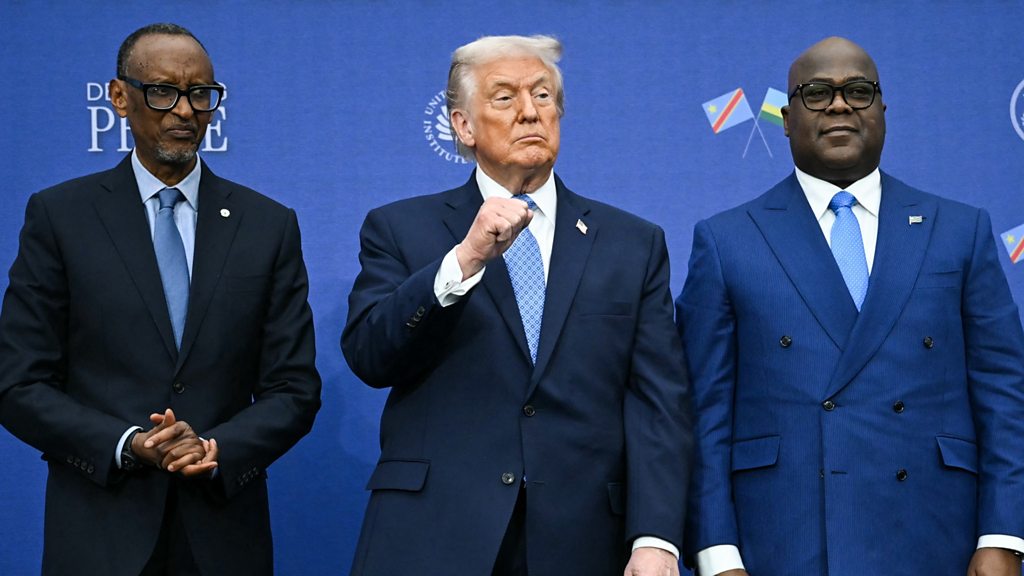
Trump last week hailed the deal signed by DR Congo’s Félix Tshisekedi and Rwanda’s Paul Kagame as “a great day for Africa and the world”. But the M23 — which was not part of the Washington agreement and is engaged in a parallel Qatar-brokered process — said it had “fully liberated” Uvira in an assault Western powers say is backed by Rwanda. Kigali denies any involvement.
Thousands have fled the fighting, including into neighbouring Burundi.
Why Uvira matters
Analysts say the timing reflects an effort by the M23 to increase leverage in negotiations and by Rwanda to counter Tshisekedi, whom Kigali reportedly views as untrustworthy.
Jason Stearns, a Canada-based regional expert, said the Uvira assault “flies in the face of all negotiations under way” and appears to humiliate Washington. The offensive began days before Kagame and Tshisekedi travelled to the US to ratify the deal.
Bram Verelst of the Institute for Security Studies said rebels targeted Uvira — 27km from Burundi’s capital, Bujumbura — to cut off supply corridors used by roughly 10,000 Burundian troops deployed in South Kivu to support the Congolese army.
Uvira, a city of about 700,000, was the government’s last major military hub in South Kivu. Yale Ford of the American Enterprise Institute said the M23 is now positioned to set up a parallel administration and use its gains “as a bargaining chip in peace talks”.
The Congolese government, which has not publicly acknowledged the loss of Uvira, warned the situation risks triggering a regional “conflagration”.
Burundi’s dilemma
Burundi, a long-standing adversary of Rwanda, fears M23 dominance in South Kivu could embolden Red Tabara, a Tutsi-led Burundian rebel group operating from the region. The rebels insist they have “no sights beyond our national borders”.
While Burundi closed its frontier with DR Congo, crossings continue under security checks. Aid agencies estimate about 50,000 displaced civilians have arrived in Burundi over the past week.
Losing access to Uvira — a lifeline for fuel and foreign currency — also threatens Burundi’s fragile economy.
How M23 broke through
The fall of Uvira follows a rapid M23 sweep through eastern DR Congo, including the capture of Goma in North Kivu and Bukavu, South Kivu’s capital.
Stearns estimated the group has more than 10,000 fighters and likely received “an influx” of disciplined Rwandan troops for the Uvira operation. Drone warfare has intensified, with Rwanda-backed units using the technology more effectively than Congolese forces, he said.
Peace process in jeopardy
The US, EU and several European states jointly called for an immediate halt to M23 and Rwandan Defence Force operations, and for Rwanda to withdraw troops from eastern DR Congo.
Stearns said observers were “baffled” by the timing: “As they were signing a peace deal in Washington, Rwandan troops were massing and then advancing on Uvira.”
Rwanda rejected accusations of violating the ceasefire and said DR Congo and Burundian forces had bombed villages near its border. Kigali argued Tshisekedi had “never been ready to commit to peace” and suggested he attended the Washington signing “as if forced”.
Kinshasa accused Kagame of deliberately abandoning the accord and sabotaging Trump’s efforts.
Can the deal survive?
The US-backed agreement required DR Congo to disarm the FDLR — a militia with roots in the 1994 genocide — which Rwanda considers an existential threat. Stearns said he saw “no scenario” in which Congolese forces could launch that operation now.
Plans for joint DR Congo–Rwanda economic cooperation on power, mining and infrastructure — a key pillar of Trump’s strategy to draw US investment into the mineral-rich region — also appear stalled.
Talks in Doha between DR Congo and the M23 are reportedly on hold.
Tshisekedi under pressure
Tshisekedi faces rising public anger over repeated failures to end the eastern conflict. Tensions with the military leadership, already strained by corruption arrests and battlefield defeats, add further pressure.
Stearns said Kinshasa is now relying heavily on Washington — and possibly Qatar — to push Rwanda to withdraw support for the M23.
“It’s going to be very difficult for the Congolese army to muster a response,” he said. “The future of the peace effort depends on how much political capital the brokers are willing to spend.”