
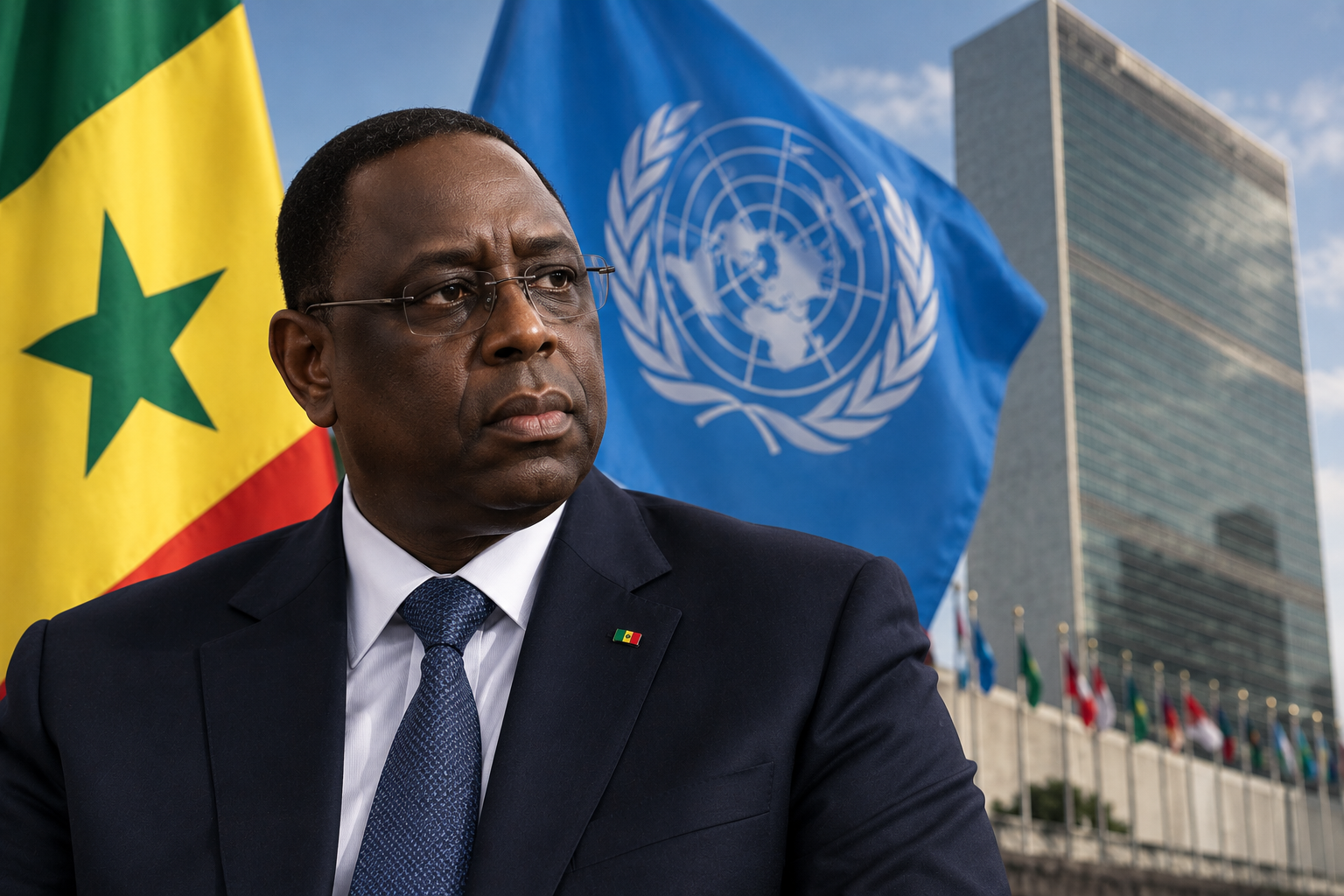
Former Senegalese President Macky Sall has withdrawn from the race to become the next United Nations secretary-general following opposition during an informal Security Council vote.
Sall announced his decision on Saturday, October 17, one day after all seven candidates reportedly received discouraging votes from permanent members of the UN Security Council.
According to Africanews and agencies, the former president said his withdrawal was intended to help other candidates reach a consensus.
The decision leaves Uganda’s Olara Otunnu as the only African candidate remaining in the contest.
Macky Sall withdraws after UN Security Council vote
Sall confirmed his withdrawal in a statement published on social media.
He said he hoped his decision would contribute to the emergence of a consensus candidate.
The announcement followed an informal Security Council poll held on Friday.
During the vote, all seven candidates reportedly received at least one discouraging vote from a permanent Council member.
Although these preliminary votes are not binding, they provide an indication of the level of support for each candidate.
As a result, Sall decided to end his campaign for the UN’s top leadership position.
How the UN secretary-general selection works
The UN Security Council plays a central role in selecting the organisation’s secretary-general.
Candidates must secure at least nine favourable votes from the Council’s 15 members.
However, the five permanent members hold veto powers.
These countries are China, France, Russia, the United Kingdom and the United States.
A negative vote from any permanent member can prevent a candidate from receiving the Council’s recommendation.
The Council conducts informal polls before making its final recommendation.
The UN General Assembly then appoints the secretary-general based on that recommendation.
Sall faced difficulties in earlier voting
The former Senegalese president had already faced challenges during the selection process.
In the first informal poll in July, Sall received six votes in favour.
Seven Council members voted against him, while two abstained.
The result suggested that he had not secured enough support to advance comfortably.
Furthermore, the latest vote highlighted continued disagreements among Security Council members.
Despite these setbacks, Sall remained in the race until Saturday’s announcement.
Senegal eventually supported Sall’s candidacy
Sall’s campaign initially faced uncertainty over support from his home country.
Senegal did not immediately endorse his candidacy.
Instead, Burundi nominated the former president for the position.
However, Senegalese President Bassirou Diomaye Faye later expressed support for Sall.
The endorsement followed a meeting between the two leaders in July.
Nevertheless, the additional diplomatic backing did not secure sufficient support within the Security Council.
Uganda’s Olara Otunnu remains Africa’s candidate
Sall’s withdrawal leaves Uganda’s Olara Otunnu as the only African contender in the race.
However, candidates from Latin America remain prominent in the selection process.
An informal regional rotation tradition has influenced discussions about who should lead the United Nations next.
Under that convention, many observers expect the next secretary-general to come from Latin America.
The practice is not a formal requirement.
Therefore, candidates from other regions can still compete for the position.
Rebecca Grynspan leads informal voting
Costa Rica’s Rebecca Grynspan received seven favourable votes in Friday’s informal poll, according to Africanews.
However, she also received five discouraging votes.
Two of those reportedly came from permanent Security Council members.
The results highlight the difficulty of securing broad agreement among the Council’s members.
Further informal voting rounds are expected before the final selection.
Consequently, the outcome remains uncertain.
What happens next in the UN leadership race?
The withdrawal of Macky Sall reduces the number of candidates seeking to lead the United Nations.
It also leaves Africa with one remaining contender.
Meanwhile, Security Council members must continue negotiations to identify a candidate who can secure sufficient support.
The selection process is expected to continue through further voting rounds.
Although several candidates have received favourable votes, opposition from permanent members remains a significant obstacle.
For now, Sall has stepped aside, saying he hopes the decision will help the Council reach an agreement on the organisation’s next leader.