
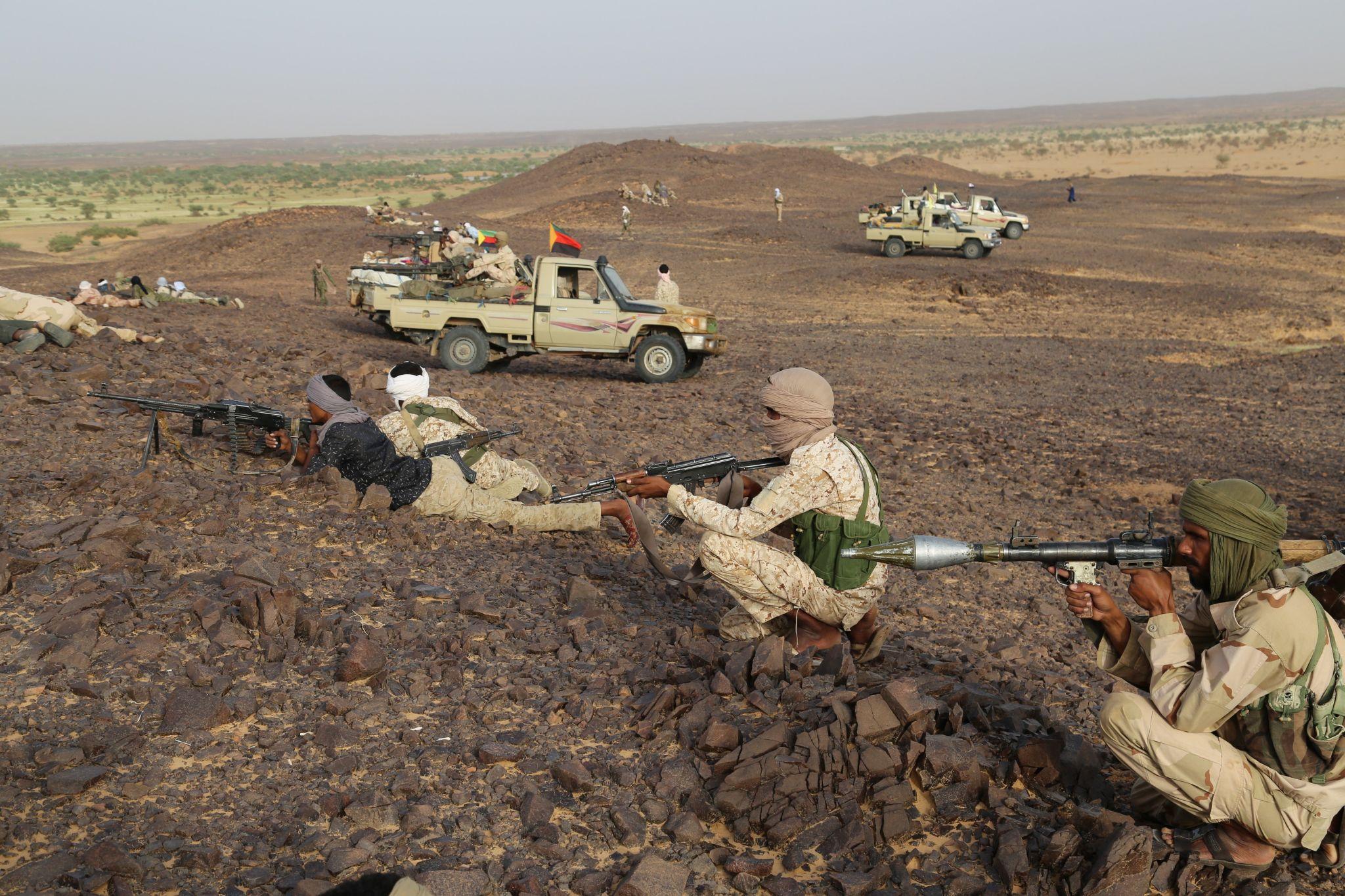
Mali’s military authorities are seeking additional foreign support after a deadly ambush near Tabarichat killed dozens of government soldiers and deepened concerns over the junta’s strategy in the country’s increasingly volatile north.
The July 18 attack took place near the village of Tabarichat, south of Anefis, as a Malian army convoy travelled through the desert region. The Azawad Liberation Front said more than 50 soldiers were killed and at least 25 others captured.
Videos circulated widely on social media days later, appearing to show the bodies of Malian troops lying in the desert and in a mass grave as vehicles carrying Azawad fighters passed through the area.
The footage caused widespread shock in Bamako and intensified scrutiny of the military government, which relies heavily on support from Russia’s Africa Corps as it attempts to regain control of northern Mali.
A former government minister, speaking anonymously, said the losses had shaken public confidence and raised doubts about the junta’s military strategy.
According to French newspaper Le Figaro, Africa Corps personnel travelling ahead of the convoy did not return to assist the Malian soldiers after the ambush. It remains unclear whether the Russian units were unable or unwilling to intervene.
The Tabarichat attack was part of a broader escalation involving the al-Qaeda-linked Jama’at Nusrat al-Islam wal-Muslimin, known as JNIM, and the Azawad Liberation Front.
Despite their different political and ideological objectives, the two groups have recently coordinated some operations against Malian government forces.
Andrew Lebovich, a specialist on the Sahel at the Clingendael Institute in the Netherlands, said the cooperation indicated growing confidence among JNIM fighters and suggested the alliance with Azawad forces remained effective for the time being.
Battle for Anefis
Earlier in July, JNIM and Azawad fighters launched a major assault on Anefis, a strategically important town controlling routes between Gao, Kidal and Mali’s far north.
The attackers initially entered parts of the town, but a large military base defended by the Malian army and Africa Corps troops resisted repeated attacks involving mortars and explosive drones.
Government forces eventually received reinforcements from Gao and broke the siege. The armed groups withdrew on July 9, allowing Bamako to present the battle as a victory.
However, analysts said the government forces had narrowly avoided a far more serious defeat.
“Anefis is a strategic centre controlling access to the entire far north while also protecting Gao to the south,” Lebovich said.
Gao remains the Malian government’s principal military base in northern Mali and houses key air force operations.
Anefis is also vital for access to Aguelhok, one of the northernmost locations where Malian and Russian forces remain deployed despite mounting pressure from JNIM.
Kidal setback
The wider struggle centres on Kidal, a city with enormous symbolic importance for both the Malian state and Tuareg-led armed groups.
Kidal’s capture by rebels in 2012 contributed to the collapse of state authority across northern Mali. French forces later advanced towards the city during Operation Serval but did not remove Azawad fighters, a decision that fuelled years of anger and accusations of betrayal in Bamako.
Mali’s military, which seized power in a 2020 coup, used those grievances to justify the expulsion of French troops and the deployment of Russia’s Wagner Group.
The junta gained considerable domestic support after Malian forces and Wagner fighters captured Kidal in 2023. The operation became central to the government’s claims that it had restored national sovereignty.
That narrative suffered a major blow in April, when an alliance of armed groups retook the city and forced Africa Corps units to withdraw.
Wassim Nasr, a researcher at the Soufan Center, described the loss as a significant setback for the military government.
“Kidal was the jewel in the junta’s crown,” he said.
The northern offensive coincided with attacks near Bamako and the military stronghold of Kati. Those operations reportedly killed Defence Minister General Sadio Camara, one of the most influential figures in the military leadership.
Although the attackers later withdrew and the government remained in power, the combined loss of Camara and Kidal damaged the junta’s standing.
“Since then, the military council has been weakened,” the former minister said. “The death of Sadio Camara and the loss of Kidal undermined its prestige among the population.”
Pressure on Goita
Interim President Assimi Goita has reportedly made a northern counteroffensive a top priority, despite growing militant activity around Bamako and in southern Mali.
Nasr said the decision to concentrate military resources in northern areas such as Anefis appeared to be driven largely by political considerations.
The deteriorating situation has also caused concern in Europe and the United States.
According to The Washington Post, US President Donald Trump has not ruled out the possibility of American airstrikes in Mali.
Any further foreign military involvement would mark a major escalation in a conflict already involving Mali’s armed forces, Russian personnel, Tuareg-led factions and al-Qaeda-linked fighters.