
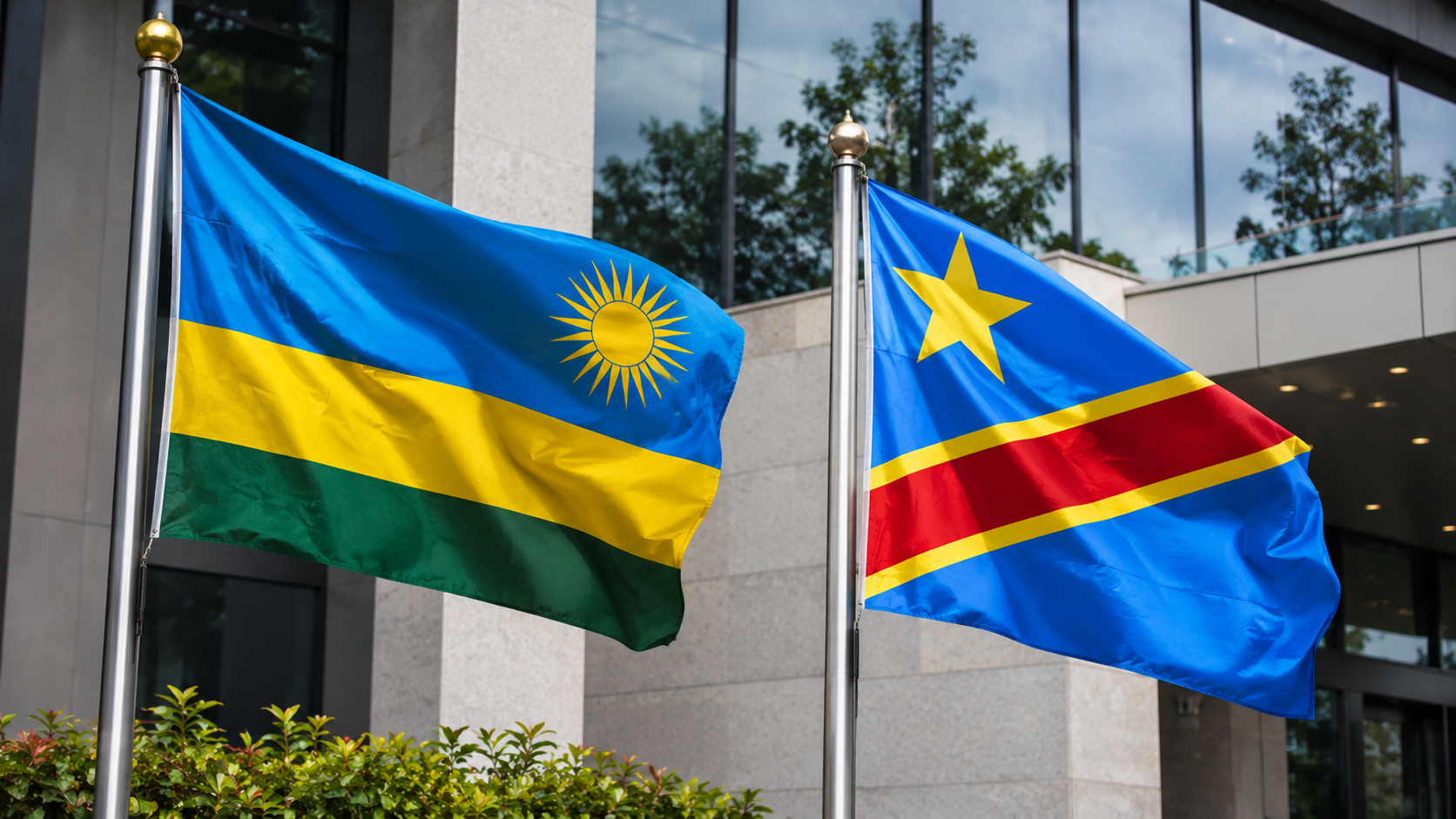
Rwanda and the Democratic Republic of the Congo (DRC) remain divided over key security commitments, raising concerns about delays in implementing their US-backed peace agreement.
Another round of talks is reportedly expected in Geneva on November 19. However, the meeting has not been independently confirmed.
According to Al Jazeera, the main disagreement concerns the Democratic Forces for the Liberation of Rwanda (FDLR) and Rwanda’s military presence and defensive measures in eastern DRC.
Both governments say they are taking steps towards peace. However, they disagree over whether those actions fulfil their obligations.
Rwanda-DRC peace agreement remains stalled
The Washington Accords, signed in December 2025, build on earlier agreements between Rwanda and the DRC.
The framework requires both countries to respect territorial integrity, end support for armed groups and implement security measures.
It also calls for the neutralisation of the FDLR and the withdrawal of Rwandan forces alongside the lifting of defensive measures.
A joint security mechanism oversees implementation, with participation from the DRC, Rwanda, the United States, Qatar and African Union representatives.
However, previous meetings have focused largely on monitoring and verification.
The two governments have yet to agree on how to measure compliance with their commitments.
Rwanda and DRC disagree over FDLR
Rwanda says the FDLR remains active in eastern DRC.
Kigali also alleges that the group continues cooperating with Congolese forces and other armed groups.
Rwandan officials argue that ending this alleged cooperation is essential to implementing the agreement.
Meanwhile, Kinshasa points to its efforts to disarm FDLR fighters.
In July, Congolese authorities announced a disarmament and demobilisation protocol with a faction of the group’s armed wing.
However, Rwanda rejected the arrangement.
Kigali argues that an agreement involving one faction does not demonstrate that the wider organisation has been neutralised.
As a result, the two sides remain divided over what constitutes meaningful progress.
US sanctions increase pressure on Rwanda
The dispute intensified after Washington imposed sanctions on Rwanda’s Ministry of Defence and Zigama Credit and Savings Society on October 28.
According to Al Jazeera, US authorities accused the ministry of supporting M23 operations in eastern DRC.
Washington also alleged that Zigama helped facilitate financial and logistical support for Rwandan military activities.
Rwanda rejected the allegations.
Kigali maintains that its concerns about the FDLR remain unresolved and has called for accountability from all parties.
The sanctions have added another complication to an already difficult diplomatic process.
M23 negotiations follow separate peace track
Alongside the Rwanda-DRC peace process, Qatar has facilitated negotiations involving Kinshasa and the M23-linked political-military coalition.
The Doha process addresses ceasefire monitoring, humanitarian access, disarmament and security arrangements.
However, the political structure involved in those negotiations has changed.
In October, the Front for the Refoundation of the Nation (FRN) announced that it was replacing the AFC/M23 political-military structure.
The new movement said it would assume the coalition’s existing commitments under the Doha process.
Nevertheless, questions remain about representation and responsibility for implementing those commitments.
Mineral partnership adds economic dimension
The United States and the DRC also signed a strategic economic partnership in December 2025.
The agreement focuses on investment, infrastructure and critical minerals, including copper and cobalt.
Washington wants to strengthen mineral supply chains, while Kinshasa is seeking tangible investment.
However, the economic partnership does not resolve the security disagreements affecting eastern DRC.
Can the peace process move forward?
The Rwanda-DRC peace process faces a familiar challenge: translating diplomatic agreements into verifiable action.
Previous regional agreements have struggled to address armed groups and competing security concerns.
The reported Geneva talks could provide another opportunity to clarify implementation requirements.
However, progress will depend on whether both governments can agree on measurable security commitments.
Until then, communities in eastern DRC continue to face uncertainty over the prospects for lasting peace.