
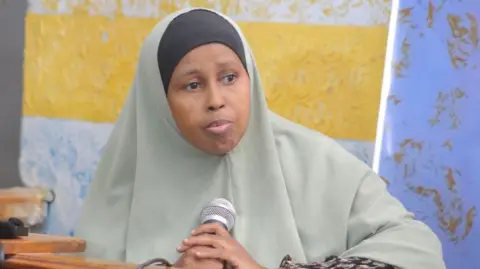
Authorities in Puntland have executed a woman convicted of murdering a 14-year-old girl, in a rare case in which the death penalty has been carried out against a woman in the semi-autonomous Somali region.
Hodan Mohamud Diiriye, 34, was executed by firing squad on Tuesday in the city of Galkayo after a court found her guilty of beating to death a teenage girl who had been working as a domestic helper.
The victim, Saabirin Saylaan, was killed in November, a crime that sparked public outrage and protests in Galkayo, with demonstrators calling for justice and stronger protections for children.
Officials said the sentence was carried out under “qisas,” an Islamic legal principle that allows the family of a murder victim to demand execution rather than accept financial compensation. Local authorities in Mudug region, where the crime took place, enforce Islamic law in such cases.
Mudug Governor Faysal Sheikh Ali said members of both the victim’s family and Diiriye’s family were present during the execution.
Puntland authorities said this was the first time in more than a decade that a woman had been executed in the region under a retaliatory sentence. The last known execution of a woman occurred in 2013, when members of the Islamist militant group al-Shabab, including one woman, were executed for their involvement in the killing of a prominent Islamic scholar.
Investigators said Saabirin had been orphaned at a young age and was later placed in Diiriye’s household to work as a domestic helper. Police said that during the two months she lived there, the girl was subjected to routine physical abuse, including beatings and torture.
Authorities recovered videos and audio recordings from Diiriye’s phone documenting repeated violence against the child. Some of the material was leaked publicly before the trial, though it remains unclear who released it.
A post-mortem examination found that Saabirin suffered multiple injuries and deep stab wounds consistent with prolonged abuse.
As details of the case emerged, hundreds of women and young people staged demonstrations in Galkayo, carrying signs demanding justice for Saabirin and urging authorities to prosecute anyone involved.
The case has renewed calls from activists, elders, and community leaders for greater accountability and stronger protections for children and domestic workers, who are often vulnerable to abuse in Somalia.