
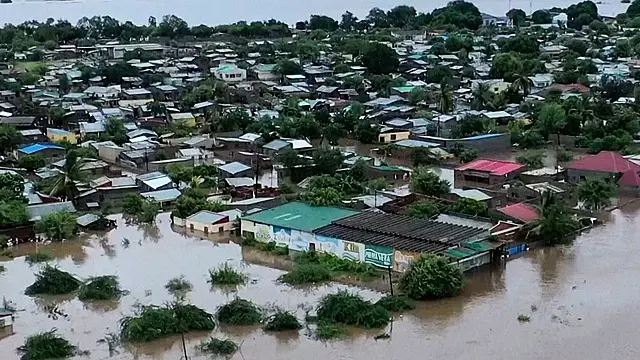
South Africa declared a national disaster Sunday after relentless floods killed dozens and destroyed homes across the country.
Heavy rains and storms battered northeastern Limpopo and Mpumalanga provinces for weeks, claiming more than 30 lives and displacing countless families.
Rivers overflowed and swallowed entire neighbourhoods in Mozambique, forcing thousands to seek shelter on rooftops and in trees amid rising waters.
In one extraordinary case, a woman gave birth on a roof while her family awaited rescue for four harrowing days.
“I classify the disaster as a national disaster,” said Elias Sithole, head of South Africa’s National Disaster Management Centre.
Authorities continued searching for survivors and recovering bodies as floodwaters began to recede in some areas, including the famed Kruger National Park.
The park, closed Thursday due to flooding, announced that day visitation would resume Monday, while urging visitors to exercise caution.
Rescue operations in Mozambique remained slow, leaving many stranded and vulnerable, with at least eight confirmed deaths since December 21.
Chauna Macuacua, a resident of Gaza province north of Maputo, said her nephew was born on a roof at 11 PM Thursday.
“My sister-in-law gave birth, and we still haven’t received any rescue or assistance for them,” she told AFP.
Civil society director Wilker Dias warned that the death toll would likely rise as reports of missing people continued to emerge.
South Africa dispatched rescue teams to southern Mozambique after floodwaters swept away a car carrying five local officials in Chokwe.
According to Mozambican government data, more than 173,000 people have been affected nationwide, with homes and livelihoods washed away.
The storms serve as a stark reminder of climate-related disasters hitting southern Africa, leaving communities exposed and struggling for survival.
Officials urged continued vigilance as recovery and relief efforts intensified across both nations, aiming to reach the most isolated and vulnerable areas.