
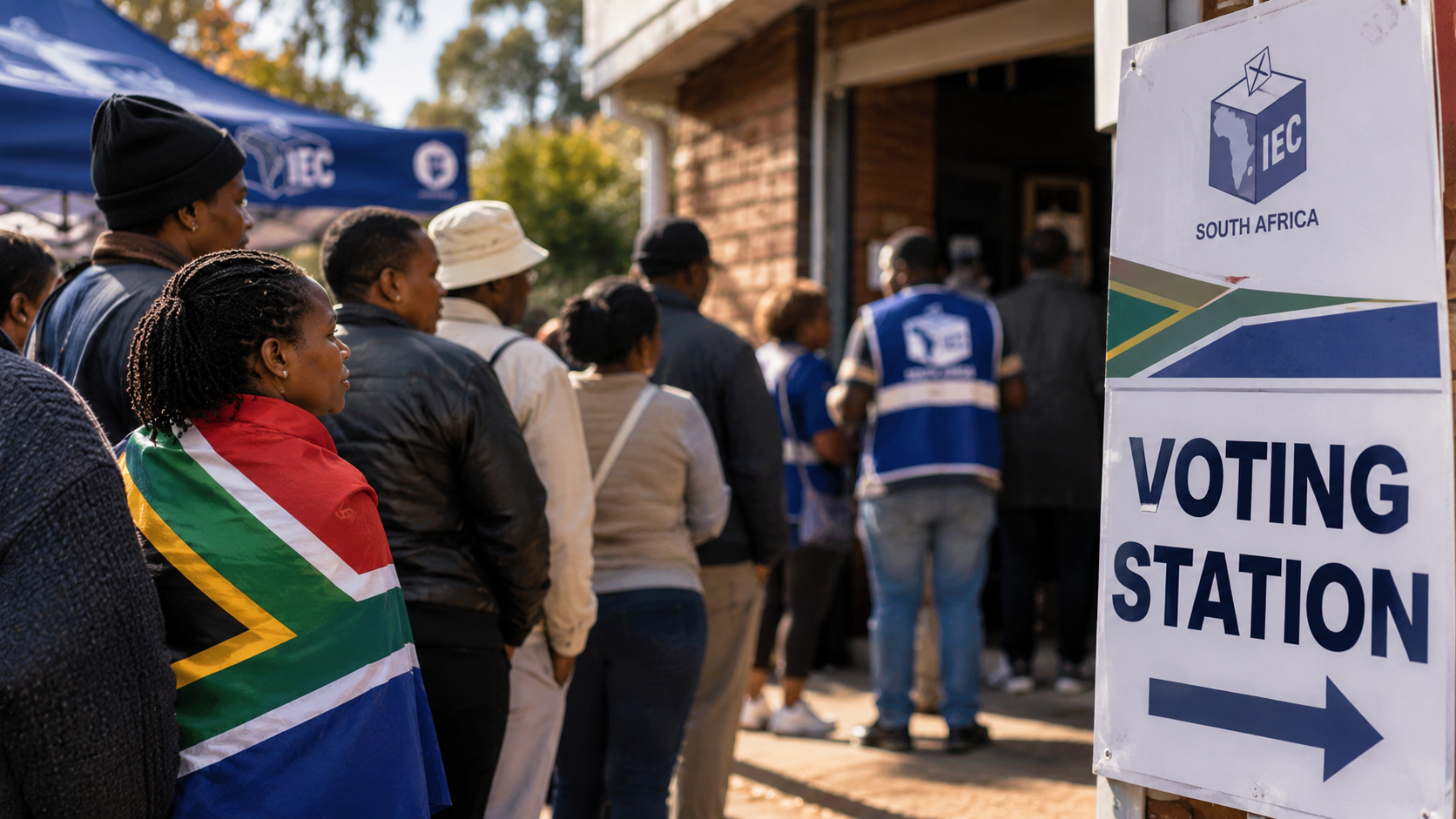
Millions of South Africans are voting in local elections on Wednesday, November 4, amid growing frustration over failing public services and declining support for the African National Congress (ANC).
The elections will determine control of municipalities across the country. They also represent a major political test for President Cyril Ramaphosa, whose party has experienced significant electoral losses in recent years.
According to South Africa’s Electoral Commission (IEC), a record 29.2 million people have registered to vote.
Polling stations opened at 7am local time and are scheduled to close at 9pm. More than 1.4 million special votes were cast on Monday and Tuesday.
Al Jazeera reported on Wednesday, drawing on Reuters and Associated Press reporting, that the elections could further weaken the ANC as voters demand improvements in essential services.
Voters demand better public services
Many South African communities continue to struggle with unreliable water supplies, electricity disruptions, damaged roads and poor waste collection.
These problems have increased public dissatisfaction with local authorities.
President Ramaphosa acknowledged the challenges in his weekly newsletter, From the Desk of the President.
“Municipal failures have contributed to declining public trust and confidence in democratic governance,” he said.
Voters are choosing representatives for eight metropolitan municipalities, 44 district councils and 205 local councils.
The elected councils will then determine municipal leadership, including the appointment of mayors.
For many voters, the main concern is whether local authorities can improve everyday living conditions.
ANC faces declining electoral support
The ANC has governed South Africa nationally since the country’s first democratic elections in 1994.
However, its political dominance has weakened over the past decade.
In the 2021 municipal elections, the party fell below 50% of the vote for the first time in a local election.
The decline continued in the 2024 national elections, when the ANC lost its parliamentary majority.
Consequently, the party formed a coalition government with the Democratic Alliance (DA) and other political groups.
According to polling cited by Al Jazeera, ANC support could fall below 40% in the latest municipal elections.
Such an outcome could force the party to negotiate further coalition agreements to maintain control of major cities.
Johannesburg becomes key election battleground
Johannesburg, South Africa’s financial centre, is among the most closely watched contests.
The city has experienced considerable political instability, with five mayors serving over the past four years.
The Democratic Alliance has nominated former party leader Helen Zille, 75, as its mayoral candidate.
Her campaign has focused on deteriorating infrastructure, water shortages and unreliable municipal services.
A News24 opinion poll placed Zille’s support at approximately 36%.
However, that level of support would likely require her party to negotiate with other political groups to secure the mayoralty.
The ANC and several smaller parties are also competing for influence in the city.
Zuma’s MK party challenges rivals in Durban
Former President Jacob Zuma’s uMkhonto weSizwe (MK) party is participating in municipal elections for the first time.
The party is expected to challenge established political groups in Durban and other parts of KwaZulu-Natal.
Speaking to supporters in Durban on Sunday, Zuma promised to strengthen his party’s influence.
“We are going to start by taking back our country here,” he said, according to AFP.
Migration, unemployment and economic concerns have also featured prominently in the campaign.
Meanwhile, competition between the ANC, DA, MK and smaller parties could produce more municipalities governed by coalitions.
Security tightened around polling stations
South African authorities have increased security measures following reports of election-related incidents.
Police recorded 21 election-related cases since Sunday.
In KwaZulu-Natal, authorities classified 165 voting stations as high-risk locations, the highest number in any province.
Election officials are also monitoring voter participation.
Only 46% of registered voters participated in the 2021 municipal elections, raising concerns about another low turnout.
According to the Mapungubwe Institute for Strategic Reflection, 74 of South Africa’s 257 municipalities were governed by coalitions or minority administrations as of February.
This reflects the growing importance of political cooperation at the local level.
Election results could reshape South African politics
Final results are expected on Sunday, November 8.
The outcome will determine which parties control municipal councils and whether the ANC can retain its influence in major urban centres.
The results could also shape internal discussions ahead of the ANC’s leadership conference in December 2027.
However, the immediate priorities for many South Africans remain access to reliable water, electricity, sanitation and other essential services.
The elections will give voters an opportunity to decide which parties they believe can address these challenges and improve local governance.