
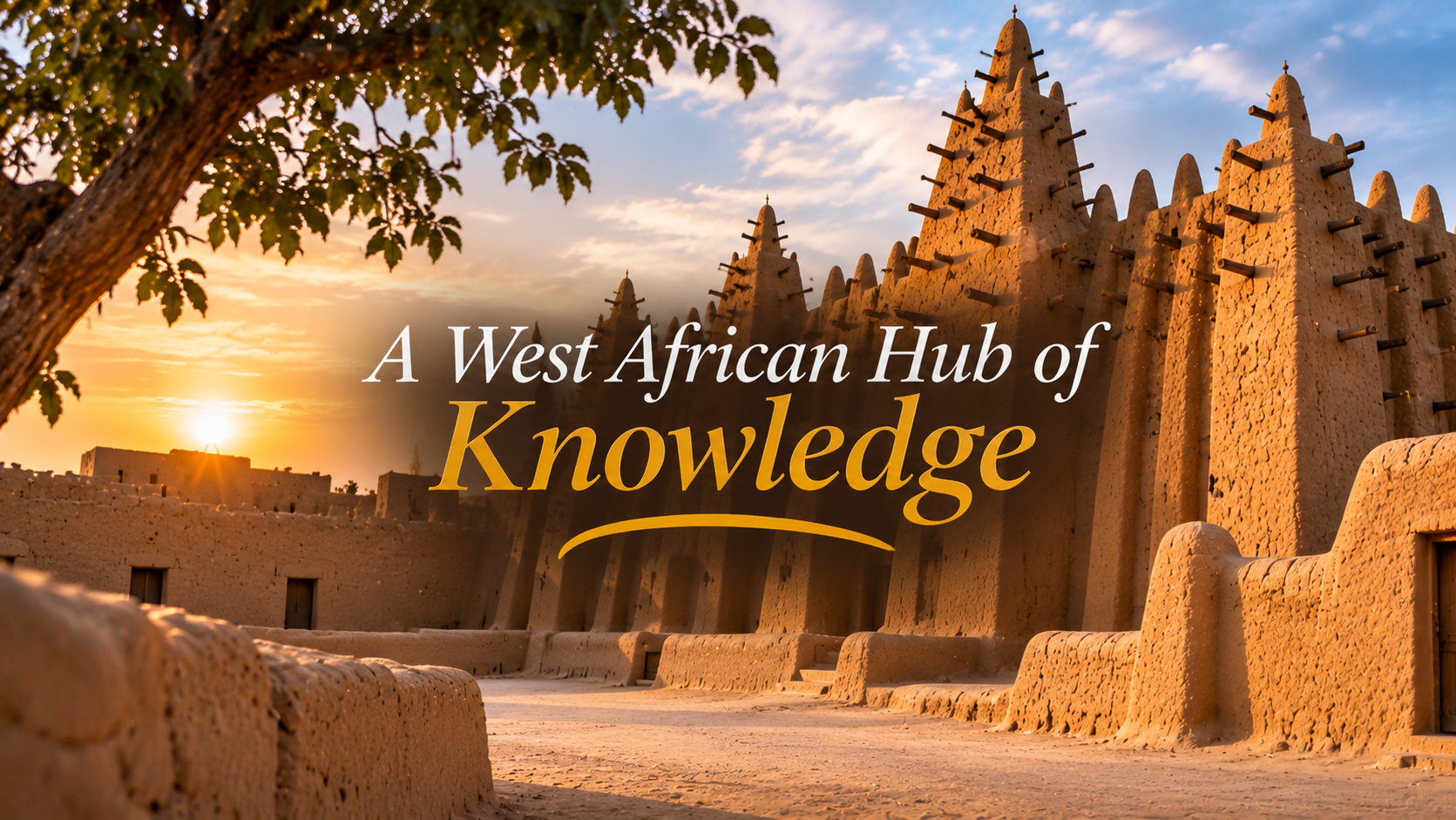
Lorem ipsum dolor sit amet, consectetur adipiscing elit, sed do eiusmod Did you know that Timbuktu, a city in present-day Mali, was once one of Africa’s most important centres of education and scholarship?
Today, Timbuktu is often associated with a distant or mysterious place. However, centuries ago, it was a thriving city where scholars studied, taught and exchanged knowledge.
During the 15th and 16th centuries, Timbuktu became a major intellectual centre in West Africa.
Students and scholars travelled there to study religion, mathematics, astronomy, law and other subjects.
How Timbuktu became a centre of learning
Timbuktu’s rise was closely linked to trade across the Sahara Desert.
Merchants transported gold, salt, textiles and other goods through the region.
As trade expanded, the city grew wealthier and developed into an important cultural and religious centre.
Education became a major part of its identity.
Scholars taught in mosques, private homes and study circles. Students often learned directly from respected teachers.
The city became especially famous for its Islamic scholarship.
The famous Sankore learning centre
One of Timbuktu’s best-known educational institutions was Sankore Mosque.
It became associated with a network of scholars and advanced religious education.
Today, Sankore is sometimes described as an ancient university.
However, it did not operate like a modern university with a single administration and formal departments.
Instead, education was organised through individual teachers and scholarly networks.
Students studied subjects such as Islamic law, Arabic grammar, logic and astronomy.
Timbuktu’s intellectual influence extended beyond Mali into other parts of North and West Africa.
Thousands of manuscripts preserved African knowledge
Perhaps the most remarkable evidence of Timbuktu’s scholarly history is its manuscript tradition.
Over centuries, scholars and families collected and preserved handwritten works.
These manuscripts covered subjects including theology, law, mathematics, astronomy, medicine, history and poetry.
Many were written in Arabic, while others reflected African languages and intellectual traditions.
The manuscripts demonstrate that West Africa had a rich written scholarly culture long before European colonial rule.
Some collections remained in private family libraries for generations.
Timbuktu’s manuscripts survived centuries of danger
Timbuktu’s historical manuscripts have faced numerous threats.
These include political instability, environmental damage and armed conflict.
During the 2012 occupation of northern Mali by armed groups, many manuscripts were at risk.
Local librarians, families and preservation specialists helped move large numbers of manuscripts to safer locations.
Their efforts protected an important part of Africa’s intellectual heritage.
However, preserving the collections remains a major challenge.
Why Timbuktu’s history matters today
Timbuktu’s story challenges the misconception that Africa lacked major centres of scholarship before the modern era.
Its scholars participated in intellectual networks that connected West Africa with North Africa and the wider Islamic world.
The city also shows how trade, education and culture can develop together.
Although Timbuktu’s political and economic importance declined over time, its historical legacy remains significant.
The real fun fact? Centuries before modern universities spread across much of the world, scholars in Timbuktu were already studying astronomy, mathematics and law, while building libraries that preserved knowledge for future generations. incididunt ut labore et dolore magna aliqua. Ut enim ad minim veniam, quis nostrud exercitation ullamco laboris nisi ut aliquip ex ea commodo consequat. Duis aute irure dolor in reprehenderit in voluptate velit esse cillum dolore eu fugiat nulla pariatur. Excepteur sint occaecat cupidatat non proident, sunt in culpa qui officia deserunt mollit anim id est laborum.