
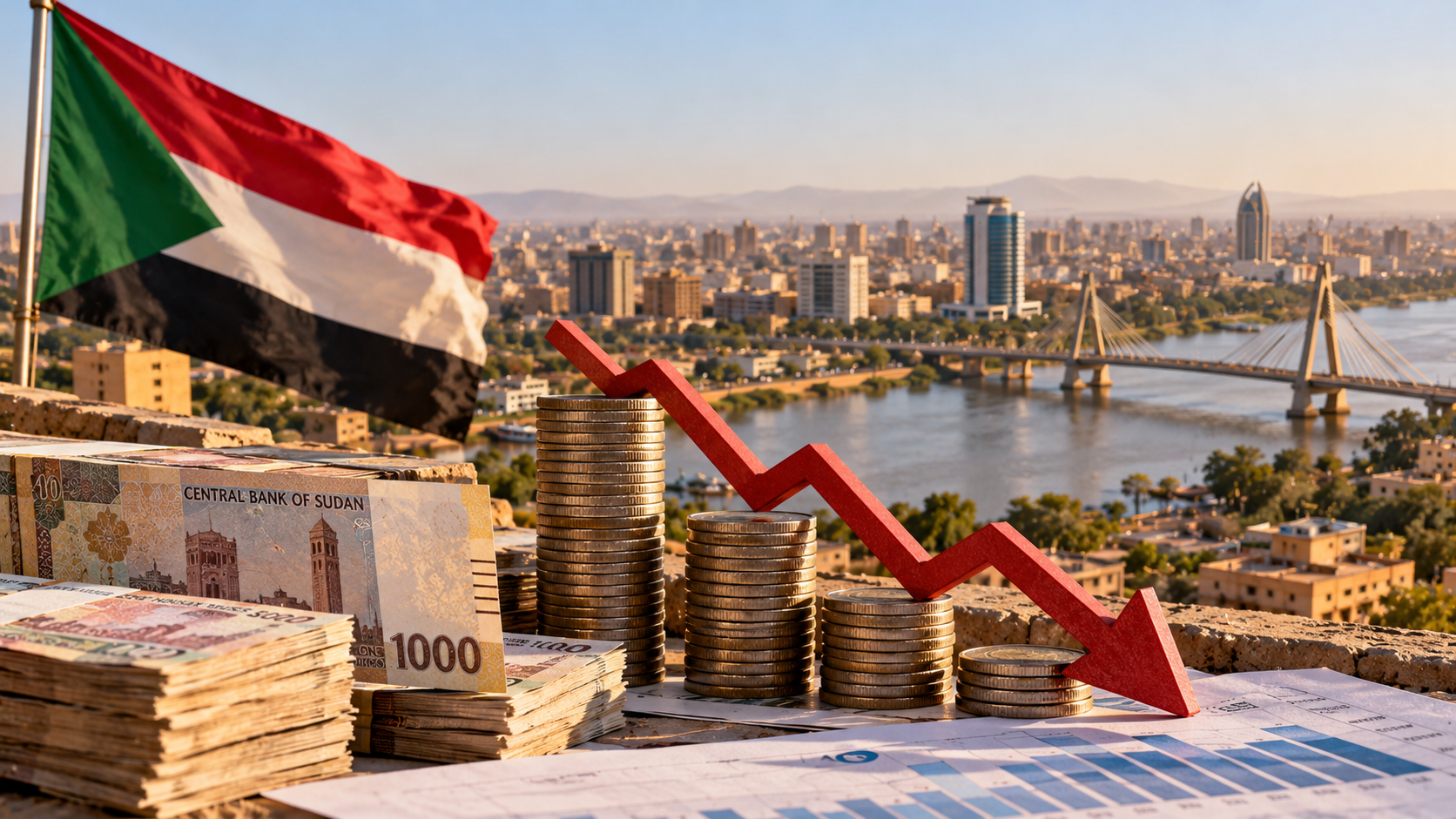
Sudan has recorded the world’s highest government debt-to-GDP ratio in 2026, with public debt estimated at 334.4% of the country’s economic output.
The figure comes from the International Monetary Fund’s (IMF) October 2026 World Economic Outlook estimates. It highlights the scale of Sudan’s financial challenges after more than three years of conflict and economic disruption.
The debt ratio means Sudan’s government liabilities are estimated at more than three times the value of goods and services produced by its economy in a year.
However, the figure does not mean Sudan owes more money than any other country. Instead, it measures the size of public debt relative to the national economy.
Sudan leads global debt rankings
The IMF’s latest estimates place Sudan ahead of other heavily indebted economies.
Sudan’s projected debt-to-GDP ratio stands at 334.4%, compared with approximately 199.4% for Japan and 166.4% for Singapore.
The figures measure gross government debt as a percentage of gross domestic product (GDP).
This indicator helps economists assess the scale of government borrowing relative to economic activity.
However, debt ratios alone do not determine whether a country can repay its obligations.
A government’s financial position also depends on its revenue, borrowing costs, foreign currency reserves and access to financing.
For Sudan, the unusually high ratio reflects the severe economic pressures facing the country.
Conflict deepens Sudan’s economic crisis
Sudan’s economy has faced major disruption since fighting began in April 2023.
The conflict has affected agriculture, industry, trade and transport across several regions.
Businesses have struggled to maintain operations, while displacement has reduced economic activity and disrupted local markets.
Damage to infrastructure and interruptions to public services have created additional financial pressures.
Meanwhile, millions of Sudanese have been forced to leave their homes, weakening household incomes and increasing humanitarian needs.
These challenges have reduced the country’s economic output and complicated efforts to restore financial stability.
A shrinking economy can also push the debt-to-GDP ratio higher, even without an equivalent increase in borrowing.
As a result, Sudan’s debt burden reflects both existing financial obligations and the sharp decline in economic activity.
High debt limits economic recovery
Sudan’s debt burden presents significant challenges for rebuilding the economy.
Large government liabilities can restrict access to affordable international financing.
They can also make it harder to fund healthcare, education, infrastructure and other essential services.
At the same time, the country faces urgent humanitarian and reconstruction needs.
Restoring agricultural production, reopening businesses and improving transport networks will require substantial investment.
However, financial recovery remains difficult while insecurity and economic disruption continue.
A sustained improvement in economic conditions would help strengthen public revenue and reduce pressure on government finances.
Sudan previously qualified for debt relief
Sudan reached the decision point under the Heavily Indebted Poor Countries (HIPC) Initiative in June 2021.
The programme, supported by the IMF and World Bank, was designed to help eligible countries reduce unsustainable external debt.
At the time, Sudan’s progress towards debt relief was viewed as an important step in its economic recovery.
However, subsequent political instability and the outbreak of war complicated the country’s financial outlook.
The latest debt estimates underline the continuing importance of international financial support and long-term economic recovery.
Any sustainable solution would need to address existing debt obligations alongside the country’s weakened productive capacity.
IMF warns of rising global debt
Sudan’s financial challenges come amid wider concerns about government borrowing around the world.
The IMF has warned that global public debt could exceed 100% of economic output before the end of the decade.
Higher borrowing costs and growing repayment obligations are placing pressure on government budgets.
Developing economies are particularly vulnerable when financial pressures combine with conflict, displacement and limited access to international funding.
However, the impact differs significantly between countries.
Some governments have stronger financial reserves and greater access to domestic borrowing.
Others face more severe difficulties because of economic instability and limited public revenue.
Economic stability remains essential
Sudan’s debt-to-GDP ratio highlights the scale of the country’s economic difficulties.
However, the 334.4% figure is an estimate for 2026 rather than a final year-end result.
The country’s longer-term financial outlook will depend on several factors, including economic recovery, improved trade and access to international support.
Restoring livelihoods and strengthening essential services will also be important for rebuilding economic confidence.
For now, Sudan faces the combined challenge of managing a heavy debt burden and recovering from years of conflict.
Progress towards stability and sustained economic activity will be central to improving the country’s financial future.