
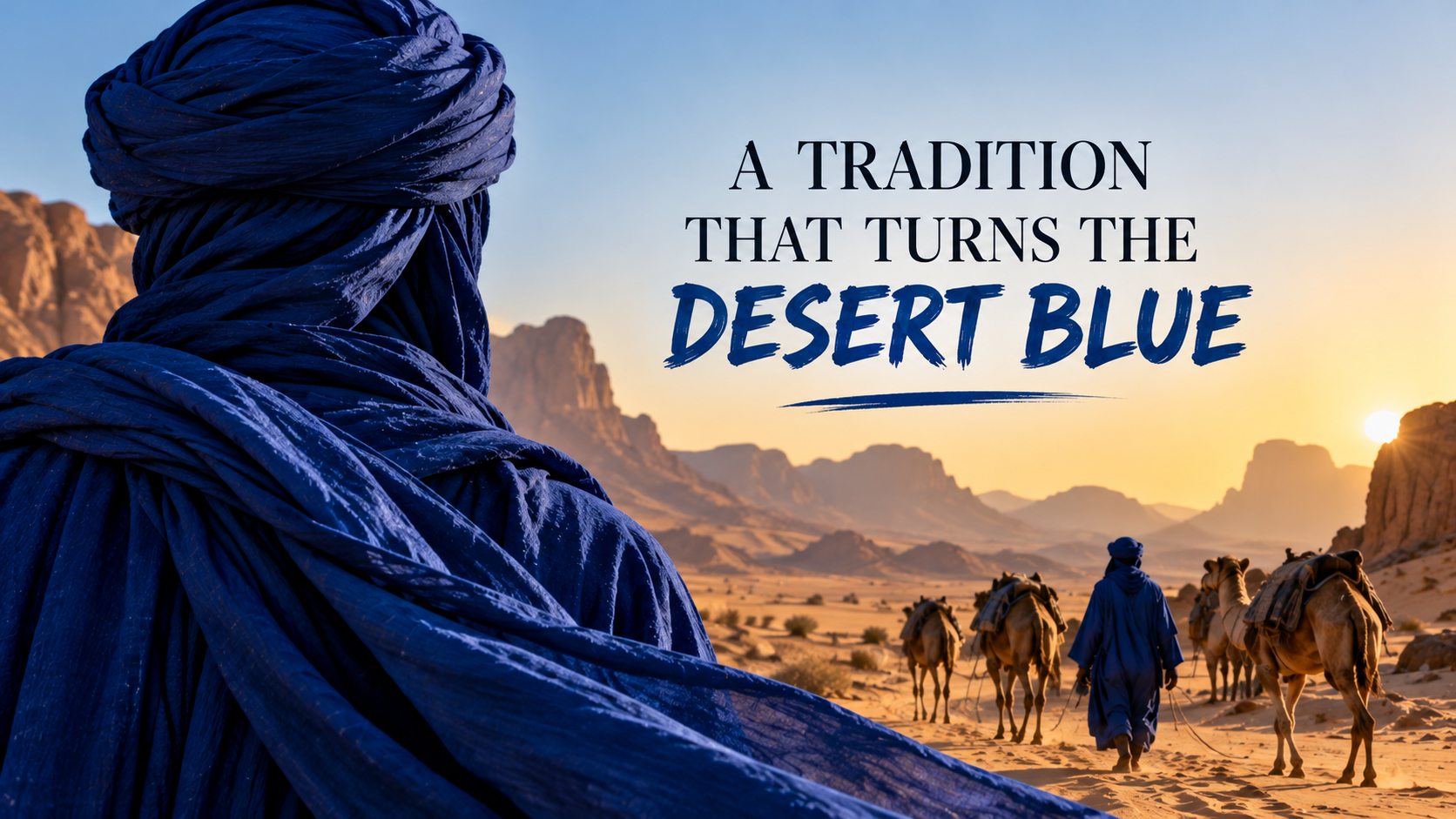
Deep in the Sahara Desert, a centuries-old clothing tradition has earned some of its inhabitants an unusual nickname: the Blue People of the Sahara.
The name is most closely associated with the Tuareg, an Amazigh people whose communities live across parts of Niger, Mali, Algeria, Libya and Burkina Faso.
For generations, some Tuareg men have worn distinctive indigo-dyed garments and face coverings.
The deep blue dye can sometimes transfer onto their skin, creating a temporary bluish appearance.
But there is much more to this tradition than its striking colour.
Who are the Blue People of the Sahara?
The Tuareg are an Amazigh people with a long history in the Sahara and surrounding Sahel region.
Their communities have traditionally been involved in herding, trading and travelling across desert routes.
Today, Tuareg people follow many different ways of life. Some live in towns and cities, while others maintain pastoral traditions.
They also speak varieties of Tamasheq, Tamajaq and Tamahaq, languages belonging to the Amazigh language family.
Although the nickname Blue People is widely recognised, it does not describe every Tuareg person.
It refers mainly to a particular clothing tradition rather than a physical characteristic or separate ethnic identity.
Why does indigo clothing turn the skin blue?
The explanation lies in a traditional fabric-dyeing process.
Some Tuareg garments are dyed with indigo, a pigment known for producing rich shades of blue.
Traditionally dyed fabrics may release small amounts of pigment through friction, especially when worn for long periods.
As the cloth touches the skin, traces of blue dye can transfer onto the face, neck or other areas.
This temporary staining helped give rise to the nickname Blue People.
The effect is not a natural change in skin colour, nor does it happen to everyone who wears blue clothing.
It depends on the fabric, dyeing method and how the garment is used.
Why do Tuareg men cover their faces?
One of the most recognisable items of traditional Tuareg clothing is the tagelmust, a long piece of cloth worn around the head and face.
It can serve several practical purposes.
In the Sahara, where strong winds frequently carry sand and dust, face coverings help protect the wearer from the environment.
They can also provide protection from intense sunlight and dry desert conditions.
Beyond these practical benefits, the tagelmust has cultural significance.
In some Tuareg communities, men traditionally begin wearing it as they reach adulthood.
The garment can reflect identity, social customs and respect within the community.
However, clothing practices vary between Tuareg groups and individuals.
The cultural importance of indigo
Indigo has long been valued in textile traditions across different parts of Africa.
Among Tuareg communities, deeply dyed fabrics have historically been associated with distinctive dress and cultural heritage.
Producing traditional indigo textiles can involve specialised skills and careful preparation.
These garments may be worn during everyday activities or important social occasions.
The colour itself has become closely associated with representations of Tuareg identity.
Nevertheless, Tuareg culture cannot be reduced to one colour or style of clothing.
Its heritage also includes language, poetry, music, craftsmanship and longstanding social traditions.
How do Tuareg communities live today?
Although the Tuareg are often associated with desert caravans, their lives have changed considerably over time.
Historically, many Tuareg communities participated in trans-Saharan trade networks.
Caravans transported goods across vast distances, connecting settlements and trading centres.
Livestock herding also played an important role in many communities.
Today, Tuareg people work in a wide range of occupations, including commerce, agriculture, education, tourism and other professions.
Some continue to practise mobile pastoralism, while others live permanently in urban areas.
Environmental pressures, economic changes and regional insecurity have also affected livelihoods in parts of the Sahara and Sahel.
Despite these challenges, many communities continue to preserve their languages, crafts and cultural traditions.
Are the Tuareg Muslim?
Islam has been an important part of Tuareg societies for centuries, and most Tuareg people today are Muslim.
Religious life exists alongside local cultural traditions, including distinctive forms of dress and community customs.
The tagelmust should not be understood as a universal religious requirement.
Rather, its use reflects a combination of cultural identity, social tradition and practical needs.
As with other communities, religious practices and cultural customs can differ among Tuareg individuals and families.
A fascinating tradition of the Sahara
The nickname Blue People of the Sahara comes from a simple but remarkable detail: indigo dye transferring from traditional clothing onto the skin.
Yet behind that detail lies a much wider story of craftsmanship, adaptation and cultural heritage.
From desert trade routes to modern towns and cities, Tuareg communities have contributed to the history and diversity of North and West Africa.
Their distinctive blue garments remain one of the Sahara’s most recognisable cultural traditions.
And while not every Tuareg person wears indigo, the clothing continues to attract interest from people around the world.