
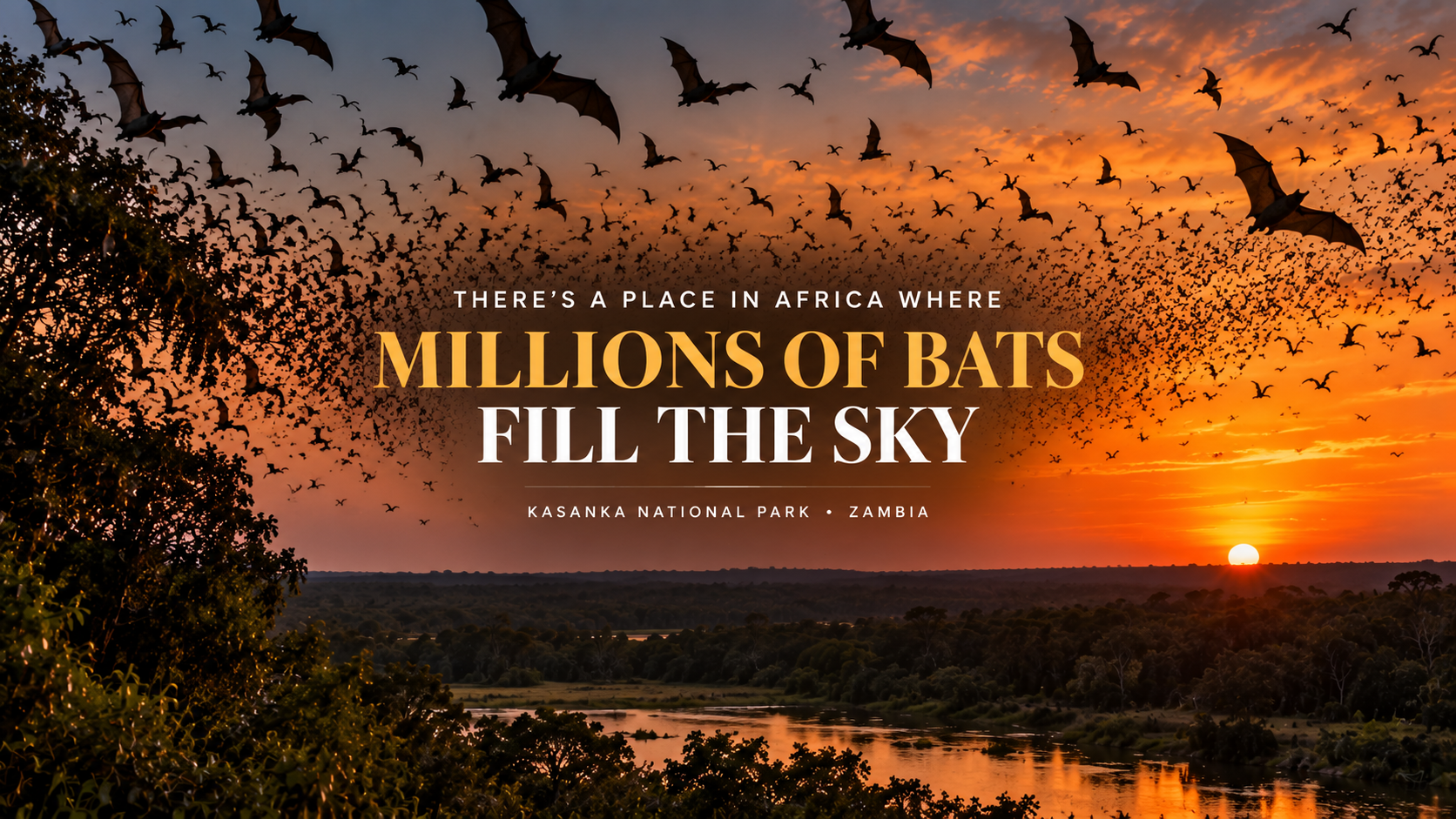
Every year, an extraordinary wildlife spectacle unfolds over a small forest in Zambia.
As daylight fades, millions of straw-coloured fruit bats rise from the trees of Kasanka National Park and spread across the sky.
The gathering is considered one of the world’s great mammal migrations. Estimates commonly range from about five million to 10 million bats during the seasonal gathering.
Where do millions of bats gather in Africa?
The spectacle takes place at Kasanka National Park in Zambia.
The bats arrive seasonally, with huge numbers gathering around the park’s forests. They begin arriving around October, and numbers have historically peaked around November.
At dusk, the bats leave their roosts in enormous waves.
The result can turn sections of the evening sky dark as countless bats fly out in search of food.
Then, around dawn, they return to the forest.
Why do so many bats gather in Zambia?
The visitors are straw-coloured fruit bats, a widespread African species.
They travel to the Kasanka area to take advantage of seasonal food supplies.
The bats can travel more than 30 miles, or around 50 kilometres, from their roost in a single night while searching for fruit.
This means their survival depends on more than the small area where they sleep during the day. Forests and feeding areas outside the park are also important.
One of Africa’s greatest migrations
Africa is famous for vast herds of wildebeest and other animals moving across its landscapes.
However, one of its most remarkable migrations happens overhead.
National Geographic has described Kasanka’s gathering as one of the world’s largest mammal migrations. Earlier estimates have placed the seasonal population at around eight million to 10 million bats, although estimates vary.
At peak times, thousands can leave the forest every second.
For visitors watching from below, the movement can appear like a vast stream flowing across the sky.
The bats also help Africa’s forests
The migration is more than a spectacular sight.
Straw-coloured fruit bats eat fruit and can carry seeds across considerable distances.
As those seeds are dispersed, the bats can help plants spread and forests regenerate.
This ecological role has earned fruit bats descriptions such as the “gardeners of Africa.”
However, habitat loss outside protected areas can threaten the food sources on which the bats depend.
For a few weeks each year, Zambia therefore becomes home to one of Africa’s most remarkable natural events — a sky filled with millions of migrating bats.