
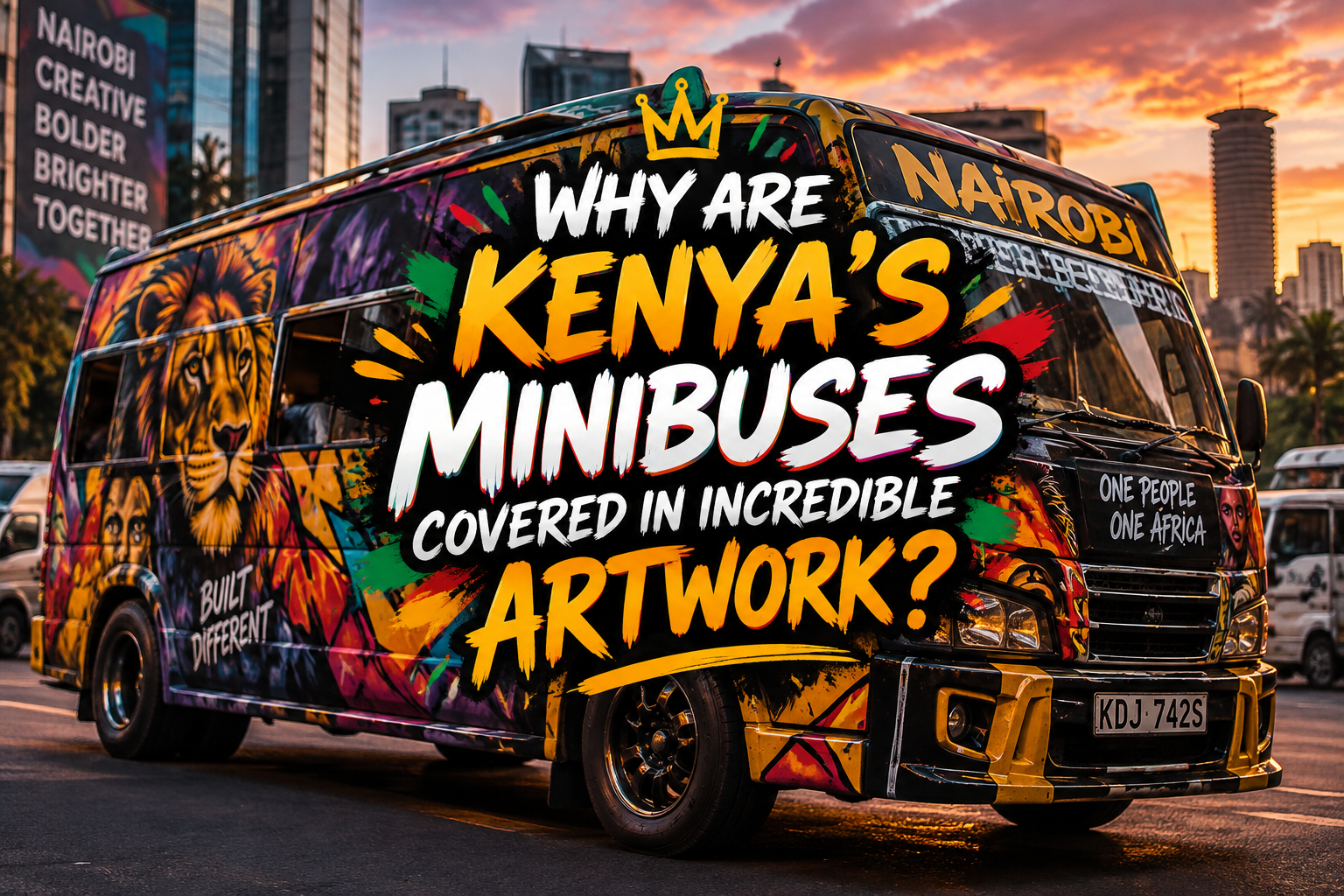
On the streets of Nairobi, a bus ride can come with much more than a way to get from one place to another.
Some of Kenya’s famous matatus are impossible to miss.
Their exteriors can feature huge portraits, bold lettering, colourful patterns and detailed graffiti-style artwork. Inside, passengers may find customised lighting, screens and elaborate interior designs.
So why put so much effort into decorating a minibus?
Because in Kenya, particularly in Nairobi, a matatu can be more than public transport.
It can also be a moving piece of popular culture.
What is a matatu?
Matatus are privately operated vehicles used for public transport in Kenya.
Depending on the route and vehicle, they can range from minibuses to larger buses. They carry passengers along established routes and remain a familiar part of everyday transport.
The term has a long history in Kenya. Today, however, the matatu has also developed a distinctive visual identity.
In Nairobi especially, some operators customise their vehicles to make them stand out.
That is where the artwork comes in.
Why are matatus so colourful?
There is no single design for a matatu.
That is part of the appeal.
Artists can cover vehicles with detailed graphics inspired by popular culture, sport, music, film or well-known personalities. Others use original patterns, slogans and typography.
The result is a vehicle that can be recognised before a passenger even steps inside.
For operators, an eye-catching design can help distinguish one matatu from many others competing for passengers on busy routes.
However, the designs have also become part of a wider creative culture.
Nairobi has a large and diverse creative sector. UNESCO has worked with Nairobi City County and local organisations to map and strengthen the city’s cultural and creative industries.
Matatu art provides one highly visible example of creativity appearing in everyday urban life.
The artwork does not stop outside
For some customised matatus, the exterior is only the beginning.
Operators may also invest in the passenger experience inside the vehicle.
Depending on the matatu, this can include decorative interiors, screens, lighting and sound systems.
Therefore, two vehicles travelling similar routes can look completely different.
The customisation can give individual matatus their own identity and make particular vehicles familiar to regular passengers.
For visitors, the designs may look surprising.
For many Nairobi commuters, however, decorated matatus are simply part of the city’s streets.
Matatus give artists a moving canvas
The vehicles also provide an unusual canvas for visual artists.
Instead of displaying their work on a wall, artists can create designs that travel through the city every day.
Graffiti and other forms of visual art already form part of Nairobi’s contemporary creative scene. For example, UNESCO-backed youth programmes in the city have included graffiti workshops alongside other forms of art.
A customised matatu takes that creativity onto the road.
The vehicle moves through neighbourhoods, stops for passengers and becomes visible to thousands of people.
In that sense, the artwork does not stay in one gallery or exhibition.
The city becomes the exhibition.
But matatus are still public transport
Despite their creative appearance, matatus operate as public service vehicles.
Kenya’s National Transport and Safety Authority regulates public transport operations, including vehicle registration and inspection. Current transport rules and proposals also cover areas such as roadworthiness, licensing and safety requirements for public and commercial vehicles.
So the artwork may attract attention, but the vehicle still has a practical job.
Every day, matatus help people move through Nairobi and other parts of Kenya.
That combination is what makes them so distinctive.
They are buses.
But some are also enormous moving artworks.