
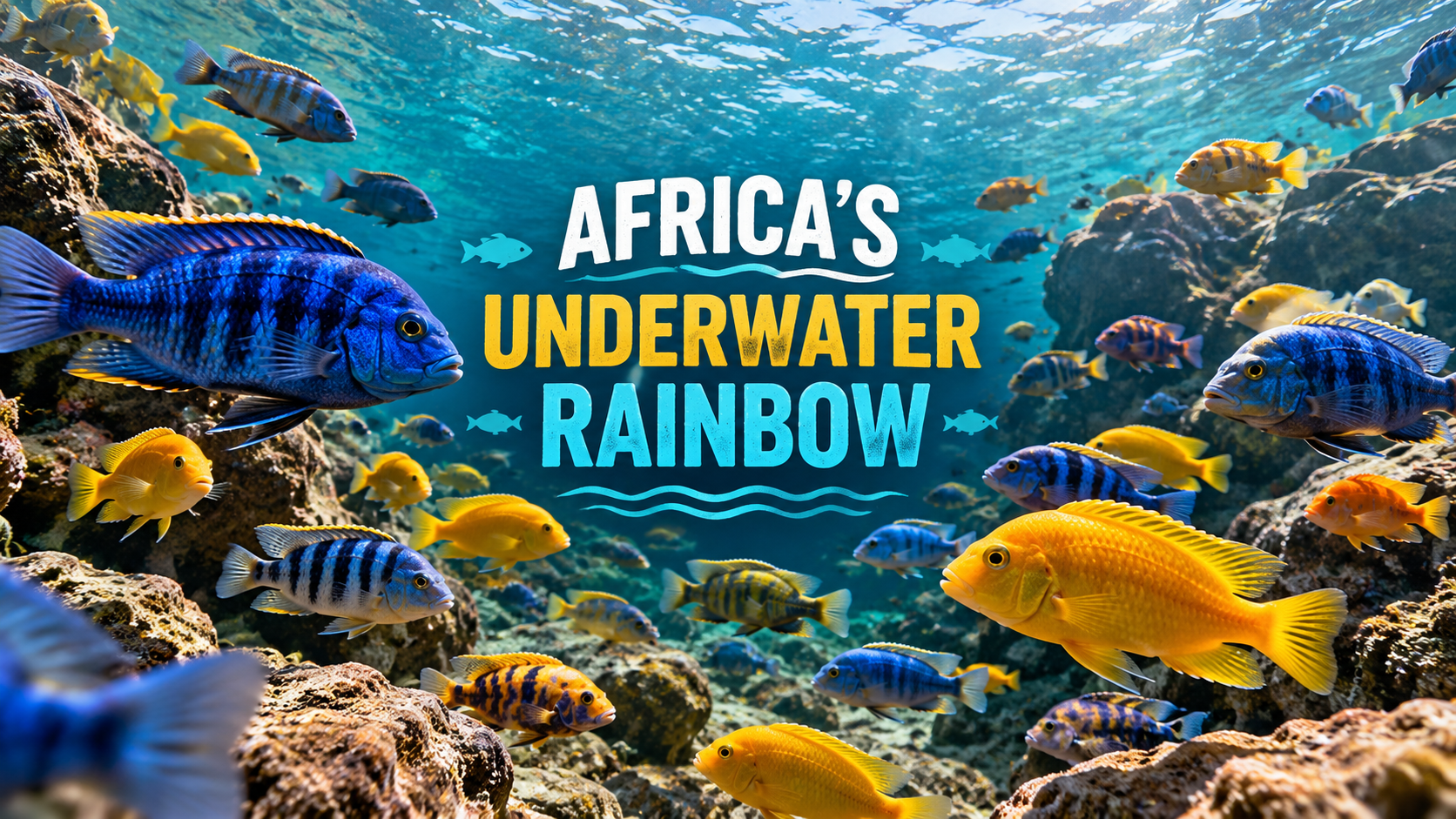
Lake Malawi fish species are among Africa’s most remarkable natural treasures. Beneath the lake’s clear waters, hundreds of colourful fish swim through rocky habitats and sandy areas.
Located in southeastern Africa, Lake Malawi is famous for its extraordinary freshwater biodiversity.
Scientists have identified hundreds of fish species in the lake. Many exist nowhere else on Earth.
What makes this African lake especially fascinating is how so many different species evolved within the same body of water.
Lake Malawi fish species create an underwater rainbow
Lake Malawi is particularly famous for a group of fish called cichlids.
These fish come in a remarkable range of colours, including bright blue, yellow, orange and black.
Some have stripes, while others display spots or unusual patterns.
However, their differences go beyond appearance.
Different cichlid species have developed specialised mouths, teeth and feeding behaviours.
Some eat algae growing on rocks. Others feed on small animals or hunt other fish.
These adaptations allow many species to share the same lake while using different food sources.
Hundreds of fish species live in one lake
Lake Malawi supports one of the world’s richest collections of freshwater fish.
Scientists estimate that the lake contains around 700 to 1,000 fish species, depending on how species are classified and counted.
Cichlids make up the majority of this diversity.
Many of these fish are endemic. This means they naturally occur only in Lake Malawi.
The lake’s remarkable biodiversity has attracted scientists from around the world.
Researchers study its fish to understand how new species develop and adapt to different environments.
How did Lake Malawi become so diverse?
One reason for the lake’s extraordinary fish diversity is its long geological history.
Lake Malawi formed millions of years ago as part of the East African Rift system.
Over time, its different underwater habitats created opportunities for fish populations to adapt.
Some species developed in rocky coastal areas. Others adapted to sandy lakebeds or deeper waters.
As populations became more specialised, many evolved into distinct species.
Scientists call this process adaptive radiation.
Lake Malawi’s cichlids provide one of the world’s best-known examples of this evolutionary process.
Three countries share Lake Malawi
Lake Malawi stretches along the borders of Malawi, Mozambique and Tanzania.
It is known as Lake Nyasa in Tanzania and Lago Niassa in Mozambique.
The lake extends for roughly 580 kilometres from north to south.
It is also one of Africa’s deepest lakes, reaching depths of more than 700 metres.
Its waters support fishing communities, transport and tourism.
For many people living along its shores, the lake provides an important source of food and income.
Lake Malawi’s colourful fish face challenges
Despite its rich biodiversity, Lake Malawi faces environmental pressures.
Overfishing can affect fish populations, especially species that communities depend on for food.
Pollution and changes in water quality also pose risks.
Meanwhile, climate change may alter water temperatures and affect lake ecosystems.
Conservation efforts aim to protect important habitats and support sustainable fishing.
Lake Malawi National Park, located in the southern part of the lake, is recognised as a UNESCO World Heritage Site.
The park protects important aquatic habitats and is especially known for its colourful cichlid fish.
An underwater world found almost nowhere else
Lake Malawi is much more than a large freshwater lake.
It is home to an extraordinary collection of fish, many of which cannot be found naturally anywhere else.
Its colourful cichlids show how different species can develop within a single ecosystem.
For scientists, the lake offers valuable insights into biodiversity.
For visitors, it reveals an underwater world filled with colour and unusual wildlife.
And for Africa, Lake Malawi remains one of the continent’s most remarkable natural environments.