
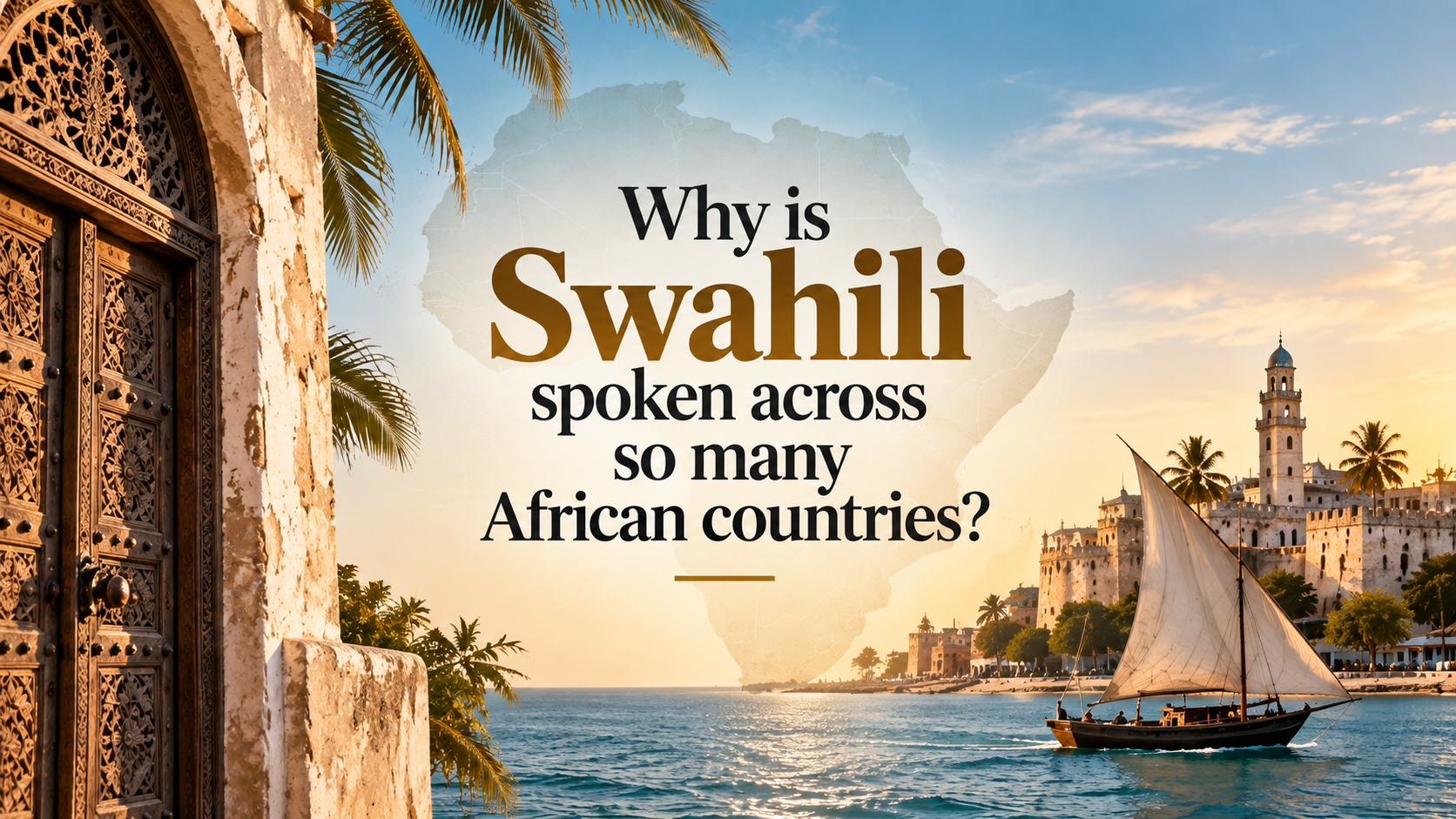
Travel across parts of Africa and you may hear the same language spoken thousands of kilometres apart.
That language is Swahili, also known as Kiswahili.
Today, more than 200 million people speak Kiswahili across Africa and beyond, according to UNESCO.
But how did one language become so widespread?
The answer begins on Africa’s eastern coast.
Swahili grew along the East African coast
Kiswahili is an African language from the Bantu language family.
It developed along the East African coast through centuries of interaction between coastal communities.
Trade also brought these communities into contact with people from the Arabian Peninsula, Persia, India and other parts of the Indian Ocean.
These connections influenced the language.
Kiswahili remained a Bantu language but absorbed words from other languages, particularly Arabic.
UNESCO describes the language as a product of centuries of trade and cultural exchange along the East African coast.
Trade helped Swahili travel inland
For centuries, the East African coast was connected to important Indian Ocean trade networks.
Merchants moved between coastal settlements and communities further inland.
Kiswahili became useful as a shared language between people who spoke different local languages.
As trade routes expanded, the language travelled with them.
It gradually spread far beyond coastal communities into other parts of East and Central Africa.
Swahili became a language connecting communities
Kiswahili continued to expand through education, government, trade and communication.
Today, it is widely used across East Africa and is also spoken in parts of Central and Southern Africa.
Countries where Kiswahili is widely spoken include Tanzania, Kenya, Uganda, Rwanda, Burundi and the Democratic Republic of Congo.
It is also used to varying degrees in several other African countries.
This has made Kiswahili an important language for communication between people from different linguistic backgrounds.
More than 200 million people speak Kiswahili
The United Nations and UNESCO say more than 200 million people speak Kiswahili across Africa and beyond.
Its importance has also grown at the international level.
Kiswahili is an official language of the African Union.
It is also used by major regional organisations, including the East African Community and Southern African Development Community.
In 2021, UNESCO proclaimed July 7 as World Kiswahili Language Day.
It became the first African language to receive this recognition within the United Nations system.
From the coast to much of Africa
The story of Kiswahili shows how a language can travel far beyond the place where it developed.
Trade and cultural exchange helped spread it from the East African coast.
Later, education, politics, media and regional cooperation expanded its reach even further.
Today, Kiswahili connects millions of people across national borders.
A language that grew along Africa’s eastern coastline has become one of the continent’s most widely spoken languages.