Nigeria

Nigeria police may seek military help after violent protests

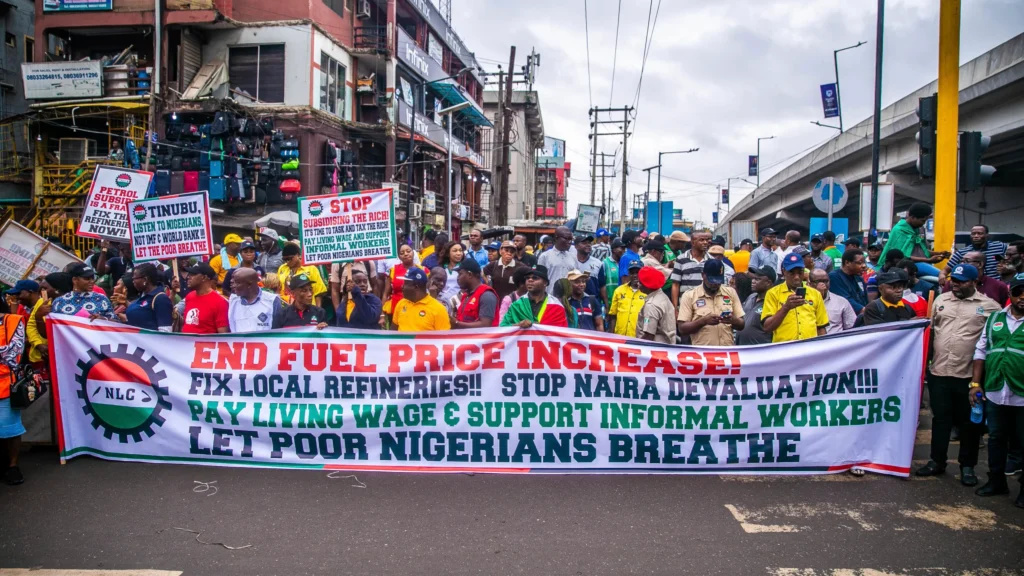
Police in Nigeria have been placed on high alert and may seek military assistance following violent protests in several cities that resulted in at least three deaths, the Inspector General of Police announced. Major cities, including the capital Abuja and Kano in the north, experienced clashes between police and demonstrators, along with looting on Thursday. Despite the early calm on Friday, further protests were anticipated. Inspector General Kayode Egbetokun stated late Thursday that the police were fully mobilized and prepared to respond swiftly to any additional threats to public safety and order. “In light of the current situation, the Nigeria Police Force has placed all units on red alert,” Egbetokun said. “The police are equipped to respond appropriately to the unfolding situation and will seek assistance from other security agencies, including the military, if necessary.” The protests, inspired by youth-led movements in Kenya, have been organized under the banner “#EndBadGovernanceInNigeria” and are set to continue for 10 days. Protesters are reacting to President Bola Tinubu’s economic reforms, which have led to rampant inflation, a weakened currency, and increasing hardship for ordinary Nigerians. President Tinubu acknowledged the pain caused by the reforms but emphasized that they are essential for putting Nigeria’s economy on a path to sustainable growth. Kano, one of Nigeria’s most populous and predominantly Muslim states, imposed a 24-hour curfew after protesters looted a shop and a government complex. Additionally, three other states have implemented curfews in certain areas.

Nigeria police may seek military help after violent protests Read More »

Curfew imposed in some Nigerian states due to protests

In Nigeria, some states have imposed curfews in response to protests against the removal of fuel subsidies, which has led to rising living costs. The protests, which began yesterday, have escalated into violence in certain areas, prompting curfews in Gombe, Jigawa, Kano, Niger, and Yobe states. Kano Governor Abba Kabir Yusuf stated, “After careful consideration, we decided to impose a curfew to prevent the looting and destruction of businesses and the killing of innocent citizens.” Curfews have also been enforced in Gombe, Jigawa, Niger, and Yobe states due to looting and clashes between protesters and security forces. Civil society organizations plan a 10-day nationwide protest starting August 1, in response to the fuel subsidy removal. Nigerian President Bola Ahmed Tinubu removed fuel subsidies on May 29, 2023, leading to a significant increase in fuel prices. The cost of fuel surged from 185 naira ($0.24) per liter to 620 naira ($0.82).

Curfew imposed in some Nigerian states due to protests Read More »

Cholera death toll in Nigeria rises to 156

The cholera outbreak in Nigeria has now claimed 156 lives, according to the Nigeria Center for Disease Control (NCDC). Between July 15 and 21, the country reported 170 new cases and three deaths. Since January, there have been 4,809 reported cholera cases. In response, medical supplies for case management and infection control have been distributed to health centers nationwide. Nigeria declared a national emergency on June 26 due to the outbreak. Last year, Nigeria recorded over 3,000 cholera cases and more than 100 deaths. Cholera, caused by the bacterium Vibrio cholerae and spread through contaminated food and water, can lead to severe diarrhea and dehydration, which can be fatal if untreated. The country’s challenges with clean water access and medical resources exacerbate the risk of disease. Additionally, Nigeria frequently contends with outbreaks of malaria, polio, typhoid, and monkeypox.

Cholera death toll in Nigeria rises to 156 Read More »

Nigeria plans nationwide protests over economic struggles

Nigerians are planning nationwide protests this week to tackle the worst cost-of-living crisis the country has seen in decades. With strong backing on social media, there are concerns that the demonstrations could mirror the deadly anti-police brutality protests of 2020 or lead to unrest similar to the recent chaotic protests in Nairobi over a tax hike. President Bola Tinubu’s government is working to prevent such outcomes. Local media reported on Tuesday that organizers of the planned protests against rising economic hardships on Thursday have rejected a police proposal to confine the rallies to specific areas. Human Rights Watch criticized the officials’ response, suggesting it reflects a concerning willingness to suppress dissent.

Nigeria plans nationwide protests over economic struggles Read More »

Africa feels climate change effects more severely

The impacts of climate change on livelihoods are varying significantly across regions, with the most vulnerable areas, including many African countries, experiencing severe daily disruptions. According to the Intergovernmental Panel on Climate Change (IPCC), African countries, despite contributing minimally to greenhouse gas emissions, are among the hardest hit by human-induced climate change. Factors such as high dependence on rain-fed agriculture, inequitable access to financial resources, and weak adaptation capacity contribute to the heightened impact. The ND-GAIN index highlights that nine out of the ten most vulnerable and least resilient countries to climate change are in Africa, including Chad, the Central African Republic, Guinea-Bissau, Eritrea, the Democratic Republic of the Congo, Sudan, Niger, Zimbabwe, and Liberia. Climate change is causing rising ocean levels that threaten Africa’s coastal metropolises with reduced land area, increased coastal flooding, and stronger storm surges. The African coastline has been experiencing a steady rise in sea levels for the past four decades. Experts predict that if this trend continues, sea levels could rise by 0.3 meters by 2030, affecting 117 million Africans. The survival of Africa’s coastal ports, which handle an estimated 90% of the continent’s import and export trade, is at risk. This poses a concern for Africa’s rapidly growing population and urbanization in coastal areas. Rising sea levels reveal the stark and destructive impact of global warming on a continent already facing rapid population growth and land pressure. Coastal cities are also facing increased public health risks due to rising groundwater levels and the transformation of urban areas into wetlands. In addition, rising sea levels are causing severe flooding and erosion. The World Bank estimates that erosion, flooding, and pollution are causing approximately $3.8 billion in annual damage along 56% of the coastline in Benin, Ivory Coast, Senegal, and Togo. Alexandria, located in the Nile Delta, is among the densely populated coastal cities at risk of being submerged within 30 years. A sensitivity assessment for Alexandria, Rosetta, and Port Said predicts that a 0.5-meter rise in sea levels by 2050 could displace over 2 million people, result in 214,000 job losses, and cause over $35 billion in damages. A 1-meter rise could lead to $50 billion in damage solely in Alexandria. In Lagos, Nigeria, a city of over 20 million people, the total annual cost of river and water flooding is estimated at $4 billion. Some forecasts suggest that a 3-degree increase in global warming could force one-third of Lagos’s population to relocate due to rising sea levels. The World Bank reports that Dakar, Senegal, has $39 billion worth of economic assets vulnerable to flooding. The city of St. Louis in Senegal is disappearing under rising waters, displacing many residents. Mozambique’s coastal cities are also at risk, situated along a cyclone path that is expanding and intensifying due to rising sea surface temperatures.

Africa feels climate change effects more severely Read More »

Scroll to Top