
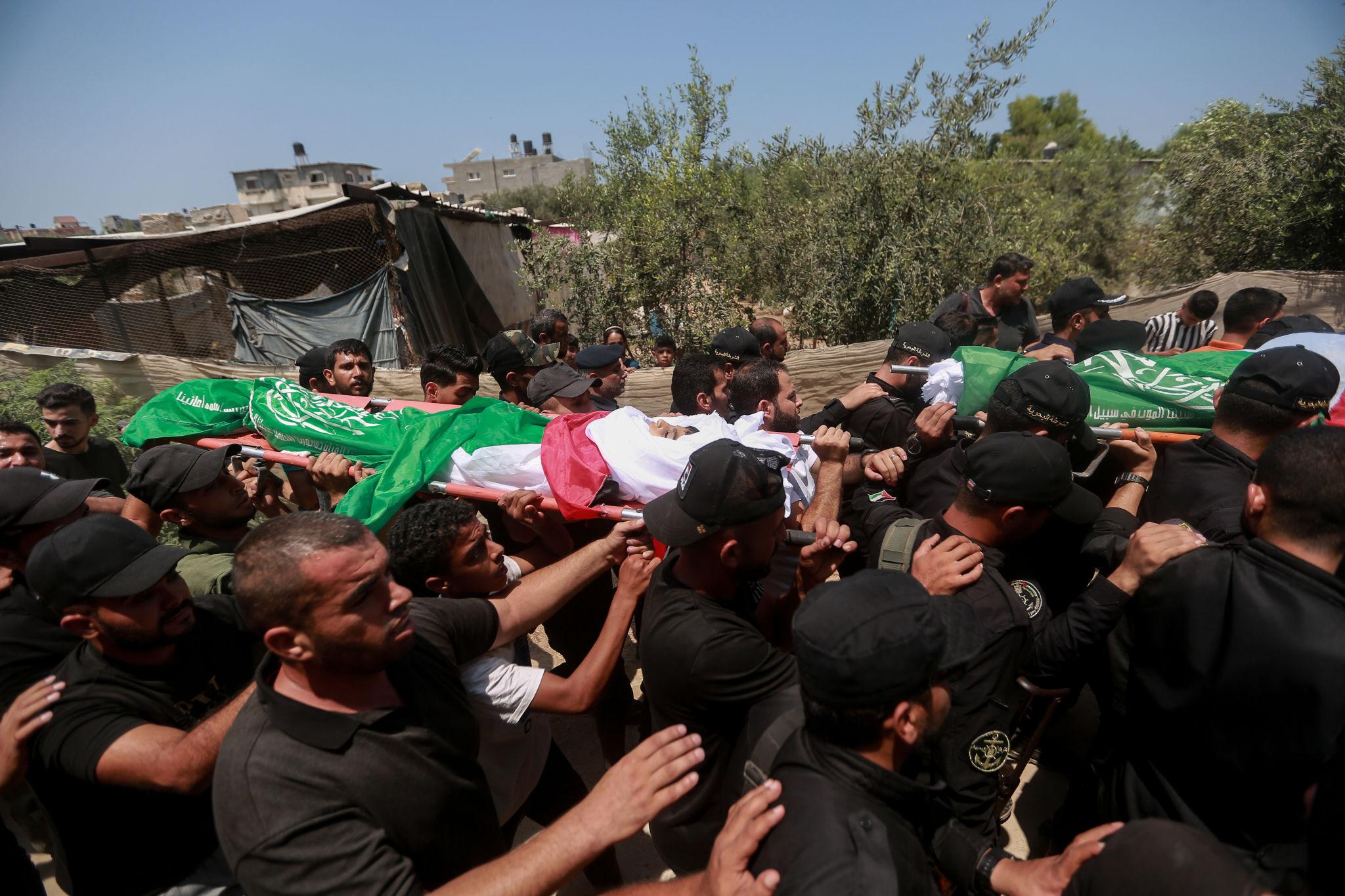
Palestinians in Gaza held a mass funeral on Tuesday for the remains of 112 members of the Al-Hassayna clan, nearly three years after Israeli airstrikes destroyed several residential buildings in Gaza City’s Sabra neighbourhood.
The decomposed remains were laid on stretchers and covered with flags under the summer sun before relatives and neighbours carried them through the streets. Palestinian authorities described the ceremony as the largest mass funeral held during the Gaza war.
According to Palestinian officials, 308 members of the extended Al-Hassayna family, also known as the Abu Sharia clan, were killed on November 22, 2023, when Israeli strikes flattened a cluster of apartment buildings as residents slept.
Around half of the victims were recovered and buried soon after the attack, but the bodies of 153 people remained trapped beneath the rubble.
A 40-member recovery team spent 17 days searching the destroyed buildings and retrieved remains identified as belonging to 112 of those still missing.
“This day is filled with grief and has reopened our wounds nearly three years after the massacre,” said Taysir Al-Hassayna, one of the surviving clan members.
“It has brought sorrow back to our children and women. But our consolation is that we believe they are martyrs with God.”
A display at the funeral showed photographs of the dead, including men, women and children.
Reuters said it could not locate an Israeli military statement from November 2023 setting out Israel’s account of the strike. The Israeli military did not immediately respond to a request for comment.
The attack took place during the opening weeks of the war, which began after Hamas-led fighters attacked southern Israel on October 7, 2023, killing around 1,200 people.
Palestinian health authorities say more than 73,000 Palestinians have been confirmed killed during Israel’s military campaign in Gaza. Most were documented after their bodies were taken to hospitals or morgues, while around 8,000 others are believed to remain buried beneath destroyed buildings.
‘They are pieces of me’
In Cairo, 65-year-old survivor Omar Al-Hassayna wept as he watched television footage of the funeral.
His wife, four adult sons and four grandchildren were killed in the Sabra attack. The grandchildren included two boys and two girls, the oldest aged four and the youngest only a few months old.
“They are pieces of me. I have thought about them every day. I have seen them in my thoughts and in my dreams,” he said.
“The funeral today is the least that could be done for those martyrs. It is time for those bodies, those little bodies, to rest in peace.”
Much of Gaza’s population is descended from Palestinian refugees displaced from areas that are now inside Israel. Extended families often live together in neighbouring homes or apartment blocks, leaving entire clans vulnerable when residential areas are bombed.
The Al-Hassayna family had lived in Sabra for decades and belonged to a prominent Bedouin clan known across Gaza.
Omar said members of the extended family had gathered inside three residential buildings for safety during the early days of the war.
Two of the buildings were completely destroyed, killing almost everyone inside. Omar was in the third building, which was partially damaged, and survived with minor injuries. Two of his daughters and one son also survived.
Recovery work limited by Israeli control
A ceasefire reached in October ended the heaviest fighting but left Israeli forces in control of more than half of Gaza, an area that has since expanded to around two-thirds of the territory.
Palestinian recovery teams are largely restricted to the remaining areas, where most of Gaza’s population of more than two million people now live, many in tents, makeshift shelters or damaged buildings.
Mahmoud Basal, spokesperson for Gaza’s Civil Defence, said identifying the Al-Hassayna remains required forensic evidence as well as information provided by surviving relatives.
“The bodies were decomposed,” Basal said. “Relatives identified some through their clothes, injuries and distinguishing marks.”
Some victims were recognised through surgical plates, while some women were identified by jewellery or necklaces bearing their names, he added.
Basal said recovery teams would now move to other accessible areas.
He said additional heavy machinery, including excavators, bulldozers and cranes, could significantly speed up efforts to recover thousands of bodies believed to remain beneath the rubble.
At the cemetery, mourners passed the small, shrouded remains over their shoulders before lowering them into newly dug graves among the ruins of Gaza.