
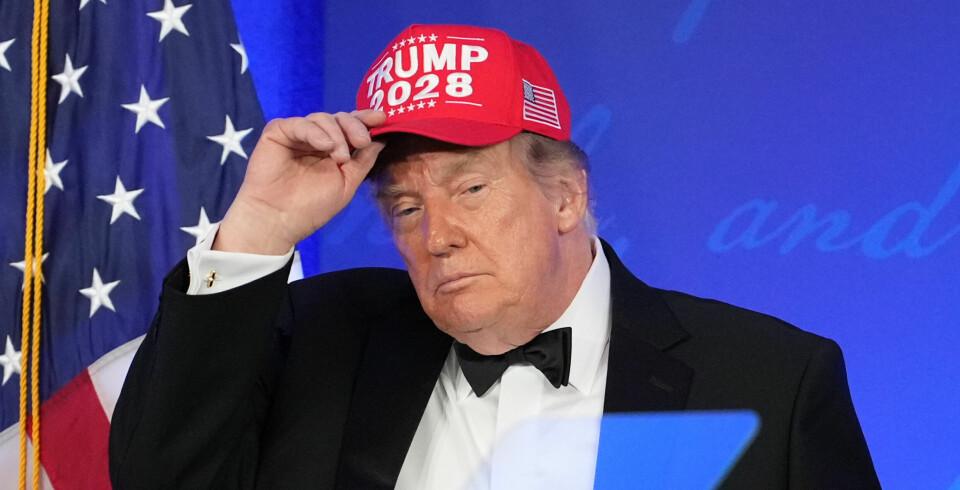
US President Donald Trump’s repeated references to a possible “Trump 2028” campaign have renewed debate over whether he could remain in power beyond his second term, despite a constitutional prohibition on being elected president more than twice.
Trump has repeatedly displayed red “Trump 2028” hats and publicly toyed with the idea of extending his presidency. At a White House Correspondents’ Association dinner in July, he jokingly announced a bid for a “fourth term” while holding up one of the hats.
The remarks have fuelled speculation over whether Trump or his allies could attempt to find a constitutional route back to the White House after his current term ends in January 2029.
But any such effort would face enormous legal obstacles.
The 22nd Amendment to the US Constitution states that no person can be elected president more than twice. Ratified in 1951 after Franklin D. Roosevelt won four presidential elections, the amendment was designed to impose a formal two-term limit on the presidency.
Changing the Constitution
The clearest legal route to another Trump presidency would be repealing or amending the 22nd Amendment.
That would require approval from two-thirds of both the House of Representatives and Senate, followed by ratification from three-quarters of US states.
Even with strong Republican support, reaching those thresholds would be extraordinarily difficult in the deeply divided US political system.
Could Trump become vice president?
Another theory raised by Trump supporters involves running for vice president in 2028 alongside another Republican candidate, who could later resign and allow Trump to succeed to the presidency.
Trump himself acknowledged that idea in 2025 when asked about possible ways of obtaining a third term, saying there were “methods” that had been discussed.
He later dismissed the vice-presidential scenario as “too cute.”
The theory is also highly disputed. The 12th Amendment says anyone constitutionally ineligible to serve as president is also ineligible to serve as vice president.
Some legal scholars have argued that the wording of the 22nd Amendment only explicitly prevents a person from being elected president a third time, potentially leaving ambiguity over succession.
But many constitutional experts reject that interpretation and say the 12th and 22nd amendments, read together, prevent a twice-elected president from using the vice presidency as a route to another term.
House speaker scenario
Another hypothetical route would involve Trump becoming speaker of the House of Representatives.
The speaker is second in the presidential line of succession after the vice president, and the Constitution does not explicitly require the speaker to be a sitting member of Congress.
Under an extremely unlikely scenario in which both the president and vice president left office, the speaker could normally succeed to the presidency.
However, whether a twice-elected former president would be constitutionally eligible to take office through such a route would almost certainly trigger a major legal challenge.
A direct challenge to the Constitution
Trump could also attempt to run for president again in 2028 despite the 22nd Amendment, potentially forcing courts to rule on his eligibility.
Such a campaign would almost certainly produce immediate legal challenges and could ultimately reach the Supreme Court.
Suggestions that Trump could simply remain president after his term by invoking martial law are far more speculative. There is no established constitutional mechanism allowing a president to suspend presidential term limits or remain in office after the expiration of a lawful term through a declaration of martial law.
Trump has frequently used the prospect of another term to provoke opponents and energise supporters, making it unclear how seriously some of his statements should be taken.
More recently, however, Trump appeared to acknowledge the constitutional barrier. Speaking to reporters on August 12, he said the law governing presidential term limits was “very strong.”
That has not completely ended speculation surrounding the “Trump 2028” slogan, but barring a constitutional amendment or an unprecedented and successful legal challenge, the 22nd Amendment remains the central obstacle to any attempt by Trump to win the presidency for a third time.