
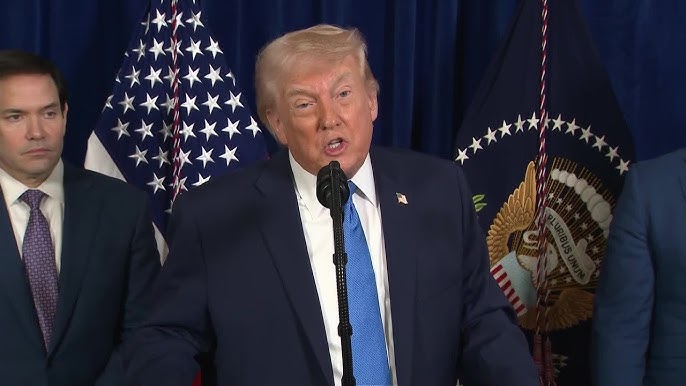
President Donald Trump said on Friday that the United States will temporarily administer Venezuela following the capture of President Nicolás Maduro, declaring that Washington will oversee the country “until there is a safe, proper, and legitimate transition of power.”
Speaking at a joint press conference alongside Secretary of State Marco Rubio, Defense Secretary Pete Hegseth, and a spokesperson for the Joint Chiefs of Staff, Trump framed the operation as a national security necessity, not a regime-change exercise for its own sake.
“We’re not here to occupy, we’re not here to colonize,” Trump said. “We’re here because Venezuela became a direct threat — to our borders, to our people, and to regional stability. Until there is a responsible government that can take over, the United States will ensure order.”
Trump described Maduro as a “narco-terrorist leader” who had turned Venezuela into a launchpad for drug trafficking, organized crime, and what he called “weaponized migration” aimed at the United States.
“This man emptied his prisons, flooded our hemisphere with criminals, and thought there would be no consequences,” Trump said. “There were consequences.”
How the operation unfolded
According to U.S. military officials, the operation was conducted as a rapid, precision mission targeting Maduro’s inner security circle. Joint Chiefs officials said U.S. forces exploited intelligence indicating Maduro had relocated to a hardened site outside Caracas after growing internal unrest.
The operation involved special operations forces, electronic warfare assets, and regional naval support. U.S. officials said the mission was completed in hours, with Maduro and his wife detained without significant resistance.
“There were no U.S. casualties,” the Joint Chiefs spokesperson said. “The objective was capture, not escalation. That objective was achieved.”
The spokesperson declined to provide details on troop numbers or staging locations, citing operational security, but confirmed that U.S. forces remain postured in the region to deter retaliation or internal collapse.
Rubio: Secrecy was essential
Secretary of State Marco Rubio said Congress was not briefed in advance to preserve secrecy, arguing that leaks would have jeopardized the mission and potentially endangered U.S. personnel.
“This operation required absolute discretion,” Rubio said. “Had word gotten out, Maduro would not be in custody today.”
Rubio said the administration viewed Maduro’s removal as unavoidable after years of failed diplomatic pressure, sanctions, and negotiations.
“This regime crossed a line,” Rubio said. “When a government deliberately exports criminality and instability to the United States, it forfeits any claim to normal treatment.”
Rubio added that Washington is now focused on assembling a transitional framework involving Venezuelan technocrats, international partners, and regional governments, while explicitly ruling out Maduro-era figures.
“There will be no cosmetic transition,” he said. “This will not be Chavismo with a new face.”
Hegseth: Message to adversaries
Defense Secretary Pete Hegseth said the operation sent a clear signal to hostile actors who believe distance or deniability shields them from U.S. action.
“This was about deterrence,” Hegseth said. “If you target the United States indirectly — through drugs, gangs, or engineered chaos — you are still targeting the United States.”
Hegseth emphasized that the mission was not aimed at the Venezuelan military or population, but at what he called “a criminal leadership structure.”
“Our forces executed this with discipline and restraint,” he said. “The goal now is stability, not occupation.”
Joint Chiefs: No timeline for exit yet
Asked how long the U.S. would remain involved in governing Venezuela, the Joint Chiefs spokesperson said no fixed timeline had been established.
“This is conditions-based,” the spokesperson said. “The end state is a Venezuelan government capable of governing responsibly and preventing its territory from being used as a threat platform.”
Officials said humanitarian corridors, energy infrastructure protection, and border security will be immediate priorities during the interim period.
International Reaction
While some regional leaders privately welcomed Maduro’s removal, others condemned the U.S. action as a violation of sovereignty. Russia and China issued statements criticizing Washington, while Cuba accused the U.S. of “imperial aggression.”
Trump dismissed the criticism.
“The same people complaining today protected Maduro yesterday,” he said. “We’re not taking lectures from regimes that helped destroy Venezuela.”