
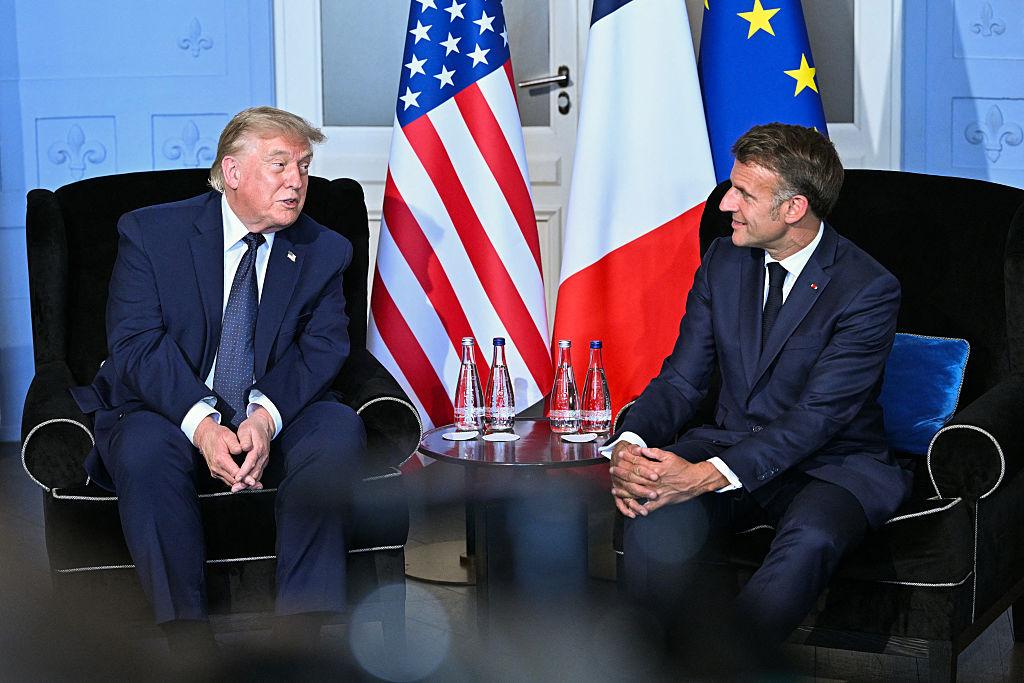
U.S. President Donald Trump said Wednesday that the ceasefire agreement reached with Iran remains only an interim understanding, warning that Washington could restart its bombing campaign if Tehran fails to meet U.S. expectations.
Speaking at the G7 summit in Evian-les-Bains, France, Trump described the deal as a “memorandum of understanding,” not a final settlement.
“If I don’t like it, we’ll go back to shooting at them,” Trump said, adding that the U.S. could resume strikes if Iran “doesn’t behave.”
The remarks came as G7 leaders welcomed the U.S.-Iran agreement while calling for an immediate ceasefire in Lebanon, where Israel’s military campaign against Hezbollah has displaced more than a million people and left Israeli forces occupying parts of the south.
The memorandum, due to be formally signed in Switzerland on Friday, extends an April ceasefire by another 60 days and is intended to open negotiations toward a permanent truce. The deal is also expected to reopen the Strait of Hormuz and end the U.S. blockade of Iranian ports, raising expectations of increased oil supply and pushing crude prices lower.
In a joint statement, G7 leaders said future negotiations must address Iran’s regional activity and ensure Tehran never obtains a nuclear weapon. Britain and France are expected to lead efforts to help secure shipping lanes once Hormuz reopens.
But the agreement leaves major questions unresolved. Iran’s government remains in power, its enriched uranium stockpile has not been surrendered, its missile programme remains intact, and its support for allied armed groups, including Hezbollah, has not ended.
Trump has argued that the deal commits Iran to never acquiring a nuclear weapon, though that largely repeats Tehran’s long-standing official position. U.S. officials say later talks are expected to focus on removing or destroying Iran’s enriched uranium stockpile.
The Lebanon front remains the most immediate obstacle. Iran has said any lasting settlement must include an end to hostilities in Lebanon and an Israeli withdrawal. Israel, excluded from the U.S.-Iran talks, says it will not withdraw and reserves the right to continue military operations.
The issue has exposed a rare public rift between Trump and Israeli Prime Minister Benjamin Netanyahu, with Trump openly criticising his wartime ally in recent days.
For Trump, the agreement offers a pause in a costly regional war, but also leaves him politically exposed. Critics are likely to argue that Iran survived the U.S. military campaign without giving up its core strategic assets, while Trump’s own warning about returning to airstrikes underlines how fragile the deal remains.