
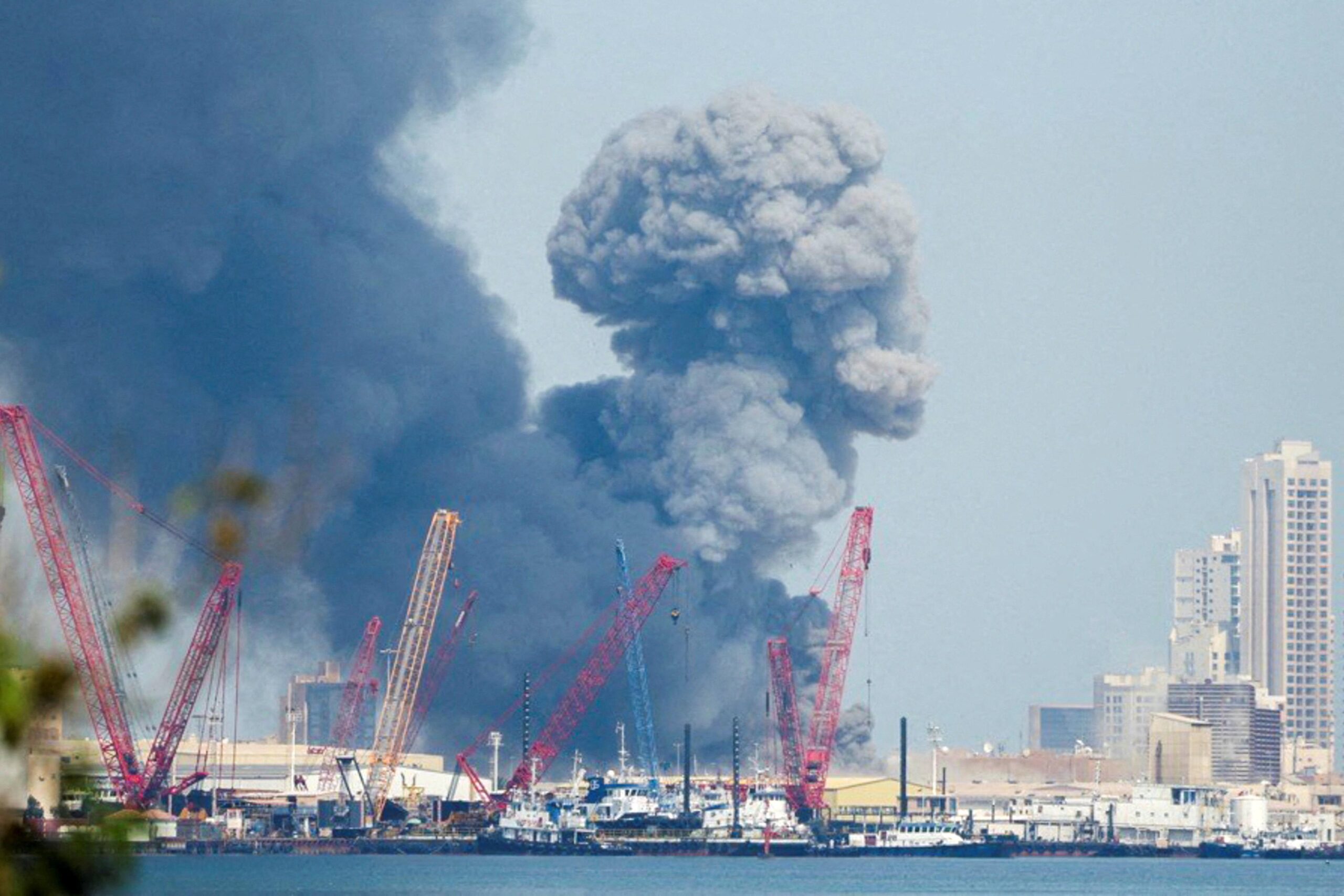
US and Iranian forces exchanged strikes for a 10th consecutive night on Tuesday, widening a regional conflict that has hit military sites, energy infrastructure and commercial shipping across the Gulf.
American forces bombed targets in southern and western Iran after US President Donald Trump warned that Tehran would pay heavily for the deaths of American troops. Iran responded by launching attacks against US-linked sites in Bahrain, Kuwait and Jordan, while a tanker was struck in the Strait of Hormuz.
The escalating violence has further undermined an interim peace agreement signed last month and pushed oil prices nearly 2% higher. However, indications that Washington and Tehran may be considering renewed diplomatic talks helped limit the increase.
US Central Command said its latest strikes targeted Iranian military command centres, naval capabilities, missile and drone launch sites, and air-defence systems.
Iranian state media reported explosions near Shiraz in the south and attacks around the coastal cities of Konarak and Chabahar. Reports also said sites near Khorramabad and Abdanan in western Iran had been targeted, although an official in Khorramabad later denied that the city had come under attack.
An Iranian Health Ministry official said 50 civilians had been killed and around 500 wounded in the latest wave of US strikes.
The US State Department issued a renewed worldwide security warning for American citizens, citing heightened tensions across the Middle East.
Iran launches attacks across Gulf states
Iranian forces carried out renewed attacks across the Gulf, where strikes on power generation and desalination facilities have raised concerns over water and electricity supplies.
Kuwaiti authorities said attacks on power stations and water desalination plants on Monday forced several generating units to be temporarily taken out of service as a precaution. Repair operations were continuing.
Iran’s Revolutionary Guards said they had targeted infrastructure in Bahrain belonging to US technology company Amazon. The Guards described the attack as retaliation for what they said was a US strike on the construction site of Iran’s planned Darkhovin nuclear power plant.
Iranian state media also reported attacks on accommodation facilities used by US military personnel at Bahrain’s Sheikh Isa Air Base.
There was no immediate confirmation from Bahrain, the US military or Amazon, and the reported attacks could not be independently verified.
The Iranian army separately said it launched drones at three US military bases in Kuwait. The Revolutionary Guards also claimed an attack on a US military site in Jordan.
Jordan said its forces intercepted and destroyed five Iranian drones.
Tanker hit in Strait of Hormuz
The UK Maritime Trade Operations agency said a tanker in the Strait of Hormuz was struck by a projectile on Tuesday, forcing its crew to abandon the vessel and move into a lifeboat.
Iran’s Revolutionary Guards also said two oil tankers caught fire following explosions as they attempted to pass through the southern section of the strait.
Shipping traffic through the waterway has fallen sharply. Data from commodities analytics company Kpler showed that only four commercial vessels crossed the strait on Monday, down from seven the previous day. Most used the northern shipping lane close to Iran’s coastline.
The Iran-aligned Houthi movement in Yemen also announced a naval blockade against Saudi Arabia, threatening to target shipping companies loading or unloading cargo at Saudi ports “in any location.”
The move risks opening another front in the war and placing additional pressure on international energy markets and maritime trade.
Iran had reportedly been urging the Houthis to close the Bab el-Mandeb strait, the southern entrance to the Red Sea, if US strikes on Iranian power infrastructure continued.
A simultaneous disruption of the Strait of Hormuz and Bab el-Mandeb would threaten two of the world’s most important energy routes.
A complete closure of Bab el-Mandeb could disrupt roughly 7% of global oil supplies by blocking much of Saudi Arabia’s seaborne crude exports, on top of an estimated 10% reduction in oil flows caused by the Gulf conflict.
Mediators push for temporary ceasefire
Despite the widening hostilities, diplomatic efforts to halt the fighting appeared to be continuing.
A senior Iranian official said Tehran had received a proposal from mediators for a 10-day ceasefire aimed at reviving the interim agreement and preparing the ground for a longer-term settlement.
The war began on February 28 with joint US-Israeli attacks on Iran.
Israel has not participated in the latest US strikes. Israeli Finance Minister Bezalel Smotrich said Israel did not want to become directly involved in the renewed escalation but was prepared for any possible scenario.
Iranian Interior Minister Eskandar Momeni asked Pakistan to resume its mediation role and later travelled to Islamabad for further talks.
The latest phase of the war has been among the deadliest for US forces, with the American military death toll rising to 17 over the weekend.
Trump, facing growing domestic pressure over higher fuel prices, said the latest attacks were retaliation for the deaths of US troops.
“Every time Iran kills an American soldier, they will pay for that killing many times over,” Trump wrote on Truth Social.
Thousands of people have been killed during the conflict, mostly in Iran and Lebanon.
Parts of southern Lebanon remain under Israeli occupation following Hezbollah attacks on Israel carried out in support of Tehran.
Lebanese President Joseph Aoun was expected to meet Trump at the White House on Tuesday to present a plan for disarming Hezbollah and securing an Israeli withdrawal from Lebanese territory.