
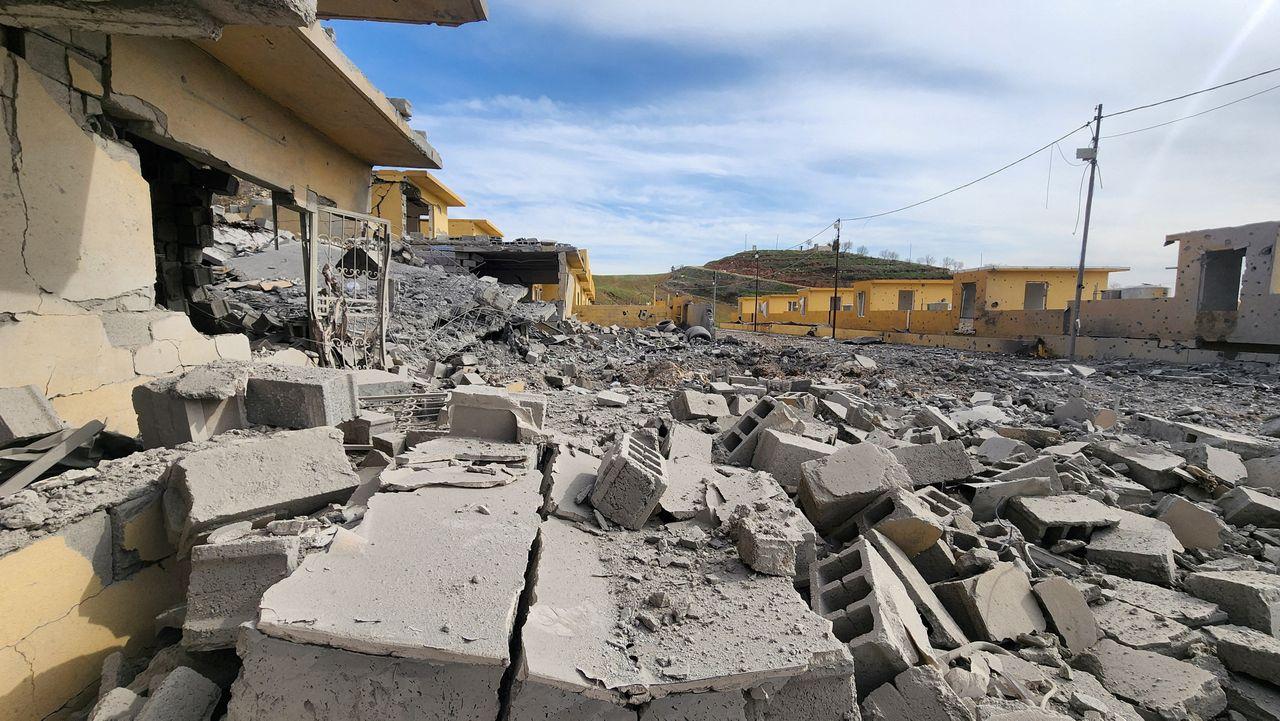
The United States and Saudi Arabia launched joint airstrikes against Iran-backed armed groups in Iraq on Wednesday, marking a major escalation in the Gulf conflict and the first US military action in the region since President Donald Trump suspended strikes on Iran last week.
Iraq’s Popular Mobilisation Forces, an umbrella organisation of mostly Iran-aligned paramilitary groups incorporated into the country’s security apparatus, said at least 20 fighters were killed and 32 wounded in attacks on several bases across Iraq.
Washington and Riyadh said the strikes were carried out in response to drone attacks launched from Iraqi territory against Saudi oil infrastructure.
Footage broadcast by Iraq’s Al-Ahad television showed men carrying the bodies of fighters from a hospital in the northern city of Mosul while chanting Shi’ite religious slogans and “Death to America.”
The operation was the first time Saudi Arabia had publicly acknowledged taking part in joint military strikes with the United States during the war, potentially opening a new front between the Sunni-majority kingdom and Iran’s Shi’ite-aligned regional allies.
Iraq’s government, which maintains close relations with both Washington and Tehran, convened an emergency meeting following the attacks.
The United States has repeatedly pressed Baghdad to rein in Iran-backed armed factions, but previous attempts to limit their influence have risked triggering political instability and unrest.
Relations between Iran and Iraq remain deeply intertwined. Hundreds of thousands of Iranian pilgrims have crossed into Iraq this week to visit Shi’ite religious shrines, with some carrying portraits of Iran’s slain supreme leader, Ayatollah Ali Khamenei.
The latest escalation came after Iran rejected an Omani proposal for regional management of the Strait of Hormuz and claimed it had attacked three vessels in the strategic waterway as well as US military installations in Jordan.
Iran’s Revolutionary Guards said they fired ballistic missiles at US bases in Jordan and struck three tankers that were attempting to pass through the strait using what Tehran described as an unauthorised route.
Jordan’s military said its air defences intercepted and destroyed five Iranian missiles. Three of the four US service members killed in the region this month died in Jordan, where American military facilities have increasingly become targets of Iranian attacks.
Hours before the US-Saudi strikes in Iraq, the US military said its air-defence systems had prevented what it described as a surprise Iranian attack on American forces in the region.
The renewed fighting followed the collapse of a US-Iran framework agreement reached in June, with negotiations breaking down over control of the Strait of Hormuz, one of the world’s most important energy shipping routes.
Iran says it has sovereign control over the strait and is seeking to collect transit fees from ships passing through it.
Oman proposed a joint regional management system backed by Gulf states, under which voluntary service charges could be collected. However, a senior Iranian official said Tehran rejected the plan as unreasonable.
The official said Iran would not accept a 50-50 control arrangement with Oman and instead wanted exclusive authority over the inbound shipping lane and partial control of the outbound route.
The United States has advised commercial vessels to sail closer to Oman’s coastline rather than pass near Iranian waters.
Iran’s Revolutionary Guards Navy said it remained in full control of the strait and warned that it would respond to what it called unlawful US military interference.
Saudi Arabia has also faced growing pressure from Yemen’s Iran-aligned Houthi movement, which announced a blockade of Saudi oil exports in the Red Sea last week and claimed attacks on ships and energy facilities.
The escalation and failure of diplomatic efforts pushed global oil prices sharply higher. Brent crude rose about 4.6% to nearly $88 a barrel, reversing some of the losses recorded after Trump halted the US bombing campaign against Iran.
Oil had briefly surged above $100 a barrel last week for the first time since May before falling back into the mid-$80 range.