
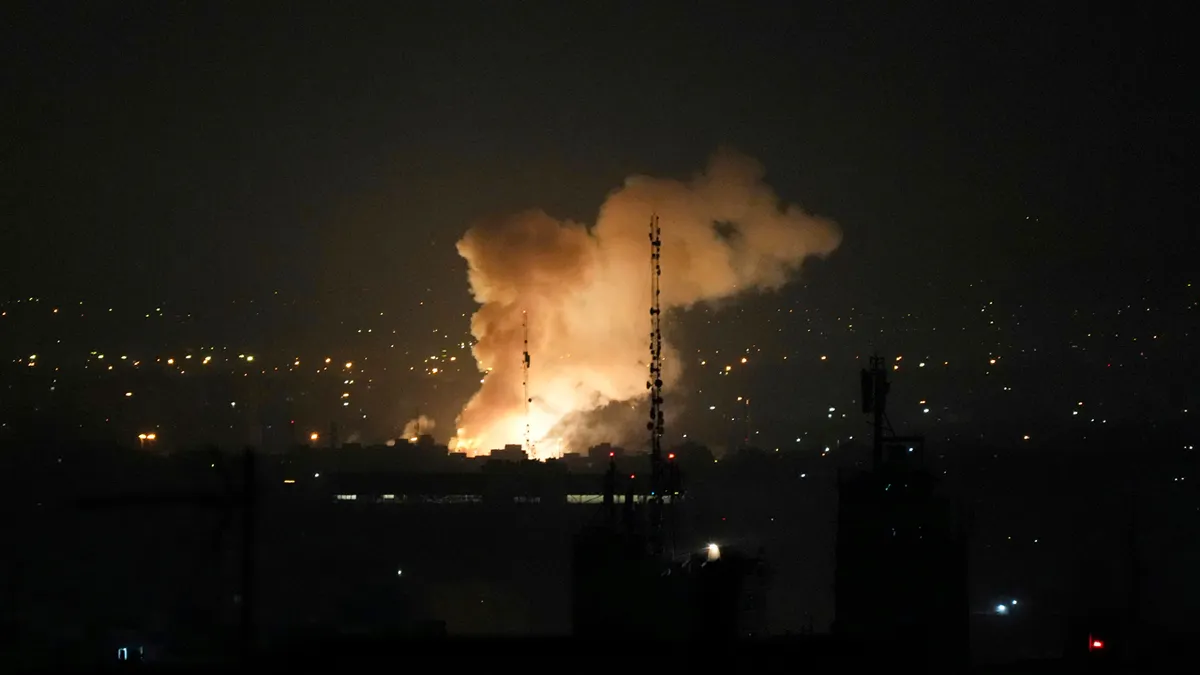
Israel said it carried out new strikes on military targets in western and central Iran on Monday, pushing ahead with attacks despite U.S. President Donald Trump reportedly urging Prime Minister Benjamin Netanyahu not to jeopardize peace talks with Tehran.
The strikes came only hours after Trump said the latest exchanges between Israel and Iran would not derail his administration’s efforts to reach an agreement with Tehran, while insisting that Netanyahu “doesn’t call the shots.”
“I call the shots. I call all the shots. He doesn’t call the shots,” Trump told the Financial Times.
The Israeli military said its forces had struck Iranian military targets. Iran’s Revolutionary Guards said Israel used air-launched ballistic missiles in attacks on sites inside Iran.
The escalation followed an Iranian missile salvo aimed at Israeli targets in retaliation for earlier Israeli attacks. Iran’s Revolutionary Guards said they targeted the Ramat David air base near Nazareth, while the Israeli military said it had detected launches from Iran and intercepted the missiles.
The renewed hostilities sent oil prices higher in early Monday trading, with benchmark Brent futures rising more than 3% and moving back above $96 a barrel.
Trump and Netanyahu spoke by phone on Sunday for just under half an hour, according to an Israeli official. A U.S. official cited by Axios said Trump told Netanyahu to avoid further strikes because Washington was “close to doing something good” on a deal.
The White House and Netanyahu’s office did not immediately respond to requests for comment.
Trump has sought to pressure Israel to halt attacks in Lebanon to preserve space for a broader deal with Iran. Last week, he reportedly rebuked Netanyahu in blunt terms during a phone call over Israeli strikes.
Despite the U.S. push, Israel on Sunday launched strikes in the Beirut area for the first time since Washington announced a truce plan for Lebanon last week. Netanyahu said the strikes on Beirut’s southern Dahiyeh district, long seen as a Hezbollah stronghold, were ordered after Hezbollah fired toward Israel.
Iran has said any peace agreement with Washington must also include a ceasefire in Lebanon, where Israel launched an invasion in March against Hezbollah fighters who had fired rockets and drones across the border in support of Tehran.
Iran’s chief peace negotiator, parliamentary speaker Mohammed Baqer Qalibaf, said U.S. bases and Israeli assets were legitimate targets because of hostile acts, including what he called violations of agreements over Lebanon.
The wider war has been largely deadlocked since the U.S. and Israel paused attacks on Iran in early April. Tehran has blocked much of the shipping through the Strait of Hormuz, a key route for about one-fifth of global oil flows, while Washington has imposed its own blockade on Iranian ports.
Washington and Tehran have both said they are close to a preliminary agreement that could reopen the strait. However, repeated strikes and counterstrikes have threatened to undermine the talks, including recent attacks involving Arab states that host U.S. bases.
Trump has said any deal must prevent Iran from developing a nuclear weapon. Tehran’s demands include the lifting of U.S. and international sanctions, recognition of its influence over the Strait of Hormuz, and the release of billions of dollars in frozen assets.
A source familiar with U.S. plans told Reuters on Saturday that Washington could make Iranian assets available to Gulf neighbors to repair damage caused by Iran. Iranian Deputy Foreign Minister Kazem Gharibabadi said on Sunday that any such diversion of Iranian assets would be illegal and that Tehran would respond.
Trump has repeatedly claimed Washington and Tehran are close to an agreement, while also warning of further escalation if diplomacy fails.
“We’re very close to a deal, or I’m going to blow the hell out of them,” Trump told NBC News’ “Meet the Press” in an interview aired Sunday to mark 100 days of the conflict.