
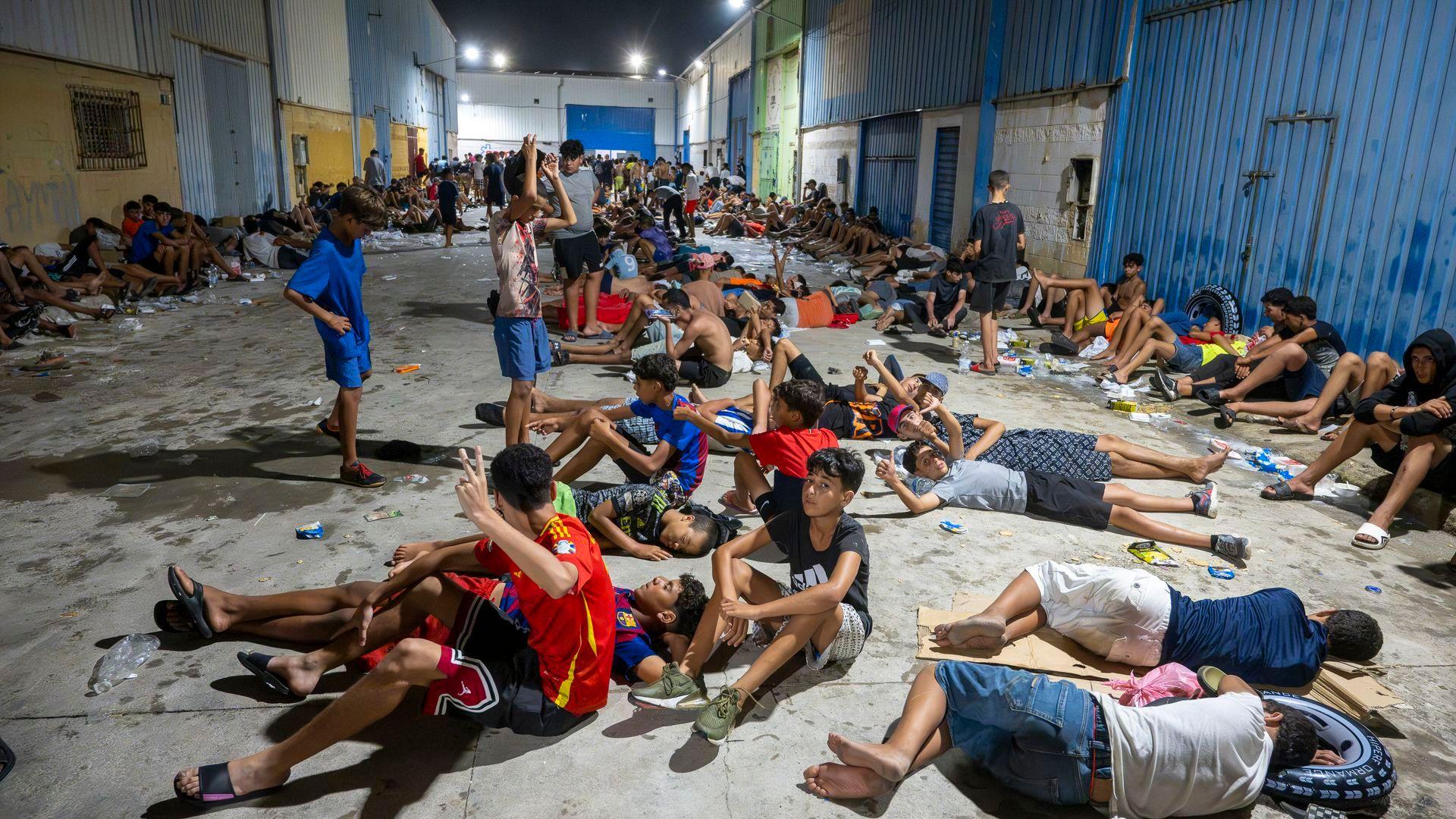
Authorities in Spain’s North African enclave of Ceuta have appealed for hundreds of unaccompanied migrant minors to be transferred to mainland Spain after reception facilities were overwhelmed by last week’s mass arrivals.
Around 72,000 migrants reached Ceuta in the space of one week, although most have since returned to Morocco. About 1,100 unaccompanied minors who arrived before or during the influx remain in the enclave, according to the local government.
Unlike adults, unaccompanied children cannot be immediately deported. Many are now staying in warehouses converted into temporary shelters, while others have been sleeping on the streets because Ceuta’s reception centres are operating beyond capacity.
“We are crying out for help and assistance,” Ceuta government head Juan Jesús Vivas told Spanish broadcaster RTVE on Wednesday. “This is an absolutely unsustainable situation.”
Around 75 people died during the border rush, which triggered concern across the European Union and revived memories of the migration crisis that affected the bloc in 2015 and 2016.
Spanish regions are legally required to help territories facing migration emergencies, but the redistribution of minors has become a source of political tension between the conservative Popular Party and the far-right Vox party.
The two parties jointly govern four Spanish regions. Vox leader Santiago Abascal has said that “not one euro” of public money should be spent on the migrant minors.
Even where regional authorities agree to receive children from Ceuta, migration experts say the relocation process could take months. Each child must be interviewed and formally identified, while authorities prepare reports and contact countries of origin to determine whether family reunification is possible.
Under changes to Spain’s immigration law introduced in 2025, unaccompanied minors must be transferred from overstretched territories within 15 days after their individual case files are completed.
The legislation was adopted after a sharp rise in arrivals overwhelmed reception facilities in the Canary Islands.
Disputes over the policy previously caused Vox to withdraw from five regional coalition governments with the Popular Party in 2024, after the conservatives supported a Socialist-led government plan to relocate 400 minors from the Canary Islands to mainland Spain.
Since the reform took effect, 719 minors have been transferred from the Canary Islands to the mainland, according to government figures released in April. More than 400 minors arriving in Ceuta have also been relocated to other Spanish regions.
The latest crisis risks reopening divisions between the Popular Party and Vox as they seek to present their regional alliances as a model for governing nationally after Spain’s election next year.
It may also add pressure to Spain’s relations with conservative-led European governments. Italy suspended passport-free Schengen travel arrangements with Spain for one month following the Ceuta border rush.
After initially saying all migrants should be returned, Popular Party official Alma Ezcurra said authorities must first follow legal procedures to establish which arrivals are minors.
“We don’t even know how many there are,” she told Onda Cero radio.
The Spanish government has approved €25 million, equivalent to about $29 million, to help Ceuta care for the unaccompanied children.
“Inter-territorial solidarity is necessary so these minors end up in other locations where they will be better off,” said Miguel Ángel Pérez, the Spanish government’s representative in Ceuta. “The law must be upheld.”