
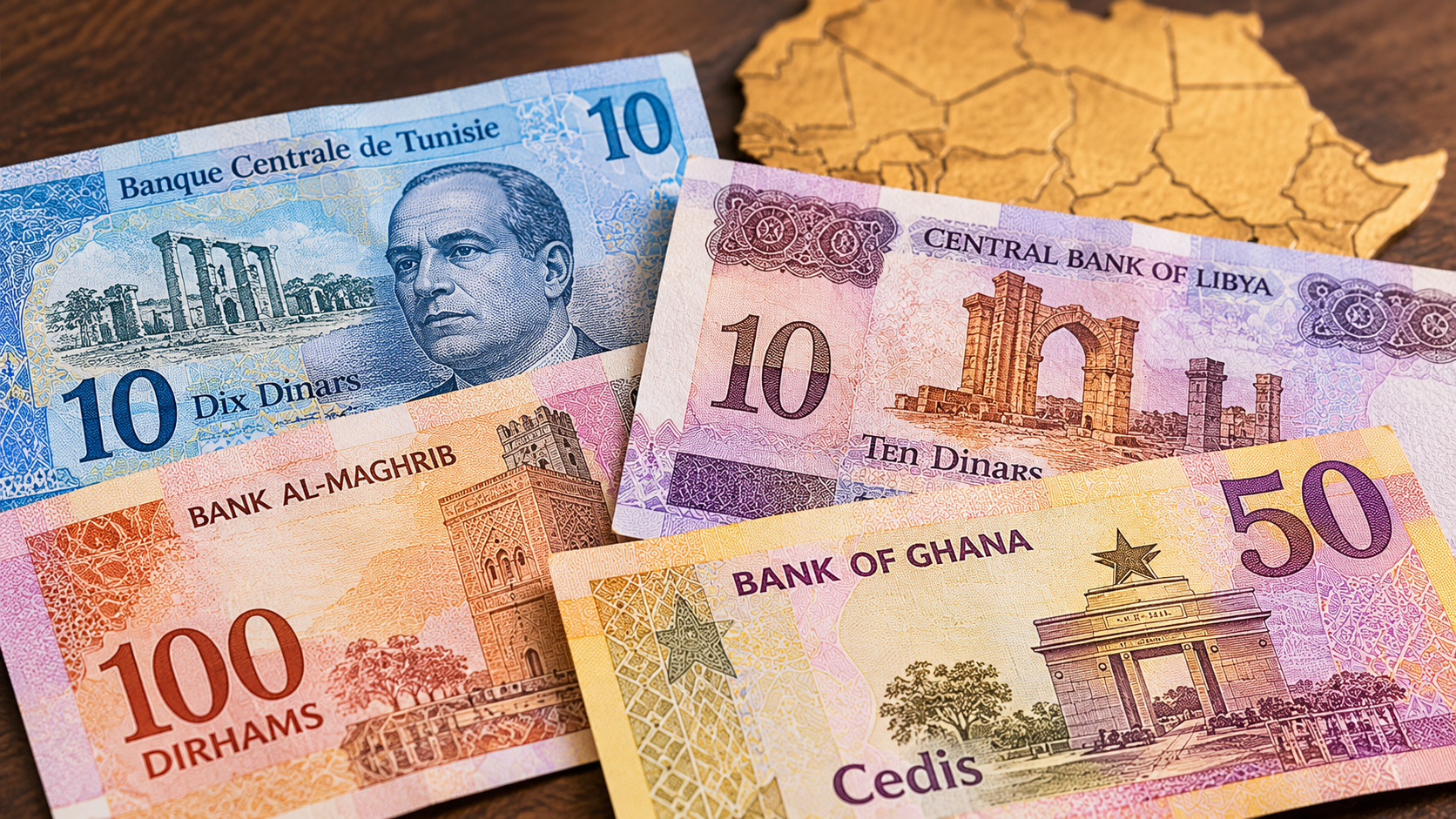
The strongest currencies in Africa in October 2026 are led by Tunisia, Libya and Morocco, according to exchange-rate data published by Business Insider Africa.
Tunisia ranks first, with its dinar trading at approximately 2.98 per US dollar. Libya follows at 6.39, while Morocco takes third place at 9.81.
Ghana, Botswana and Seychelles also appear among the top ten.
The ranking uses figures from the Forbes currency calculator. It compares how many units of each local currency equal one US dollar.
However, a high currency value does not always mean a strong economy.
Why currency strength matters in Africa
A stronger local currency can benefit businesses and consumers.
For example, it can reduce the cost of imported fuel, food and machinery. As a result, businesses may spend less on international purchases.
Additionally, currency stability helps companies plan their expenses.
Investors also benefit from predictable exchange rates. This is because sudden currency movements can affect their returns.
However, exchange rates are only one measure of economic performance.
Inflation, employment and economic growth also matter.
Top 10 strongest currencies in Africa in October 2026
According to Business Insider Africa, these are the ten highest-valued African currencies against the US dollar.
The figures show how many units of each currency equal one US dollar.
1. Tunisia – Tunisian Dinar
Exchange rate: 2.98 TND per USD
Tunisia leads the ranking in October 2026.
Its dinar has the highest nominal value among the African currencies listed.
Approximately 2.98 Tunisian dinars equal one US dollar.
2. Libya – Libyan Dinar
Exchange rate: 6.39 LYD per USD
Libya takes second place.
Around 6.39 Libyan dinars equal one US dollar.
The currency remains among Africa’s highest-valued currencies by nominal exchange rate.
3. Morocco – Moroccan Dirham
Exchange rate: 9.81 MAD per USD
Morocco ranks third.
Approximately 9.81 Moroccan dirhams equal one US dollar.
As a result, North African countries occupy the top three positions.
4. Ghana – Ghanaian Cedi
Exchange rate: 11.58 GHS per USD
Ghana ranks fourth.
The cedi gained value during October following improved foreign exchange availability.
Additionally, dollar sales by the Ghana Gold Board helped support the currency.
5. Botswana – Botswana Pula
Exchange rate: 13.76 BWP per USD
Botswana occupies fifth position.
Approximately 13.76 pula equal one US dollar.
The country has one of Southern Africa’s highest-valued currencies.
6. Seychelles – Seychellois Rupee
Exchange rate: 14.00 SCR per USD
Seychelles ranks sixth.
Around 14 Seychellois rupees equal one US dollar.
The island nation is also the only Indian Ocean country in the top ten.
7. Eritrea – Eritrean Nakfa
Exchange rate: 15.00 ERN per USD
Eritrea takes seventh place.
Its official exchange rate stands at approximately 15 nakfa per dollar.
However, Eritrea maintains strict foreign exchange controls. Therefore, the official rate may not reflect actual currency availability.
8. Lesotho – Lesotho Loti
Exchange rate: 16.55 LSL per USD
Lesotho ranks eighth.
Its currency is pegged to the South African rand.
Consequently, the loti moves alongside the rand.
9. Namibia – Namibian Dollar
Exchange rate: 16.55 NAD per USD
Namibia occupies ninth position.
Its dollar is also pegged to the South African rand.
Therefore, it shares the same nominal exchange value as Lesotho’s currency.
10. Eswatini – Swazi Lilangeni
Exchange rate: 16.55 SZL per USD
Eswatini completes the ranking.
Its currency is pegged to the South African rand.
As a result, Eswatini, Namibia and Lesotho have matching exchange rates in this list.
Ghana’s cedi records gains in October
Ghana experienced notable currency gains during October.
According to Business Insider Africa, the cedi appreciated by approximately 1.5% between October 7 and October 15.
It reached around 11.65 cedis per dollar on October 15.
Improved foreign exchange availability helped support the gains.
Furthermore, the Ghana Gold Board supplied dollars to commercial banks.
This helped businesses access foreign currency for international payments.
A stronger cedi could also reduce the cost of some imported goods.
However, domestic prices depend on several other economic factors.
Kenya shows the importance of stable exchange rates
Kenya does not appear among the ten strongest currencies in Africa.
Nevertheless, its exchange-rate stability offers an important example.
On October 22, the Kenyan shilling traded at approximately 129.80 to 130 per dollar.
According to Reuters, the currency remained broadly stable despite demand from importers.
This stability can help businesses manage costs.
Moreover, predictable exchange rates make international trade easier to plan.
They can also reduce uncertainty over foreign-currency debt payments.
Does a strong currency mean a strong economy?
Not necessarily.
A currency’s nominal value does not determine a country’s economic strength.
For example, a currency worth three units per dollar is not automatically stronger economically than one worth 100 units per dollar.
Exchange rates depend on several factors.
These include monetary policy, currency controls and market conditions.
Therefore, economists also examine inflation, employment, investment and purchasing power.
Currency stability is often more important than a high nominal value.
North Africa leads the October ranking
Tunisia, Libya and Morocco hold the top three positions.
Meanwhile, Ghana ranks fourth, followed by Botswana and Seychelles.
Eritrea, Lesotho, Namibia and Eswatini complete the list.
Overall, the strongest currencies in Africa reflect different exchange-rate systems and economic conditions.
However, nominal currency rankings tell only part of the story.
For businesses and consumers, stable prices and predictable exchange rates remain essential.