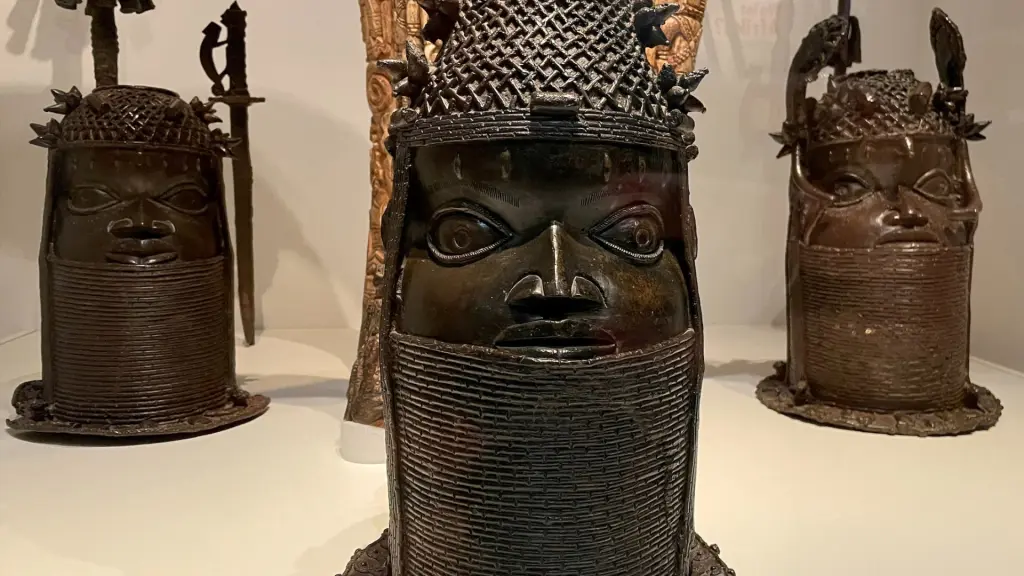
Did you know that the Benin Bronzes are not all made of bronze, and that they do not come from the country called Benin? They come from the Kingdom of Benin, whose capital, Benin City, is in today’s Edo State in southern Nigeria.
Most of them left the city in 1897, when British forces captured it and emptied the royal palace. More than a century later, museums in Europe and the United States are handing some of them back.
What are the Benin Bronzes?
“Benin Bronzes” is a loose name for thousands of artworks, according to Encyclopaedia Britannica. The British Museum says the objects are made of brass and bronze, and that the term is sometimes also used for works in ivory, leather, coral and wood.
They include cast plaques, commemorative heads, animal and human figures, royal regalia and personal ornaments, the museum says. Britannica adds pendant masks, ceremonial swords and bells to the list.
The works were made by specialist guilds working for the royal court of the Oba, the king of Benin. The British Museum dates them from at least the 16th century onwards. Britannica says most were made between the 15th and 19th centuries.
Many were made for the altars of past Obas and Queen Mothers, and were used in rituals to honour ancestors and to confirm a new Oba on the throne, according to the British Museum. They were sacred objects and a record of the kingdom’s history.
What happened in 1897?
In January 1897 a British party travelling to Benin City was ambushed and most of its members were killed. Britannica says the Oba had asked the party to delay its visit because of a festival, and that scholars believe the attack happened without his knowledge.
Britain answered with a military campaign that it called a “punitive expedition”. Benin City was captured in February 1897. The British Museum describes the occupation as “bloody and devastating”.
Shrines and the palace were looted. The British Museum says thousands of objects were taken to the UK, including more than 900 brass plaques. Some were kept by members of the expedition. Others were given to the British Museum or sold to help pay for the invasion, according to Britannica.
Oba Ovonramwen was captured and exiled to Calabar, where he died in 1914, Britannica says.
Where are they now?
All over the world. The British Museum says it holds more than 900 objects from the historic Kingdom of Benin, the largest single collection. Berlin’s Ethnological Museum has the second largest, according to Britannica.
Britannica cites research by the archaeologist Dan Hicks, who counted Benin objects in 45 institutions in the UK and 38 in the United States, but only nine in Nigeria.
Who has returned them?
- Germany: returned 21 objects in 2022 and signed over ownership of about 1,100 more, many of which remain in German museums on long-term loan, according to Britannica.
- United States: the Smithsonian’s National Museum of African Art says it transferred 29 bronzes to Nigeria in October 2022.
- Netherlands: handed over 119 objects in June 2025.
- Cambridge: the University of Cambridge said in February 2026 that it had transferred ownership of 116 objects to Nigeria. Seventeen will stay in Cambridge on loan for now, the university said.
The British Museum has not returned its collection. The Art Newspaper reports that a 1963 UK law stops the museum from permanently removing items from its collection. The museum says it has good relations with the Benin royal palace and with Nigeria’s National Commission for Museums and Monuments (NCMM).
Who looks after them in Nigeria?
That question has been debated inside Nigeria. In March 2023 the then president, Muhammadu Buhari, declared that returned bronzes belong to the Oba of Benin, Ewuare II, The Art Newspaper reports. The NCMM later signed an agreement with the Oba to manage the objects on his behalf, according to the same report.
The new Museum of West African Art (MOWAA) in Benin City was once expected to house them. Its director, Phillip Ihenacho, told The Art Newspaper that the museum is “not a receptacle for the Benin Bronzes”. The paper reports that its opening, planned for November 2025, was halted after protesters entered the building.
Why it matters
The bronzes are sacred objects and a record of the Kingdom of Benin’s history. Their return has also become a test case for other looted treasures across the continent, and young Africans are adding to the pressure on museums.