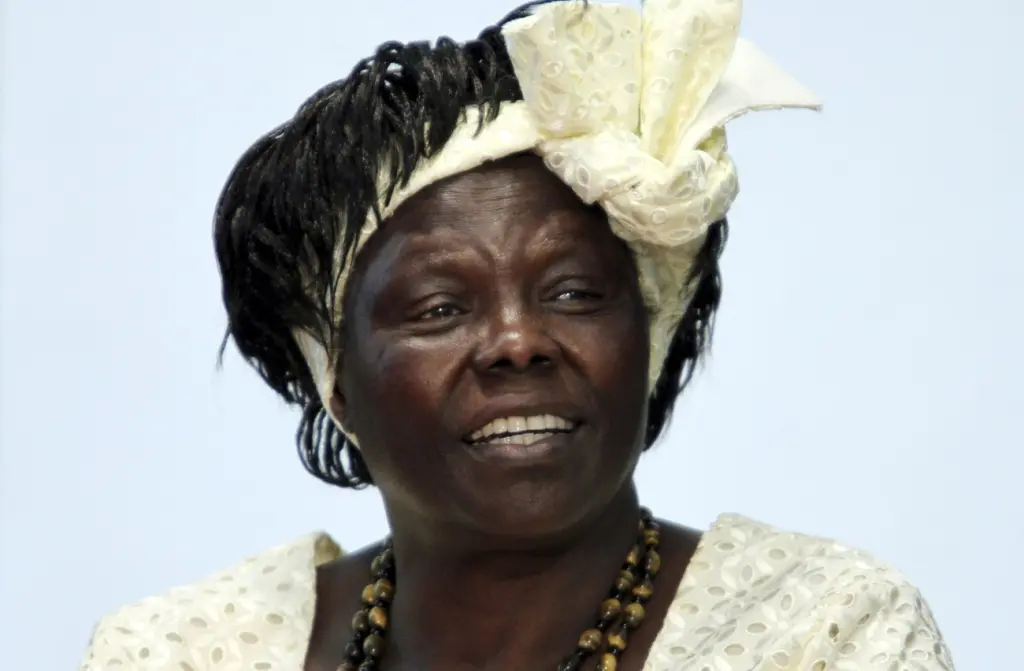
Did you know that the first African woman to win the Nobel Peace Prize earned it by planting trees? Her name was Wangari Maathai, she came from Kenya, and the movement she started has helped to plant more than 30 million trees, according to the Nobel Prize organisation.
She accepted the prize in Oslo on 10 December 2004. More than two decades later, her story is still one of the continent’s great firsts.
Who was Wangari Maathai?
Wangari Maathai was born on 1 April 1940 in Nyeri, in central Kenya, according to the Nobel Prize organisation. She studied biology in the United States, earning a degree from Mount St. Scholastica College in Kansas in 1964 and a master’s degree from the University of Pittsburgh in 1966.
She then came home. In 1971 she earned a PhD at the University of Nairobi, where she also taught veterinary anatomy.
A life of firsts
That doctorate made history. Her official Nobel biography describes her as the first woman in East and Central Africa to earn a doctorate degree.
More firsts followed. The same biography says she became chair of the Department of Veterinary Anatomy in 1976 and an associate professor in 1977, the first woman in the region to hold either post.
The Green Belt Movement
Maathai’s big idea was a practical one. While she was active in the National Council of Women of Kenya, she proposed that communities plant trees, her Nobel biography says. In 1977 that idea became the Green Belt Movement.
The movement encouraged women to plant trees where they lived. Its aim, the Nobel Prize organisation says, was to counter the deforestation that was threatening the livelihoods of farming communities. The Norwegian Nobel Committee said in 2004 that over nearly thirty years she had mobilised poor women to plant 30 million trees.
The idea travelled. In 1986 the movement set up a Pan African Green Belt Network to share its approach with other African countries, according to Encyclopaedia Britannica.
Maathai also campaigned against land grabbing and the handing out of forest land, her Nobel biography notes. One of the places she championed was Karura Forest in Nairobi, a green space of about 1,000 hectares that King Charles visited in 2023, when he met her daughter, Wanjira Mathai.
From activist to Parliament
In December 2002 Maathai was elected to Kenya’s parliament with 98% of the vote, according to her Nobel biography. In 2003 she was appointed assistant minister for environment, natural resources and wildlife, Britannica says.
The Nobel Peace Prize
On 8 October 2004 the Norwegian Nobel Committee announced that Maathai had won the Peace Prize “for her contribution to sustainable development, democracy and peace”.
The committee noted that she was the first woman from Africa to receive the prize. It also tied peace to the environment. “Peace on earth depends on our ability to secure our living environment,” it said in its announcement.
Her legacy
Maathai died in Nairobi on 25 September 2011, aged 71. She left behind several books, including her memoir Unbowed, published in 2007, and The Challenge for Africa, published in 2009.
She also left a simple lesson that still speaks to young Africans facing climate change: big change can start with something as small as a seedling.
Want more stories from Kenya? Read why Kenya’s minibuses are covered in incredible artwork and how camels once delivered library books.