Africa

Zimbabwe senate passes bill to abolish death penalty

Zimbabwe Senate Approves Death Penalty Abolition The Zimbabwean Senate has passed legislation to abolish the death penalty, marking a significant step towards ending a law that has not been enforced in nearly two decades. The bill will take effect once signed by President Emmerson Mnangagwa, who has long opposed capital punishment. The last execution in Zimbabwe occurred in 2005, and the country has faced challenges, including a shortage of executioners, in applying the death penalty. Mnangagwa, who was sentenced to death during the country’s independence war, has also used his presidential powers to commute death sentences to life imprisonment. Amnesty International has called for the bill to be signed “without delay” and for the commutation of the sentences of over 60 people currently on death row in Zimbabwe. While Zimbabwe joins several African nations moving toward abolition, it remains one of the over 50 countries globally that still has the death penalty on the books. According to Amnesty’s 2023 report, there were 1,153 known executions worldwide, with China, Iran, and Saudi Arabia being the leading executioners.

Zimbabwe senate passes bill to abolish death penalty Read More »

AFDB approves $108M loan for Zambia’s economic reforms

The African Development Bank Group’s Board of Directors has approved a $108 million loan to Zambia aimed at strengthening the country’s economic governance and supporting reforms across key public sectors. This financing will support the Fiscal Sustainability and Economic Resilience Support Programme, a vital initiative designed to foster a more robust and diversified economy in Zambia. Key objectives of the programme include boosting domestic revenue generation through measures such as the implementation of an electronic “smart invoice” system, registering 12,000 VAT-eligible taxpayers, and enhancing Zambia’s engagement in the Global Forum on Transparency and Exchange of Information for Tax Purposes. The programme also targets the growth of the agro-industrial sector, particularly by backing the Ministry of Agriculture’s agricultural mechanization strategy and establishing ten mechanization centres. This will increase agricultural productivity and help farmers—especially those without access to modern equipment—produce goods for both domestic and international markets. A key goal is to reduce Zambia’s reliance on the mining sector, with at least 257 million kwachas (around $9.4 million) allocated for the 2023-2024 agricultural season. The project will facilitate market-driven funding, offering small and medium-sized farmers access to affordable financing for agricultural inputs through financial institutions. Additionally, the programme will improve public investment management, enhancing the efficiency and transparency of public spending. As of November 30, 2024, the African Development Bank’s active portfolio in Zambia includes 24 projects with a total value of $872.3 million.

AFDB approves $108M loan for Zambia’s economic reforms Read More »

Egypt’s Giza Pyramids: A legacy of kings, architecture, and tourism

The Secrets of the Pyramids: Legacy, Tourism, and Preservation The ancient pyramids of Egypt, built for kings, their sons, and grandsons, continue to protect their mysteries. Surrounding these monumental tombs are smaller pyramids for queens and other family members, where they too were mummified and laid to rest. Two temples are also located around the pyramids, likely used for funeral ceremonies and rituals. In ancient Egypt, belief in resurrection after death prevailed. Pharaohs were mummified, buried with treasures to ensure their protection and immortality. The secret of the mummification process, which prevented the bodies of kings from decaying for centuries, remains a mystery to this day. The famous 17th-century traveler, Evliya Çelebi, also mentioned the Egyptian pyramids in his travelogue, highlighting their enduring significance. A Pillar of Egypt’s Economy Last year, Egypt welcomed 14.9 million tourists, with a significant portion of its tourism revenue coming from visitors to the pyramids. The pyramids attract millions of tourists annually, making a vital contribution to the country’s economy. Visitors to the Giza Necropolis can explore the pyramids between 7:00 AM and 5:00 PM. However, the Great Pyramid of Giza (Khufu’s pyramid) is closed to visitors from 12:00 PM to 1:00 PM. Ticket offices remain open until 4:00 PM, with entry fees set at 540 Egyptian pounds for general admission and 270 pounds for international student cardholders. To enter the pyramids’ interiors, the fee is 900 pounds for general entry and 450 pounds for students. Payments are only accepted via bank card, and children under 6 years old can visit for free. While photography is allowed outside the pyramids, no photos are permitted inside. Camel and Horse Cart Tours At the entrance to the pyramid complex, visitors can enjoy camel and horse-drawn carriage rides. Horse cart rides cost 500 Egyptian pounds per hour, offering the best views of the pyramids from various angles. Symbolic camel tours, often associated with the pyramids, cost 1,000 Egyptian pounds per hour, while a short photo opportunity on a camel is priced at 300 pounds. A Monumental Construction The Great Pyramid of Khufu, part of the 4th Dynasty of Pharaohs, was built with massive limestone blocks, each weighing thousands of kilograms. Construction of the pyramid, made from an estimated 2.3 million stone blocks, is believed to have taken 20 years, with 800 tons of stone laid each day. The king’s burial chamber inside the pyramid was made of granite stones, believed to have been transported by boat from Aswan via the Nile River. The second largest pyramid, that of Khafre, is thought to have been built by Khufu’s son, Khafre, and remains a remarkable testament to the architectural and engineering prowess of ancient Egypt.

Egypt’s Giza Pyramids: A legacy of kings, architecture, and tourism Read More »

Somaliland inaugurates new president in push for recognition

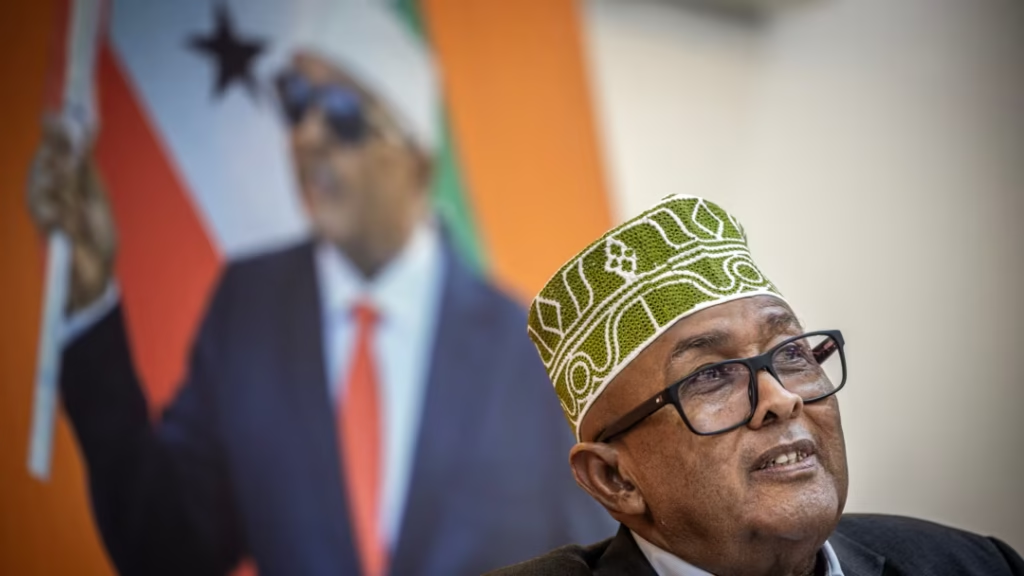
Somaliland Inaugurates New President Amid Tensions Over Regional Disputes and Quest for Recognition Somaliland, the self-declared independent region of Somalia, inaugurated its new president on the heels of last month’s election, reinforcing its push for international recognition. The ceremony took place just one day after Somalia and Ethiopia reached an agreement in Turkey to begin “technical talks” over a contentious deal between Somaliland and Ethiopia. Abdirahman Mohamed Abdullahi, the newly elected president, took office after defeating incumbent Muse Bihi, who had served for seven years. Abdullahi, from the opposition Waddani Party, secured over 50% of the vote in the November 13 election, which was hailed for its high voter turnout and peaceful conduct—further solidifying Somaliland’s reputation as a stable democracy in a region often beset by instability. In his inaugural speech, Abdullahi outlined his government’s priorities, stressing the importance of renewing Somaliland’s international relations. “Our first job is to renew relations with the rest of the world to create a new Somaliland that contributes to the security of the entire region, including the Red Sea,” he said. Richard H. Riley, the U.S. ambassador to Somalia, congratulated Abdullahi on behalf of the United States and the international community. “We extend our warmest congratulations to you on this historic occasion,” Riley said, acknowledging Somaliland’s democratic achievements. Despite its stable governance, Somaliland’s quest for recognition remains a challenge. It declared independence from Somalia in 1991 but has yet to receive official recognition from the African Union, the United Nations, or any other nation. Somalia continues to regard Somaliland as part of its territory. Somaliland’s pursuit of recognition has been complicated by its recent agreements, including a controversial deal with Ethiopia to lease coastal land for a marine base. In exchange, Ethiopia would acknowledge Somaliland’s independence—something Somalia has condemned as a violation of its sovereignty. During his campaign, Abdullahi criticized the deal for its lack of transparency and promised to reassess such agreements to ensure they align with Somaliland’s strategic interests. Abdullahi’s presidency will also face challenges in managing ongoing tensions in the Sool region, where clashes between Somaliland forces and local militias have persisted. As he works to strengthen his country’s international standing, his leadership will play a critical role in shaping Somaliland’s future, both regionally and globally.

Somaliland inaugurates new president in push for recognition Read More »

Clashes erupt in Southern Somalia over disputed Jubbaland election

Clashes erupted in the southern Somali town of Raskamboni on Wednesday between federal government forces and regional troops from Jubbaland, amid rising tensions over a disputed regional election. The fighting, which lasted for several hours, subsided by midday, but both sides blamed each other for sparking the violence. Details about casualties remain unclear due to a telecommunications blackout in the area. The conflict highlights growing tensions between Somalia’s federal government and Jubbaland’s administration, raising concerns about further instability in this strategically important region near the Kenyan border. Somalia’s federal forces are taking over the fight against the al-Qaida-linked militant group al-Shabab, with plans to replace the African Union peacekeeping mission by the end of the month. The federal government accused Jubbaland’s forces, led by Ahmed Madobe, of attacking federal positions vital to the fight against al-Shabab. Madobe’s reelection for a third term as Jubbaland president in November has sparked controversy, with the federal government claiming it violates term limits. Opposition groups in Jubbaland have rejected the results and formed a rival government. Jubbaland officials, however, claimed the federal forces initiated the fighting by targeting their positions, accusing the federal government of trying to undermine regional authority. The violence comes as Somalia prepares for a new African Union mission starting in January, though it will exclude Ethiopia, with which Somalia is engaged in a dispute over the breakaway region of Somaliland.

Clashes erupt in Southern Somalia over disputed Jubbaland election Read More »

Scroll to Top